Movie-A-Day #105: The Jackie Robinson Story (1950).
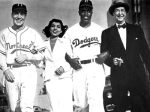 When Jackie Robinson played his first game for the Brooklyn Dodgers on April 15, 1947, he was doing more than just becoming the first black player in modern baseball history. He was also taking the cause of racial equality and civil rights for all Americans on his shoulders. And it was his grace under the pressure of violent racism that served as an inspiration and a rallying cry for the civil rights movement of the 1950s and 1960s. “The Jackie Robinson Story” is his authorized biopic, with Robinson playing himself and Ruby Dee playing his wife Rachel. Frankly, he wasn’t nearly as great of an actor as he was an athlete, and being made just three years after the fact, the film is a little to close to the subject to give it the treatment it deserves. But it’s still interesting to watch.
Movie-A-Day #104: The Man Who Laughs (1928).
 Today is International Moment of Laughter Day, set aside for spreading the joys of humor and laughter. But why just a moment and not longer? Maybe so you don’t take it too far, like Conrad Veidt in “The Man Who Laughs.” (In fact, Veidt’s makeup in this film has been cited by Batman creators Bob Kane and Jerry Robinson as the inspiration for the Caped Crusader’s arch-nemesis, The Joker.)
Movie-A-Day #103: Apollo 13 (1995).
 It was on this day in 1970 that an oxygen tank exploded aboard the command module of Apollo 13 lunar mission, aborting the crew’s journey to the moon. It also created a battle for survival that captured the world’s attention, prompted an ingenious engineering solution on the fly, and gave us the catchphrases “Houston, we have a problem” and “Failure is not an option.” The heroism of Jim Lovell and his crew gets a rousing depiction in Ron Howard’s film “Apollo 13,” starring Tom Hanks, Kevin Bacon, Gary Sinise and Ed Harris.
Movie-A-Day #102: Glory (1989).
 Today is the sesquicentennial of the start of the American Civil War. On April 12, 1861, rebel forces at Fort Sumter, off the coast of Charleston, South Carolina, opened fire on federal troops, marking the culmination of a long run-up to secession by South Carolina and six other Southern states. Eventually the Confederacy would be made up of 11 states, although they would all later be re-admitted to the Union after the surrender of Gen. Robert E. Lee almost exactly four years later.
It was easily the most divisive period in the nation’s history – not just because of the literal split of the United States into two countries, but also because of the deep wounds it left behind for generations and the issues it raised, many of which have never been fully resolved.
Even 150 years later, Confederate flags still fly around the country and many in the South still refer to the Civil War as “the war of Northern aggression.” While many who are marking the anniversary today continue to paint it as a struggle for states’ rights against an overarching federal government – even to the point of comparing it to today’s Tea Party-inspired political battles – in reality it was about slavery and nothing else. The right the Southern states were fighting so hard to protect was the right to own slaves and to build their economy (and culture) on the oppression of an entire race. And while blacks in America might have enjoyed an unprecedented level of political freedom immediately after the war, those gains were quickly rolled back as Jim Crow laws took hold across the South. It took the civil rights struggles of the 1950s and 1960s – nearly a century later – to finally overturn those laws. But racism, born of centuries of slavery, still persists to this day. And it is that racism which is still celebrated – perhaps unwittingly, but perhaps not – with every stars-and-bars flag that still flies and every Confederate memorial that is still recognized.
The wounds of the Civil War are still open, and they may take several generations more to properly heal. If they ever do.
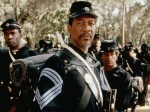
Based on a true story, “Glory” tells the tale of the 54th Regiment from Massachusetts, one of the first platoons of black soldiers to fight for the Union. Besides battling a racist, slave-holding enemy, the group also had to cope with the institutionalized racism of the northern side. Much of the script was based on the letters of the regiment’s white commanding officer, Col. Robert Shaw, played by Matthew Broderick. However, he’s the only real life member of the 54th depicted in the movie. The other soldiers in the film, including those played by Morgan Freeman, Denzel Washington, Andre Braugher and others, are composites or fictional versions of the real members of the 54th Regiment. Sadly, their story remains to be fully told.
Movie-A-Day #101: Buffalo ’66 (1998).
 Wow, Vincent Gallo turns 50 today. He’s older than I thought he was. Anyway, his career has taken some strange twists and turns over the years, but his creative voice has always been distinctive, if not always comprehensible. For a look at the intriguing (but not self-indulgent) side of Gallo, take a look at “Buffalo ’66,” which he starred in, co-wrote, directed and even wrote the music for. This story of an ex-con (Gallo) who kidnaps a dancer (Christina Ricci) so that he can appear respectable to his estranged parents is both compelling and unsettling. And a little touching.
 Desuko Movie Spot.