Logan’s Run (1976).
The Scoop:
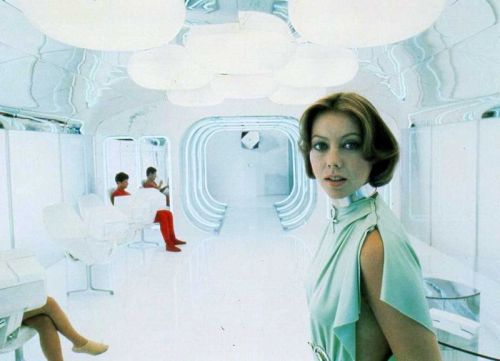
Some things just get more ridiculous and dated with age. This includes just about everything from the 1970s, but, most especially (and ironically), ’70s science fiction.
And never did the future seem so retro as in “Logan’s Run.” In a utopian society (which lives inside a shopping mall done up to ’70s excess) that keeps the peace by secretly killing every citizen on his or her 30th birthday, Logan (Michael York), who is 29, decides something is wrong and tries to escape along with his girlfriend (Jenny Agutter). You see, Logan’s job as a “sand man” is to keep the 30-year-olds from running away from their date with destiny. So, of course, he bucks against the system and winds up hunted by his sand man buddy (Richard Jordan). Along the way, they discover giant cardboard-looking robot (Roscoe Lee Browne) and an old man who lives in the U.S. Senate chamber with hundreds of cats (Peter Ustinov). Somewhere along the line there is a moral message about environmental responsibility and overpopulation — the usual ’70s sci-fi concerns.
And don’t blink, or you’ll miss Farah Fawcett’s ridiculously over-billed bit part as a medical secretary.
Best Line:
“Overwhelming, am I not?”
Side Note:
If the Sandman headquarters building looks familiar, that’s because the model was later reused in several episodes of “Star Trek: The Next Generation” as the Starfleet Academy.
Companion Viewing:
“THX 1138” (1970), “Zardoz” (1973) and “Rollerball” (1975).
Links:
IMDb.
The Cylon Alliance.
Retroland.
Take a Look:
Run!
Logan tries to get Jessica to run:
“There is no sanctuary!”
A great line, repeated for emphasis:
He Knows You’re Alone (1980).
 The Scoop:
Before he was heralded as the greatest actor of his generation, Tom Hanks made a lot of dumb ’80s comedies. And before he made those dumb ’80s comedies, he made some truly bad movies. This is one of them.
“He Knows You’re Alone” was his film debut, and he’s the only reason to see this turd. Unfortunately, we don’t even get the chance to see him in a big role. Instead, he turns up toward the end as a disposable boyfriend of another minor character.
The main plot involves a serial killer stalking women on the night before each one’s wedding. As the corpses pile up at a sluggish rate, it’s up to bride-to-be Caitlin O’Heaney and ex-boyfriend Don Scardino to put a stop the clichéd shenanigans.
If you’re in the mood for a decent, mindless “first wave” (i.e., late-’70s/early-’80s) slasher film, this should be toward the bottom of your list.
Best Bit:
The end credits, I suppose, because that means it is finally, mercifully over.
Side Note:
O’Heaney is the great-great-great granddaughter of Jacob Best, the creator of Pabst Blue Ribbon beer.
Companion Viewing:
“April Fool’s Day” (1986).
Links:
IMDb.
Take a Look:
The trailer:
Hamlet (1996).
 The Scoop:
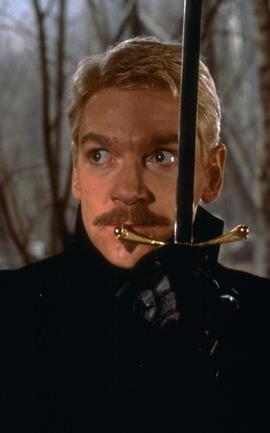
“Hamlet” is — period, hands down — the greatest piece of drama ever written. It’s a stupendous achievement that was the keystone of Shakespeare’s larger revolution in humanizing the dramatic arts. Unfortunately, its navigations of the psychological terrain are so vast that it has rarely been performed on stage (and never on film) in its entirety. All of Shakespeare’s texts have been abridged and adapted over the years (and I’m a big advocate of uncut Shakespeare), but with “Hamlet” it has been as much a case of practical necessity as artistic interpretation. The play is just too long to expect an audience to get through in one sitting. Scholars say that even the very first performances by Shakespeare’s company were edited down to a manageable size. However, even the best cuts have done a disservice to the work.
Kenneth Branagh has tried to remedy that history with this film, the only complete and unabridged film version of “Hamlet.” The result, clocking in at more than four hours, is a treat. The cinematography is beautiful and extravagant, and the core group of actors (including Branagh, Julie Christie, Derek Jacobi and Kate Winslet) hit all the right notes. Most of the smaller parts feature familiar faces, and with the exception of Jack Lemmon’s uncharacteristically wooden take on Marcellus, they do their duties well, too. Charleton Heston is a particularly delightful surprise, in a role (The Player King) that usually doesn’t require much more than good diction. This adaptation is essential Shakespeare.
Best Line:
“There are more things in heaven and earth, Horatio, than are dreamt of in your philosophy.”
Side Note:
Nicholas Farrell, who plays Horatio here, was in Franco Zefferelli’s “Hamlet” (1990) as Rosencrantz and in Branagh’s “A Midwinter’s Tale” (1995) as the actor playing Laertes in a stage production of “Hamlet.”
Companion Viewing:
“A Midwinter’s Tale” (1995).
Links:
IMDb.
Movie Links.
Read the play.
Take a Look:
The trailer:
Branagh asks the most famous question in literature in an odd aspect ratio:
I’ve always thought this was a better soliloquy than “To be or not to be”:
Greed (1924).
The Scoop:
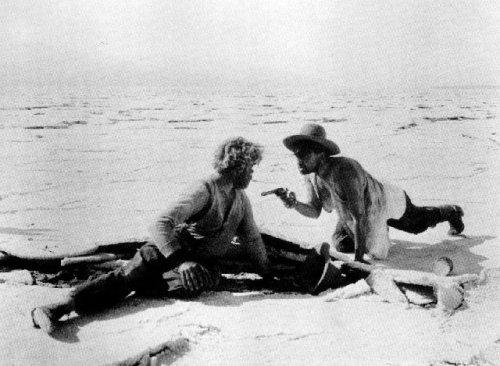
Avarice, violence, hate — it’s all here, every bit of the dark side of human nature. “Greed” is an adaptation of the Frank Norris novel “McTeague,” about the disasterous consequences a lottery jackpot has on the lives of two men (Gibson Gowland and Jean Hersholt) who are battling over the same woman (Zasu Pitts). The film is also both Erich von Stroheim’s masterpiece and perhaps the most notorious example of loss of creative control in film history.
The original director’s cut was nearly nine hours long and was only shown once, to a group of studio executives. After the studio took control, the film was edited down to only 140 minutes. Most of the outtakes were eventually destroyed. Several attempts at reconstructing the movie have been made by film scholars over the years, but it was not until 1999 that Turner Classic Movies released the most complete restoration.
Using the small amount of surviving outtakes and still photographs from the lost scenes, the newest version runs just over four hours. While that might be a mind-numbing length for most movies, “Greed” holds its own the whole way — and still feels incomplete. Too bad this is probably the most complete version we will ever get to see.
Best Bit:
The grim ending, shot on location in Death Valley. (The 37-day shoot was just as hard on the actors as it was on the characters. Hersholt lost 27 pounds and had to be hospitalized when it was all over.)
Side Note:
Herscholt was better known for his philanthropic efforts, and is the namesake of the Jean Herscholt Humanitarian Award given at the Oscars. He was also the uncle of actor Leslie Nielsen.
Companion Viewing:
“The Treasure of the Sierra Madre” (1948).
Links:
IMDb.
Frank Norris’ original novel.
Fan site.
Take a Look:
TCM offers this spoiler-y clip from the Death Valley sequence. Watch with caution!
Newsreel footage of the cast and crew trekking into Death Valley:
A Fool There Was (1915).
 The Scoop:
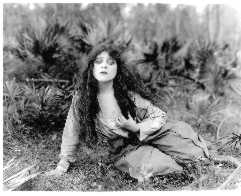
Theda Bara was the first of the silver screen’s sex goddesses, and this is the film that launched her reputation. In fact, the word “vamp” was invented specifically by the studio (the Willam Fox Vaudeville Company, the ancestor of today’s Fox Film Corporation) to describe her in this role.
The plot and script are conventional for the era — a loose women tempts then ruins a series of wealthy men — and it can be rough slogging for the modern viewer. But Bara’s performance alone makes it memorable and worth watching today. It would be nothing without her. Every celebrity sex symbol and every movie vixen to come after owes a major debt to Theda.
Best Line:
“Kiss me, my Fool!”
Side Note:
The lack of preservation of early films has really taken its toll on the work of Theda Bara — she was the biggest star of her time, but the only other feature films of hers that still exist in their entirety are her pre-fame “The Stain” (1914) and “The Unchastened Woman” (1925), which was made on the downside of her career.
Companion Viewing:
“It” (1926) and “Pandora’s Box” (1929).
Links:
IMDb.
Take a Look:
You can see the film in its entirety on YouTube:
 Desuko Movie Spot.