B. Monkey (1998).
The Scoop:
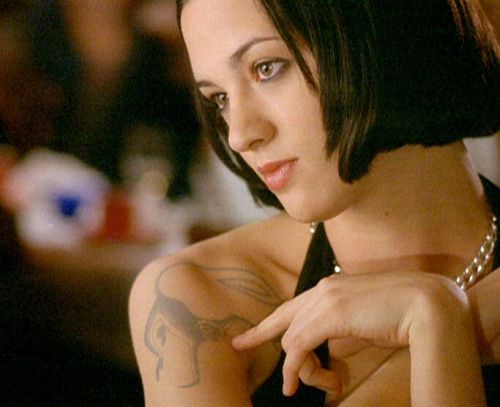
The main thing to recommend this middling, faux-edgy romantic drama is some generous flashes of nudity from the luscious, though marginally talented, Asia Argento.
She plays the title character in this British production about a sweet and decent grade school teacher/frustrated musician Alan (Jared Harris) who gets involved with a sexy former thief (Argento, in the title role) who can’t quite put her past behind her (nor fully mask her thick Italian accent). The robbery sequences provide the only real energy in the movie, which also features a great performance by Rupert Everett in a wasted role as B.’s former partner in crime/bisexual lover.
Watch it just to ogle Asia, or for the odd other little touches, like Alan’s nighttime job as a jazz DJ in a hospital (huh?).
Best Line:
“Whoever thought I could find happiness in the middle of fucking nowhere?”
Side Note:
Asia is the daughter of Italian horror/suspense meister Dario Argento, and she got her start appearing in his films. I guess you could call her an Italian Sofia Coppola, since she has also moved on to directing films that have been generally better received than her acting.
Companion Viewing:
“Killing Zoe” (1994).
Links:
IMDb.
Take a Look:
B. gets pulled back into the game by Bruno (played by Jonathan Rhys-Meyers):
Some more chitchat, this time with tongues:
Happy birthday, Bruno!
Finally, some action! (Contains spoilers):
The Bat (1959).
 The Scoop:
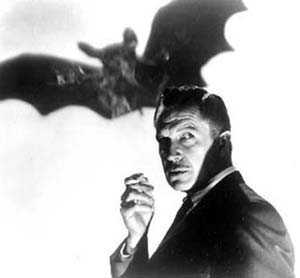
Vincent Price and Agnes Moorehead lead the cast of this charming, if somewhat awkwardly scripted, throwback to the “old dark house” melodramas of the turn of the century.
Moorehead plays popular mystery writer Cornelia van Gorder, who rents an old mansion in which an embezzling local bank president has hidden millions of dollars. A mysterious villain known as The Bat is after the money, as is the creepy town doctor, played by Price. Before a long, a slew of supporting characters find their way to mansion, where the bodies start piling up, with the obligatory twists and red herrings.
The production is well-made, if awfully static, betraying its origins as a 1920 stage play by Avery Hopwood. (It had previously been filmed as “The Bat” in 1926 and “The Bat Whispers” in 1930). Much of the creaky melodrama of the play remains, although it seems odd to see it dressed up in late ’50s production design. The performances are strong, despite the cheesy material, and there is some especially good chemistry between Price and Gavin Gordon, who plays the local police chief. There is even a suprisingly swift and brutal murder to shake things up.
All of this makes “The Bat” a fun way to spend and dark and stormy night.
Best Bit:
The oddly casual way in which the bank president opens the cabin door to discover a forest fire.
Side Note:
The absurdly extraneous character of Judy Hollander is played by Darla Hood — young Darla from “The Little Rascals,” all grown up. This was her final screen role.
Companion Viewing:
“The Bat Whispers” (1930) and “The Cat and the Canary” (1927).
Links:
IMDb.
Take a Look:
The trailer:
Horrors of the Black Museum (1959).

The Scoop:
I love ’50s-era ballyhoo movie gimmicks, and this British production has one of the cheesiest — “Hypno-Vista.” The film starts with a way-too-long introduction by Emile Franchel, licensed hypnotist, trying to justify the validity of his quacky profession, and the story that follows is supposedly chock-full of “cues” to hypnotize the entire audience.
In a performance from early in his career, veteran character actor Michael Gough gives a passable performance as a hack columnist with a collection of torture devices, who tries to evade suspicion while a series of torture murders plagues London. Co-star June Cunningham tries hard to be the British Marilyn Monroe, but doesn’t even manage to be the British Mamie Van Doren. The other female lead (Shirley Ann Field) is gorgeous, but a terrible actress. And for some reason all the cross-fades have a red tint — I don’t know if this is part of the gimmick, or just a flaw in the print I’ve seen.
In all, it adds up to a muddled mess in what should have been a promising premise. “Horrors of the Black Museum” definitely misses the touch of William Castle, who could have done wonders with it.
Best Line:
“We can always count of London for another murder.”
Side Note:
Field was later a regular on the short-lived soap opera “Santa Barbara.”
Companion Viewing:
“The House on Haunted Hill” (1958).
Links:
IMDb.
HermanCohen.com.
Take a Look:
The trailer:
Sleep With Me (1994).
 The Scoop:
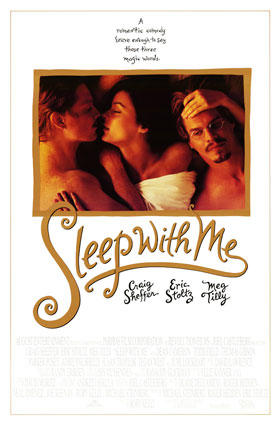
Oh, the angst! This romantic comedy is emblematic of the navel-gazing neuroses that characterized “GenX” indie cinema in the early 1990s.
The product of six different writers (and it shows), “Sleep With Me” follows the self-absorbed romantic tribulations of Joseph (Eric Stoltz), who is about to marry Sarah (Meg Tilly) only to find that his best friend Frank (Craig Sheffer) is in love with her, too. Of course, the complications flow.
Despite the ocassional amusing moment, a terrific cast of indie film veterans (including Parker Posey, Adrienne Shelley and Joey Lauren Adams) is let down by indifferent direction and a trite script. The only redeeming moment comes in the extended party scene in the middle of the film, in which Quentin Tarantino makes a cameo with a classic spiel about the secret gay subtext of “Top Gun.” In those couple minutes, he steals the show and gives the only reason to even watch this movie.
Best Line:
“You can ride my tail anytime!”
Side Note:
The “Top Gun” speech was written for Tarantino by his filmmaking partner Roger Avary and had been originally used in some of their other screenplays, only to keep winding up on the cutting room floor. But they liked it so much that Tarantino brought it with him when asked to appear in “Sleep With Me.”
Companion Viewing:
“Kicking and Screaming” (1995) and “Reality Bites” (1994).
Links:
IMDb.
Take a Look:
Thankfully, someone has compiled all the Tarantino bits into a single YouTube clip. So now you don’t have to rent the movie!
Woodstock (1970).
 The Scoop:
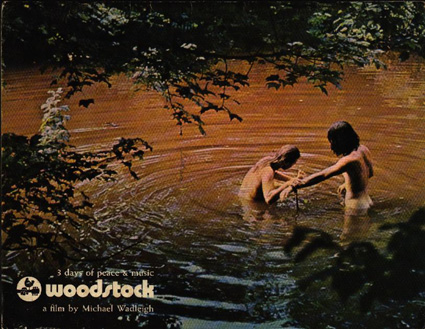
That August 1969 weekend in upstate New York may have become over-mythologized and over-commercialized since then, but that doesn’t change the fact that the Woodstock Music and Arts Festival was still pivotal to the history of rock music and American culture.
This justly-celebrated documentary by Michael Wadleigh and an army of assistants may have become pegged as a relic of the hippie era, but it is worth another look with fresh eyes. The film captures both the energy of the live music (including classic performances by Jimi Hendrix, The Who and Janis Joplin) and the spirit of the kids in the crowd. In fact, the crowd sequences contain some of the film’s best moments, providing a rich glimpse at the many sides of the era and illustrating the complexities underlying so many of the old “hippie” stereotypes we’ve inherited.
Even its nearly four hour running time, packed with some of the best-ever use split screen imagery, doesn’t seem enough to do justice to the three days of peace, love and music. A classic time capsule of a generation.
Best Bit:
The two guys who think the government is trying to stop the festival by seeding the clouds to make it rain.
Side Note:
Among the bevy of film editors were the fledgling Martin Scorcese and his career-long editing partner, Thelma Schoonmaker. They both also received assistant director credits on the film.
Companion Viewing:
“Monterey Pop” (1969).
Links:
IMDb.
Take a Look:
Whoopee! We’re all gonna die!
Joe Cocker performs “With a Little Help From My Friends”:
 Desuko Movie Spot.