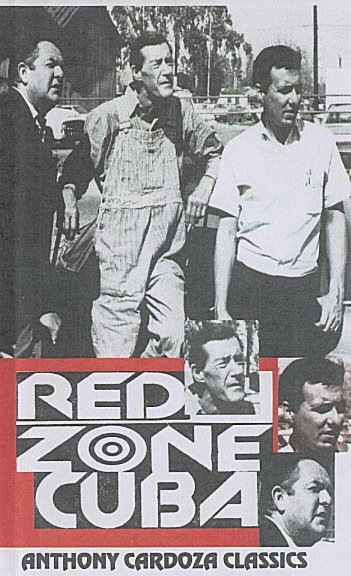
Red Zone Cuba (a.k.a., Night Train to Mundo Fine) (1966).
 The Scoop:
This is yet another Coleman Francis/Anthony Cardoza turd, only this time it is apparently Francis’ grand artistic statement.
Back in the ’60s and ’70s, just about anybody could get John Carradine to appear in their film for about the cost of a ham sandwich, so Francis apparently blew his budget on that, and then wasted the whole thing in the first two minutes of the movie. In the opening scene, Carradine turns up as a grizzled railway worker who is telling this story to a nondescript bystander. After this incredibly short day’s work, Carradine disappears from the movie forever, but not before croaking the horrendously awful theme song.
From there, the real story starts. An escaped convict (played by the auteur himself, who also wrote, directed, produced and edited this red-baiting debacle) gets mixed up with five or six revolutionaries who try to invade Cuba. After an excursion that makes the Bay of Pigs look like an epic triumph, our intrepid non-heroes get captured, and a couple of them try a semi-daring escape before getting hunted down by a half-hearted posse back in the States.
At least, that’s what the plot seems to indicate. Mostly, “Red Zone Cuba” just meanders from scene to scene, without much differentiation between one setting and the next. In fact, if this film is to be believed, Cuba is just a little town in the California desert. And I think the guy with the cigar and glued-on beard is supposed to be Fidel Castro.
Best Line:
“I’m Cherokee Jack!”
Side Note:
Apparently Cherokee Jack’s plane is still in use, and is currently being flown out of a small airport in Alaska.
Companion Viewing:
“The Beast of Yucca Flats” (1961) and “Invasion U.S.A.” (1952).
Links:
IMDb.
The Agony Booth.
Daddy-O’s Drive-In Dirt.
Take a Look:
Just try to be entertained. I dare you:
Red Zone Cuba: the first 5 minutes @ Yahoo! Video
Pandora’s Box (1929).
 The Scoop:
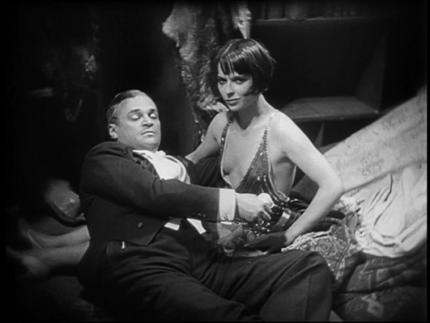
Silent screen legend Louise Brooks had her signature performance as Lulu in this German masterpiece. She entices, she allures, she arouses, and today, 80 years later, she still breaks hearts, both male and female alike.
Brooks’ performance, still among the sexiest and most charming ever in screen history, anchors G.W. Pabst’s tearjerker about a reckless party girl who gets her comeuppance at the hands of Jack the Ripper.
Once you get beyond Louise Brooks, the rest of the film is fairly conventional, but very well executed. Based on a pair of popular German plays by Frank Wedekind, some of the subject matter went beyond the bounds of what Hollywood was doing at the time, although the basic “rise and fall of an evil, heartbreaking woman” plot — and the troubling view of women’s sexuality it presented — was a cliché even by that point. But there are also good performances by Fritz Kortner and Francis Lederer, as the father and son who get ruined by Lulu’s lust. And director Pabst does a superb job of holding it all together and bringing out the best in his leading lady. And as if that wasn’t enough, her haircut became iconic and started a fashion trend.
The strong-willed Brooks, who was beginning to make a name for herself in Hollywood, fled to Germany to make “Pandora’s Box” out of frustration over the lack of good roles available back home. The powers that be in Hollywood never forgave her for that, though, and this movie, which launched her to superstardom, also marked the effective end of her acting career.
This film, and Brooks in particular, contain all the elements of which greatness is made, and provide a marvelous swan song for the silent era.
Best Bit:
Lulu and Alice’s dance.
Side Note:
Countess Anna, played by Alice Roberts, is believed to be the first lesbian character depicted in film. Roberts didn’t realize her character was gay until filming began, and although she wanted to walk off the film, she was persuaded to stay and not break her contract.
Companion Viewing:
“It” (1927).
Links:
IMDb.
Lenin Imports.
Senses of Cinema.
Silent Volume.
Take a Look:
Watch it on the YouTube installment plan, beginning here:
Kingdom of the Spiders (1977).
 The Scoop:
This entry in the late-’70s wave of evil spider movies is pretty much just like all the others — except this one has William Shatner, which really puts it over the top.
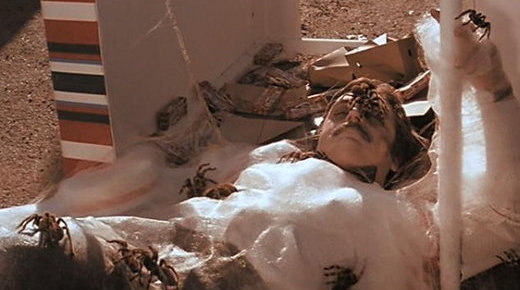
The Shat plays a studly cowboy veterinarian with the soap opera ready name of Rack Hansen who goes to a small Arizona town to investigate a rash of unexplained livestock deaths. It turns out, of course, that the deaths are caused by a gang of angry tarantulas who eventually take over the town, give everyone the willies and deliver an Important Ecological Lesson along the way. Basically, it starts out like “Jaws” and ends up like “The Birds.”
Veteran Z-grade exploitation star John “Bud” Cardos directed this and does a technically credible job. But the script from Alan Caillou and Richard Robinson is a turd, the supporting cast (including Woody Strode, Tiffany Bolling and Altovise Davis) is overwrought and Shatner has the smarm set on overdrive. Plus just about every ’70s ecological disaster film cliché is crammed onto the screen.
In other words, it’s a hoot. But if you have issues with spiders and couldn’t stomach the other spider movies, you won’t be able to stomach this one, either.
Best Line:
“I don’t think DDT’s gonna kill ’em.”
Side Note:
Cardos worked a lot of jobs behind the camera during his career on the fringes of Hollywood. But of most relevance here was his experience as a bird wrangler for Hitchcock on “The Birds.”
Companion Viewing:
“The Giant Spider Invasion” (1975) and “Tarantulas: The Deadly Cargo” (1977).
Links:
IMDb.
X-Entertainment.
Take a Look:
The trailer:
Check out the opening. It has everything you need — an awesome theme song, star quality bovine acting and sexually charged banter about animal vaccinations. And, believe it or not, the movie’s just getting warmed up:
The Gorilla (1939).
 The Scoop:
I watch this crap so you don’t have to.
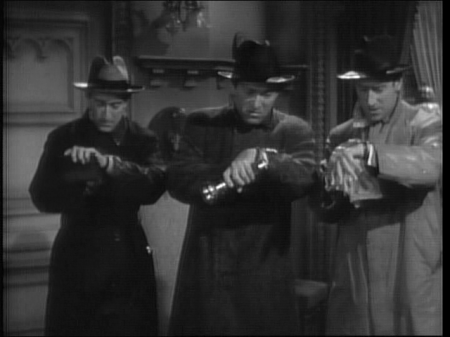
Why should you bother watching “The Gorilla”? This one is only for the morbidly curious who want to see Bela Lugosi’s career in mid-decline. Here he plays straight man (as does the similarly-declining Lionel Atwill) to the tragically unfunny Ritz Brothers who are trying to solve the mystery of a serial killer in an old mansion.
They don’t get much more boring than this. Even eight hours of Andy Warhol’s camera trained on the Empire State Building will entertain you more than “The Gorilla.”
Seriously, I can’t recommend this movie to you less. I shouldn’t even be writing about it, and you shouldn’t even be reading about it. As it is, we’ve all just wasted a few precious minutes of our finite lives on it, not to mention all the irreplaceable fossil fuels we’ve just burned up by using our computers to deal with it. Let’s all just cut our losses now and move on. Please, just move on.
Best Line:
“But how could a monkey write those notes to Uncle Walter?”
Side Note:
The costumes were designed by Gwen Wakeling, who would go on to create Barbara Eden’s iconic costume for “I Dream of Jeannie.”
Companion Viewing:
“The Bat Whispers” (1930).
Links:
IMDb.
1,000 Misspent Hours.
Take a Look:
Here’s a taste. Now imagine 66 straight minutes of this:
You best watch out. Bela regulates the fridge:
Cobra Woman (1944).
 The Scoop:
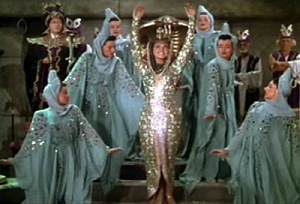
This technicolor extravaganza is campy B-movie jungle adventure fun at its best.
Maria Montez, who really deserves to be a bigger drag queen icon, plays twins (one good and one evil, of course). It seems that the evil twin, Naja, is the priestess of an ancient island cobra cult and when she discovers the existence of good twin Tollea, she has her kidnapped for no good reason. Tollea’s fiancé Samu (Jon Hall) sets off to rescue her with his trusty native pal Kabo (Sabu) by his side. Lon Chaney Jr. also lurks around the edge of the action. Plus, there’s a chimp!
All the swashbuckling, campy fun and beautiful native girls on display here make this a perfect time-waster. (In fact, Kenneth Anger once called this is all-time favorite film, which should give you an idea of what you’re in for.) Noir master Robert Siodmak stepped outside of his comfort zone to direct this with gusto from a completely inept script by Gene Lewis and Richard Brooks. It’s so wrong it’s right.
Best Bit:
The cobra dance. Oh yes. You must stick around to watch Maria do her cobra dance.
Side Note:
Famed Shakespearean stage actor Fritz Leiber, near the end of this life, has a small unbilled part.
Companion Viewing:
“Voodoo Woman” (1957).
Links:
IMDb.
1,000 Misspent Hours.
Take a Look:
The trailer:
“I have spoken. King Cobra!”
 Desuko Movie Spot.