Let the Devil Wear Black (1999).
 The Scoop:
All you really need to know is that this is an update of “Hamlet” set in the L.A. Jewish underworld.
It’s a promising concept, but ultimately falls flat. Jack (Jonathan Penner) is depressed about his father’s death, especially when his mother (Jacqueline Bisset) marries his uncle (Jamey Sheridan). Thanks to a mysterious informer and a little detective work, Jack discovers that his uncle killed his father, then plots out his revenge. Meanwhile his girlfriend (Mary-Louise Parker) slowly goes insane.
The problem is that nothing seems to hang together. There’s very little plot progression and, in fact, if you didn’t know the basic story of “Hamlet” you’d probably have not idea what was happening at all. Only the barest outline of the “Hamlet” story remains, replaced with a lot of scenes that go nowhere and with reams of pretentious, pseudo-philosophic, pseudo-gritty dialogue. It’s slow and dreary, and even at 89 minutes if feels way too long.
Not content with being a wannabe Shakespeare, director Stacy Title (who also co-wrote with Penner) also tries to be a wannabe Tarantino. And “Let the Devil Wear Black” is nothing more than just another late entry in the wave of Tarantino imitations that flooded indie cinemas in the ’90s.
Best Bit:
“If brains were cars, you’d have a boat.”
Side Note:
The title “Let the Devil Wear Black” of course comes from Shakespeare’s play — Hamlet says it to Ophelia in Act III, Scene 2.
Companion Viewing:
Kenneth Branagh’s “Hamlet” (1996) for a good treatment of the original play, and Ethan Hawke’s “Hamlet” (2000) for another updated version.
Links:
IMDb.
Take a Look:
The trailer:
Some NSFW bullshit philosophy:
Sgt. Pepper’s Lonely Hearts Club Band (1978).
 The Scoop:
With Beatles Rockband coming out tomorrow, we’re in the midst of another one of those periodic waves that flood our culture celebrating the Beatles’ legacy. It is most definitely a legacy that deserves celebrating, but sometimes it’s worth remembering that not every appropriation of the Beatles is a work of genius.
Take, for instance, this… thing. How was this ever a good idea? Pop stars of the ’70s (including the Bee Gees, Peter Frampton and Earth, Wind & Fire) gather to cover Beatles songs and participate in some sort of plot cobbled together from references to Beatles lyrics. And the resulting film is even worse than the description sounds.
It was directed by Michael Schultz (who was also responsible for “Car Wash” and “Carbon Copy”), written by Henry Edwards (who had no other film credits after this) and the non-musical cast includes George Burns, Donald Pleasance, Sandy Farina and Steve Martin.
Despite an interesting touch or two (such as the inspired casting of Aerosmith as the evil enemy band), this is only good for unintentional laughs and not much else. Provided you can stomach the desecration of such great music.
Best Line:
“Could Billy survive 10,000 volts? It was a lot more than normally came through his guitar. Frankly, he was shocked. Stunned and unconscious, only the power of true love could revive the injured Billy.”
Side Note:
The “Guests of Heartland” read like a who’s who of the mid-1970s pop charts, including Leif Garrett, Jose Feliciano, Donovan, Yvonne Elliman, Rick Derringer, Seals and Crofts, Dr. John and dozens of others. Hidden in the crowd – and carefully omitted from the end credits – are George Harrison and Paul and Linda McCartney.
Companion Viewing:
“Xanadu” (1980) and “Across the Universe” (2007).
Links:
IMDb.
Fan site.
Trading cards!.
The history of the trumpet.
Take a Look:
The trailer:
Sandy Farina plays Strawberry Fields, singing “Strawberry Fields Forever”:
Summer Rerun: Dante’s Inferno (2007).
The busy minions at Desuko World HQ are taking a well-deserved summer vacation, so in the meantime, enjoy these favorite posts from the past. [Originally published July 18, 2008]
 The Scoop:
One unintended consequence of the electronic media age has been a change in the way we experience classic (i.e., pre-20th century) literature. Now it’s all about the adaptation. (Of course, these adaptations make sense for the filmmakers, who get cheap access to familiar material and don’t have to deal with authors who demand royalties or protest changes in the script.) More and more, one’s first encounter with Shakespeare or Dickens or countless other authors is through a film or television adaptation of one of their works. If audiences aren’t rushing to the cineplex for their first tastes of these classics, they are getting them in the classroom — teachers typically now accompany their reading assignments with screenings of films based on these works to help students better understand them. Shakespeare has now become inseparable from Olivier or Branagh, and Jane Austen from the starlet du jour.
All of which brings us to this version of “Dante’s Inferno.”
Italian poet Dante Alighieri’s “Comedy” — his epic tale of his journey through hell (“Inferno”), purgatory (“Purgatorio”) and heaven (“Paradiso”) under the tutelage of his idol, the Roman poet Virgil and Dante’s beloved Beatrice — is notoriously resistant to onscreen adaptation. Except for a couple perfunctory stabs from the silent era and a BBC miniseries from the 1980s, little straight adaptation has been done of the poem. More commonly, elements of the “Comedy” have been used as inspirations or jumping-off points for newer works. (One typical example is the 1935film “Dante’s Inferno,” a turgid morality play in which Spencer Tracy plays a carnival barker wrestling with the ethics of his profession. The attraction he shills for, a ride based on “Inferno,” is shown in only a few scenes, primarily as a comment on the action of the main story.)
So give filmmakers Sean Meredith, Sandow Birk and Paul Zaloom credit for attempting a full adaptation of “Inferno.” One reason adaptors have stayed away from Dante is his work’s resistance to modernized spins on the material (something that has become a staple of filmed Shakespeare, for instance). But the threesome give it a try, mixing in modern situations and personalities with the arcane issues and obscure historical figures used by Dante. Credit should also go to them for doing it in the form of a puppet show.
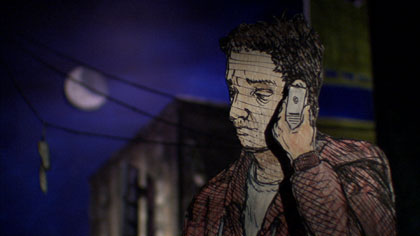
In this version Dante (voiced by Dermot Mulroney) wakes up hung over in a seedy alley, not knowing how he got there. He his approached by Virgil (James Cromwell), who leads him down a sewer into the pit of hell, where they encounter pimps and whores, corporate malfeasance and urban decay to go along with the medieval horrors chronicled in the original.
The puppetwork, using paper figures that manage to be terrifically expressive, is wonderful, but many of the other creative choices fall flat. For every update that works (portraying the Maleboge demons as hypervigilant T.S.A. agents, or mounting Ulysses’ story as a puppet show within a puppet show) there are a handful that don’t (Lucifer’s fondue pot, or the multiple references to the rock band Styx).
Pacing is a problem as well. By the film’s halfway mark, Virgil and Dante have raced through the first seven pits of hell, then spend the last half in a leisurely stroll through the final two pits, including plenty of non-Dante tangents along the way. Also, purists may be offended that (spoiler alert!) Dante’s trip through hell ends with him back on earth rather than preparing to scale the mountain of purgatory.
But in all it’s an admirable effort to try to make a 700-year-old epic poem relevant to modern audiences. The somewhat basic approach may make it cringe-worthy for Dante aficionados. But that makes it ideal for use in a high school classroom, giving another generation an opening to understanding a monumental piece of literature.
Best Bit:
The Pope John Paul II cameo.
Side Note:
Zaloom is better known as Beakman from the TV show “Beakman’s World.”
Companion Viewing:
“Dante’s Inferno” (1935).
Links:
IMDb.
Official Site.
Take a Look:
The trailer:
A song and dance number explaining the grip lobbyists hold on Congress:
Summer Rerun: F For Fake (1974).
The busy minions at Desuko World HQ are taking a well-deserved summer vacation, so in the meantime, enjoy these favorite posts from the past. [Originally published Nov. 27, 2007]
 The Scoop:
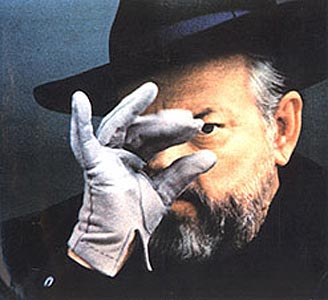
Orson Welles was the consummate trickster. Already a successful theater director, he burst into the public eye in 1939 with his infamous “War of the Worlds” radio broadcast, a pioneering piece of pseudo-documentary hucksterism. From there it was onto the capital of illusion, Hollywood, where he began a film career in which he repeatedly played with the audience’s notions of the boundaries reality and imagination, and celebrated the power of magic.
In the documentary “F For Fake,” which would ultimately prove to be his final directorial effort, he turns his lifelong fascination with trickery and illusion toward investigating the case of notorious art forger Elmyr de Hory and his equally notorious biographer (and Howard Hughes diary forger) Clifford Irving. As they tell their stories for his camera, Welles interweaves his own philosophizing on the power of fraud and the nature of art. Plus, as if that weren’t enough, the careers of Hughes and Welles himself get mixed in for good measure.
And then there’s the final 20 minutes or so, in which Welles detours into telling the story of Oja Kodar, which transcends all the indulgence and trickery that came before.
The result is an essay, really, more than a film — but one that is sprawling and fascinating.
In the end, “F For Fake” becomes a fitting tribute to his career — both thought-provoking and self-serving, dishing out equal parts brilliance and self-indulgence. And utterly ignored by the mainstream.
Best Bit:
There’s lots of good, quotable stuff here, but the discourse on the cathedral at Chartes stands out.
Side Note:
The excerpt of “War of the Worlds” that Welles includes is actually a recreation, not the original broadcast, and even includes some rewritten lines.
Companion Listening/Viewing:
Welles’ original “War of the Worlds” (1939) and “The Blair Witch Project” (1999).
Links:
IMDb.
Take a Look:
The trailer:
The Chartes monologue:
Summer Rerun: Watchmen (2009).
The busy minions at Desuko World HQ are taking a well-deserved summer vacation, so in the meantime, enjoy these favorite posts from the past. [Originally published March 31, 2009]
 The Scoop:
When Alan Moore and Dave Gibbons’ “Watchmen” was released in 1985, it became a landmark in the emerging genre of graphic novels and has cast a long shadow. Not only did it enlarge the storytelling possibilities in the comics field, but its effects have also been felt in the larger popular culture, particularly the way films and television shows have handled superhero themes. It was also very much a product of its times, delving deep into the Cold War anxieties of the mid-1980s.
All of which make any sort of film version of “Watchmen” especially problematic. As written by David Hayter (“X-Men”) and newcomer Alex Tse and directed by Zack Snyder (“300”), the film is full of thunder and excitement, but runs up against a few walls.
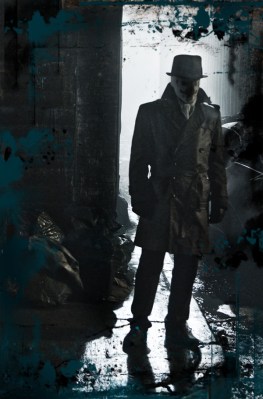
The story takes place in a darker, alternate version of 1985 America in which costumed adventurers and vigilantes are common place and, after their halcyon days in the 1940s, have become increasingly distrusted by the public for enforcing the oppresive policies of the U.S. government, led by Richard Nixon in his fifth term as president. Against the backdrop of escalating nuclear tensions between the U.S. and Soviet Union, the hero-turned-military-mercenary The Comedian is murdered. As the sociopathic vigilante Rohrshach tries to solve the crime, he and his former compatriots (including Nite Owl, Silk Spectre, Dr. Manhattan and Ozymandias) uncover corruption and a global power grab.
The novel’s genius lies in its multi-layered storytelling, which is rich in symbolism, literary allusions and a wonderfully fleshed-out cast of supporting characters. The history of this alternate world is also richly detailed, providing a running commentary on the main story and rewarding careful attention. All these elements combine to debunk the idealized superhero mythos, turning a cynical eye to the corruption possible when so much power is concentrated in the hands of flawed human beings. It is a world that is less about Superman and more about Travis Bickle.
Accordingly, a faithful film adaptation is a pretty tall order. The Cold War paranoia has lost much of its edge in the nearly quarter century since its release, as had the shock of the novel’s innovations. The filmmakers do their best to honor the source material, but come up with a mixed bag.
For the sake of brevity and to not alienate those who haven’t read the novel, the filmmakers sweep aside much of the complex backstory for the film. While this serves to keep the focus on the current generation of heroes, it also diminishes the psychological realism of the piece. Consequently, a lot of the characters’ actions exist in a vaccuum, and much of Moore’s original message is lost. Almost all of the cast of minor characters is lost, too, making the proceedings seem so much thinner and one-dimensional.
And then there’s the violence. While the novel and the film are each especially violent, they wind up being two different creatures. Snyder and his writers toned down many of the more brutal passages of the book in favor of Snyder’s patented garish fight choreography. Limbs shatter and blood gushes in gruesome slow motion. It’s hypnotic and balletic, but ultimately just eye candy. The amoral brutality that Moore used to illuminate his hard-edged characters is replaced by empty and gratuitous exercises in CGI wizardry.
But it’s not all bad. The novel’s greatest weakness — its convoluted, inorganic ending — is given a minor revamp here to better effect. It’s still not wholly satisfying, but it is definitely a step in the right direction. There is also terrific cinematography by Larry Fong (a veteran of “300” and “Lost”) that vividly brings to life some of the best parts of Gibbons’ original artwork.
The acting, too, is solid. With the exception of a wooden turn by Malin Ackerman as the second Silk Spectre, this is a talented ensemble. Billy Crudup (as Dr. Manhattan) and Jackie Earle Haley (as Rohrshach) are particularly great.
In total, “Watchmen” is not completely successful, but it’s not a failure, either. Just be sure to read the book first, to fully appreciate the story’s rich possibilities.
Best Line:
“Never compromise. Not even in the face of Armageddon.”
Side Note:
Having been in development for decades, “Watchmen” has had numerous actors, writers and directors attached to the project at various times. Among the directors considered were Terry Gilliam, Darren Aronofsky, Paul Greenglass and Michael Bay. Among the candidates to play Rohrshach were Robin Williams, Simon Pegg, Daniel Craig and Doug Hutchinson.
Companion Viewing:
“V For Vendetta” (2005) and “The Incredibles” (2004).
Links:
IMDb.
Official Site.
Watchmen Wiki.
The Annotated Watchmen.
Take a Look:
The trailer:
 Desuko Movie Spot.