The Notorious Bettie Page (2005).
 The Scoop:
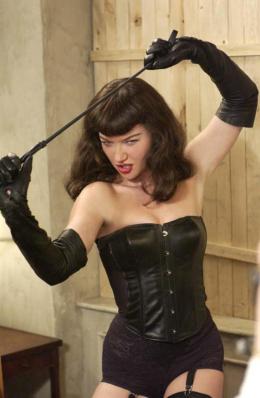
Unlike “Bettie Page: Dark Angel,” this can be considered a true biopic of the iconic pinup queen. However, also unlike that film, “The Notorious Bettie Page” lacks a bit of sizzle.
Yet that’s not to say that Mary Harron’s film isn’t worth watching. Particularly exciting is Gretchen Mol’s performance in the title role. For all her fame and influence, Bettie Page is an idol who is frozen in amber for us. All we know of her comes from hundreds of still photographs and just a few film shorts, most of which are devoted more to particular fetishes rather than Bettie’s own considerable personality – and all of which came for just a short period of her life.
But Mol fills in the blanks wonderfully well. She bears a remarkable resemblance to Bettie and recreates the photogenic personality we know from all those pinups. But she also expands on that to bring to life a complex character who maintains a childlike innocence about her powerful sexuality, but who enjoys exercising it nonetheless. Plus, she’s not afraid to go the full monty with a refreshing exuberance.
The supporting cast — which includes Chris Bauer as Irving Klaw, Lili Taylor as Paula Klaw, and David Straithairn as Sen. Estes Kefauver – is also excellent.
Also of note is the cinematography of Mott Hupfel. His rich black and white photography creates a gritty, noir-esque vision of 1950s New York that also faithfully recreates the look and feel of Page’s pinup work with the Klaws. For the Miami sequences, Hupfel switches to a brilliant, pastel-filled color palette that matches the sunny world of Bunny Yeager’s photos of Bettie.
So where’s the problem? Mostly it’s in the screenplay by Harron and Guinivere Turner, who also teamed up for “American Psycho.” There is an evocative opening sequence introducing us to the world of 1950s adult bookstores, but the script quickly devolves from there into a clichéd naïve-country-girl-in-the-big-city take on Page’s pinup career. While we see all of the key moments in Bettie’s life from her start in modeling in New York in 1953 to her religious awakening in Miami in 1959, there is not depth or understanding to it. Also absent are all but a few hints of some of the darker, more extreme aspects of Page’s combustible sexuality.
Nowhere does the film really get under Bettie’s skin. So, consequently, it can’t get under the audience’s skin either. At the end of the film, Page remains just as much of a mystery to us as she was at the beginning, despite Mol’s best efforts to give us a glimpse at the real Bettie Page.
The film also avoids dealing with the mess of Page’s post-modeling life, which included evangelic missions, paranoid schizophrenia, an attempted murder trial, years in a psychiatric institution, followed by some messy copyright battles over her image in the 1990s. (She died in seclusion in 2008 at the age of 85). But that’s just as well, because that’s not the Bettie Page we want to remember.
We want to remember the Bettie staring back at us from all those classic pinup shots – energetic, confident and just as enticing to men as to women, generation after generation. “The Notorious Bettie Page” makes a spirited effort to capture that Bettie, but falls just a bit short.
Best Line:
“I’m not ashamed. Adam and Eve were naked in the Garden of Eden, weren’t they? When they sinned, they put on clothes.”
Side Note:
This film is filled with improper camera technique on the part of the actors playing the photographers. While most of the cameras being used are period accurate, the actors are just waving them around without any clue of how they were supposed to be handled.
Companion Viewing:
“Bettie Page: Dark Angel” (2004) and “I Shot Andy Warhol” (1996).
Links:
IMDb.
Take a Look:
The trailer:
Scorched (2002).
 The Scoop:
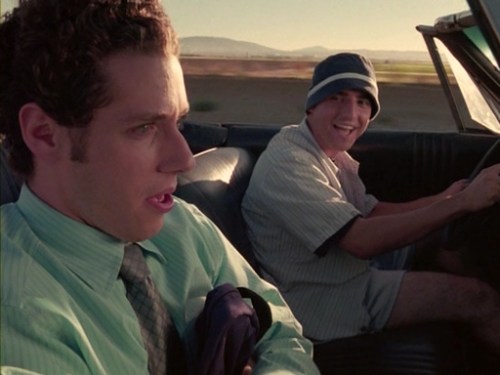
Let’s cut to the chase. Gavin Grazer and Joe Wein’s film “Scorched” is just another one of those self-consciously quirky indie comedies that tries too hard to be clever for its own good.
In a nondescript California desert town (apparently named Desert, California), three disgruntled employees of the local bank each plot come up with their own plans to rob the bank, and execute their heists on the same weekend. There’s Stewart (Paolo Costanzo) and his numbskull pal Max (David Krumholtz) who “borrow” $250,000 from the mini-vault to use on an all-or-nothing roulette bet in Las Vegas. Sheila (Alicia Silverstone) enlists new firefighter pal Max (Ivan Sergei) to empty out the ATMs to get back at her ex-boyfriend, the douchebag bank manager Rick (Joshua Leonard). And then there’s Woody Harrelson in the role he was born to play — Woods, the spaced-out desert rat assistant manager who wants to get revenge on infomercial con artist Mr. Merchant (John Cleese) by cleaning out his safe deposit box. Also mixed up in the shenanigans are new employee Doleman (Marcus Thomas) and his free-spirited pal Shmally (Rachel Leigh Cook).
The plot, which relies on such improbabilities as the banks lack of 24/7 video cameras and the fact that ducks live wild in the desert, plays out pretty much as you’d expect. The comedy is pretty half-baked, unless your idea of fun is watching Woody Harrelson try to hold his own while acting opposite various animals. And, except for Silverstone and Costanzo, everyone else pretty much mails it in.
Sure, there are worse ways to spend 90 minutes of your life. But there are also lots of better things you can do with your time than spending it on this well-meaning but forgettable trifle.
Best Bit:
Jeffrey Tambor’s cameo as the spaced-out bank executive.
Side Note:
The horned toad Woods is talking to in the desert at the beginning is actually an Australian bearded dragon, which is not native to California.
Companion Viewing:
“Love and a .45” (1994).
Links:
IMDb.
Take a Look:
Something put together by a Rachel Leigh Cook fanboy:
Bettie Page: Dark Angel (2004).
 The Scoop:
Along with Marilyn, Elvis and James Dean, Bettie Page was one of the quintessential 1950s icons. She may not have gotten the acclaim during her own time that those others did, but that’s only because she was the epitome of sexuality in that era — a sexuality that the nation’s moral guardians tried so hard to keep under wraps. But her fans wouldn’t be deterred and for years after her abrupt retirement from modeling, they kept her legacy alive with pinup shots and film shorts hidden in dresser drawers and under mattresses until the world was ready for her re-emergence in the 1990s.
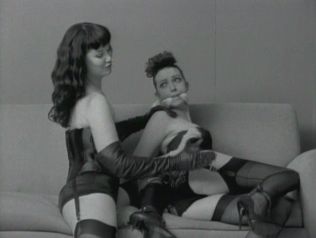
“Bettie Page: Dark Angel” is ostensibly a biopic, but only in the loosest sense. Produced by Cult Epics — the current distributor of most of her film loops — the movie is built around faithful recreations of some of Bettie’s most infamous “lost” shorts. Interspersed with the recreations are scenes from her life during that period, with the focus squarely on her bondage work with Irving Klaw, although there is brief lip service paid to her shoots with Bunny Yeager. But these scenes have all the awkward writing, stilted acting and cardboard quality production values that you’ve come to expect from the non-sex scenes of your favorite old pornos.
So the results are uneven, to say the least. But luckily, you’re probably not watching this movie for the dramatic scenes.
The recreations are campy fun and star Paige Richards not only is a dead ringer for Bettie, but also brings along her years of experience in softcore porn to really sell it. She doesn’t have the same presence as Bettie, but no one could. She comes close, though, which goes a long way toward making this cheapo production watchable.
Best Bit:
The kindergarten quality recreation of the Kefauver hearings.
Side Note:
The theme song is by Chris Stein of Blondie. He was signed to do the whole score, but then backed out. The swinging burlesque score used in the film is by Danny B. Harvey and Zack Ryan.
Companion Viewing:
“The Notorious Bettie Page” (2005).
Links:
IMDb.
Official site.
Take a Look:
The trailer:
A montage:
I Was a Teenage Werewolf (1957).
 The Scoop:
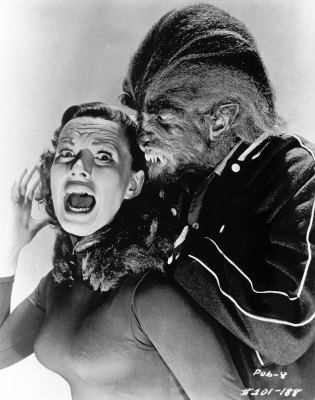
This cult classic follows a formula pretty common in the late 1950s — take a conventional B-movie concept and weld it onto a teen alienation story derived from “Rebel Without a Cause.” Obviously, the B-movie theme this time around is lycanthropy.
A young Michael Landon (in tremendous spasms of scenery chewing) is Tony, a typical ’50s version of a troubled teen who is sent to psychologist Dr. Brandon (Whit Bissell) to get his head straight. Unfortunately, the doctor is secretly a mad scientist who wants to use Tony as the test subject for some hypnotic devolutionary mumbo-jumbo that turns people into werewolves. In completely predictable fashion, Tony turns hairy, terrorizes his small town, turns on Dr. Brandon, then is put down by the authorities.
The make-up isn’t bad, but otherwise the movie’s huge financial success at the time has colored its perception today, making it far too overrated. Especially bad is the “Eeny Meeny Mieny Mo” song.
Best Line:
“It’s my belief that these legends and myths died out with the invention of electricity.”
Side Note:
Landon later returned to spoof this material in an episode of “Highway to Heaven” called “I Was a Middle-Aged Werewolf.”
Companion Viewing:
Producer Herman Cohen’s follow-up films, “I Was a Teenage Frankenstein” (1957), “Blood of Dracula” (1957) and “How to Make a Monster” (1958).
Links:
IMDb.
HorrorFind.
Take a Look:
The trailer:
Love’s Labour’s Lost (2000).
 The Scoop:
One of the joys of seeing Shakespeare on stage, even after 400 years’ worth of productions, is the range of experimentation that is still possible with the material, even if the risks don’t always pay off. On film, however, the risks have traditionally been kept to a minimum, with most productions being set either in a generic 19th century European countryside, or in Elizabethan dress.
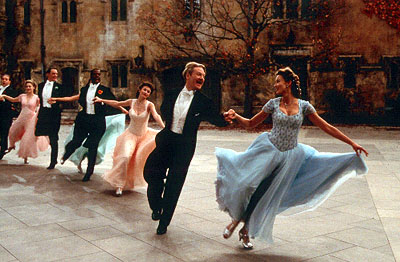
So, on that level, it’s a breath of fresh air to watch Kenneth Branagh’s take on “Love’s Labour’s Lost,” which he stages as a 1930s movie musical. For all of Branagh’s Shakespearean bonafides, it’s a bold move to have the Bard’s words broken up by musical numbers set to the songs of George Gershwin, Jerome Kern, Cole Porter and others. However, this is one experiment that falls flat.
But first, for the uninitiated, here’s the story in a nutshell. The King of Naverre (Alessandro Nivola) and his three buddies (Matthew Lillard, Adrian Lester and Branagh) agree to give up the company of women for three years to devote themselves to their studies. However, the French princess (Alicia Silverstone) shows up on a diplomatic mission with her attendants (Natasha McElhone, Carmen Ejogo and Emily Mortimer). As you might guess, various wackiness ensues before a bittersweet ending. The play is one of Shakespeare’s early comedies that doesn’t carry the weight or beauty of his later, more famous work.
The biggest problem with the film is that Branagh’s concept requires such wildly different skill sets from his cast that none of them can do it all. So, despite the presence of a talented ensemble, nothing quite hangs together. The actors are either good at the poetry (Branagh, McElhone and the wonderful old pro Richard Briers) or the song and dance (Lester and Nathan Lane, who seems to be channeling all four Marx Brothers). And then there are the unfortunate few (namely, Silverstone and Lillard) who can handle neither. As a result, every scene seems strained as everyone on screen is trying too hard to reach out of their comfort zone to deliver something they may not have training in. And then there’s the performance of Timothy Spall as Don Armado, who chews the scenery into tiny pieces.
But for all of that, it is still a lovely film to look at, thanks to the art direction of Mark Raggett, the costumes by Anna Buruma and Alex Thomson’s excellent cinematography. There are even a few good directorial touches from Branagh. It’s not quite enough to offset the problems with the acting, but it’s still good to see a play from outside the usual cinematic Shakespearean canon on the big screen, even if most of the text has been cut.
Best Bit:
The best Shakespearean bit is Branagh’s dynamite delivery of the “From women’s eyes” soliloquy. The best musical bit is the Gene Kelly-ish sensuality and bravado of the “Let’s Face the Music and Dance” number.
Side Note:
Shakespeare’s ending to “Love’s Labour’s Lost” is notoriously inconclusive, which is something Branagh addresses with a montage showing what happened to the characters after the end of the story. However, many scholars now believe that this play is just the first part of the story, which was finished by Shakespeare in a play called “Love’s Labour’s Won” that is now lost to history.
Companion Viewing:
“Pennies From Heaven” (1981) and “Everybody Says I Love You” (1996).
Links:
IMDb.
The complete play.
Take a Look:
“I Won’t Dance”:
Branagh doing what he does best (by which I mean the soliloquizing, not the tap dancing):
Nathan Lane doing what he does best (by which I mean the Broadway-zing, not the soliloquizing):
“Let’s Face the Music and Dance” (complete with Spanish subtitles):
Behind the scenes featurette:
 Desuko Movie Spot.