Festival Express (2003).
 The Scoop:
The stretch from about 1967 to 1971 was a hotbed for innovative music, and it was the heyday of the festival concert. But it was also the heyday of the concert film, and every festival worth its name – Woodstock, Monterey Pop, Big Sur, even Altamont – had a film attached. The result of this huge archive of film, of course, is a valuable time capsule of that era. “Festival Express” is a latter-day addition to that genre.
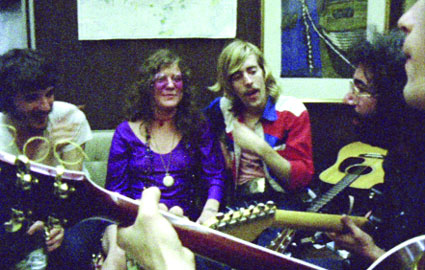
In the summer of 1970, a short festival tour was organized across Canada, featuring the Grateful Dead, The Band, Janis Joplin, Buddy Guy, Ian & Sylvia, the Flying Burrito Brothers, Bonnie & Delaney, Sha Na Na and Mashmakhan. (Traffic and Ten Years After also were part of the tour, but don’t appear in the film due to a conflict over music rights.) Everyone on the bill traveled together by train across country. It was an arrangement that was clearly a hit with the performers, who created a traveling commune, spending the long days living, eating and, most importantly, jamming together. And the film crew was there for all of it.
The tour itself was a financial disaster, not just because of the expense of the train, but also because it was dogged by protests and bad press along the way from kids who demanded that all the shows be free. The business side wound up in chaos, which is why all the film footage of the tour ended up on the shelf for more than 30 years. Which is a shame, because the footage is fantastic.
With the benefit of three decades of hindsight, director Bob Smeaton includes new interviews with the promoters and many of the performers to put the footage in context. But at times the interviews intrude too much. The film is at its best when the footage from 1970 speaks for itself. The live performances are uniformly excellent, as the musicians were obviously energized by the creative cauldron inside that train (which a couple of the interviewees describe as “heaven”). But the real treat is the train footage, which is full of great jamming from a host of talented musicians, and which also offers an extensive offstage glimpse of the people involved – something the other classic concert films of the era can’t match.
Especially poignant are the performances by Joplin. She was at the top of her game, and because she died shortly after the tour, these are among her last ever performances.
Regardless of whether you’re a fan of the era, “Festival Express” is still a must-see if you’re a fan of live music. Plus, there’s lots of rail footage too if you’re a fan of train movies, so everyone wins!
Best Bit:
The liquor run in Saskatoon.
Side Note:
The guitar used by Jerry Garcia during “C.C. Rider” is the same one that was played by George Harrison during the Beatles’ rooftop farewell performance the year before.
Companion Viewing:
“Woodstock” (1970) and “Monterey Pop” (1968).
Links:
IMDb.
Official site.
DocumentaryFilms.net.
Take a Look:
The Grateful Dead perform “C.C. Rider” with Ian & Sylvia and others:
Kill the Umpire (1950).
 The Scoop:
William Bendix was a fantastic character actor who built a fine career in the 1940s and 1950s playing distinctive supporting parts in a variety of different films. He specialized in playing gun-toting heavies in classics like “The Blue Dahia” and “The Glass Key,” as well as playing the lovable schlub/best buddy in plenty of war movies. Unfortunately, he didn’t get to tackle lead roles too often, but when he did (most memorably in “The Life of Riley” and as the Sultan of Swat in “The Babe Ruth Story”) it was always worth a watch.
That’s why his presence is the best thing about the otherwise forgettable “Kill the Umpire.”
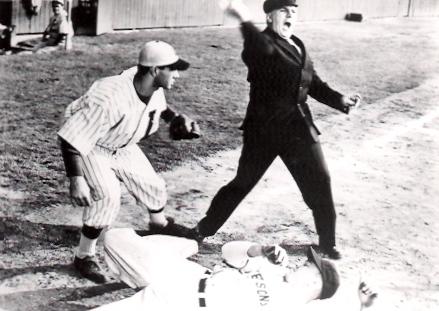
Bendix plays Bill Johnson, a former ballplayer who still gets so wrapped up in the game that he can’t keep a steady job because he keeps sneaking off to the ballpark during work hours. After losing one too many jobs, his wife threatens to leave him if he doesn’t do something to shape up. Bill’s father in law, a retired major league umpire, comes up with the idea of sending Bill to umpiring school so that he can make a living in the game he loves. What follows is a lot of slapsticky, sitcom-ish comedy and moralizing about the importance and integrity of umpires as Bill finally finds a steady life for himself.
The script by Frank Tashlin and direction by Lloyd Bacon are amiable and competent, but also silly and predictable. (When the opening theme incorporates the melody of “Three Blind Mice,” you know exactly what you’re in for.) Baseball has been a constant presence on the big screen since the beginning, but stories focusing on umpires have been rare, so it’s good to see that aspect of the game highlighted, even if it’s only superficially.
And it lets Bendix put his flair for comedy to work. Plus he’s surrounded by a solid cast of fellow character actors (lots of familiar faces, including Ray Collins, Una Merkel and William Hawley) who do a lot to save the film from itself. But ultimately “Kill the Umpire” falls a little flat with its ridiculous situations and hokey theme.
It’s a treat to see Bendix get a chance to carry a film himself, even if the material doesn’t live up to his talents.
Best Bit:
The three-headed steer. (Don’t ask.)
Side Note:
The uncredited actor playing Harry Shea, the catcher whose bobbled play is at the center of the rhubarb at the end of the film, is none other than Alan Hale Jr.
Companion Viewing:
“Safe at Home” (1961).
Links:
IMDb.
AZ Snakepit.
Take a Look:
The trailer:
The Hidden Fortress (1958).
 The Scoop:
Stop me if you’ve heard this one before – a grizzled warrior must help a feisty princess escape from the clutches of an evil empire, with the help of a pair of bumbling accomplices who prove to be heroic in spite of themselves.
That’s the plot of Akira Kurosawa’s wonderful “The Hidden Fortress.” But throw in a naïve farm boy, an amoral smuggler and a Wookiee and you’ve got seed for Obi-Wan Kenobi’s rescue of Princess Leia from the Death Star in “Star Wars.” George Lucas has famously cited “The Hidden Fortress” as the inspiration for his first “Star Wars” story, from which the rest of his complicated universe sprang.
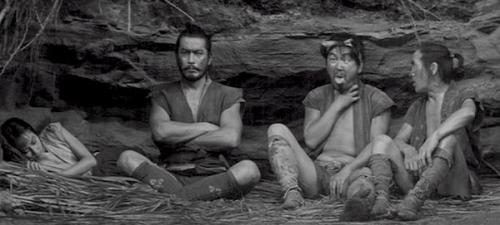
Besides the spine of the plot, several other details were borrowed by Lucas, especially the early scenes introducing bickering peasant buddies Tahei and Matakishi, which resurfaced in R2-D2 and C-3PO’s adventures on Tatooine.
But while it’s fun to play “spot the inspiration,” it’s a mistake to judge “The Hidden Fortress” solely in the light of “Star Wars.” It’s another rousing samurai adventure from Kurosawa that more than stands on its own.
Toshiro Mifune is incredible as always as Makabe, the wise, battle weary general who must protect tomboyish teenage Princess Yuki (Misa Uehara) and her kingdom’s stash of gold, then smuggle them to safety in neighboring Hayawaka. Their native land of Azikuzi has been overrun by armies from Yamana, but once in Hayakawa, Yuki will be able to use the told to rebuild her army and take back her lands.
They find their ticket out with appearance of Tahei (Minoru Chiaki) and Matakishi (Kamatari Fujiwara), who just want to escape from the war and return to their homes in Hayakawa. Thanks to their unwitting assistance, the foursome is able to stay one step ahead of the pursuing Yamana soldiers, but not without plenty of hardship and comic relief on the way.
This isn’t Kurosawa’s best samurai epic, nor is it one of the first that springs to mind when thinking about his classics – but don’t consider that an insult. “The Hidden Fortress” easily stands alongside the likes of “The Seven Samurai,” “Yojimbo” or “Rashomon.” But if it doesn’t quite reach their heights, it’s still better than most other action/adventure fare from lesser directors. Kurosawa was one of the masters of cinema; we’d expect nothing less from him.
Best Bit:
The escape on horseback.
Side Note:
It wouldn’t be a Kurosawa samurai classic without Mifune — the two made 16 films together in a 17 year stretch from 1948 to 1965.
Companion Viewing:
“Star Wars – Episode IV: A New Hope” (1977) and “The Seven Samurai” (1954).
Links:
IMDb.
Take a Look:
The Japanese trailer:
Scooby Doo: The Mystery Begins (2009).
 The Scoop:
So why waste your time on this? What’s the point of bothering with a made-for-cable, third generation live action adaptation of a hack cartoon, which is squarely aimed at tweens? Really, why bother?
Well, it turns out that this disposable entertainment has a thing or two to recommend it.
A Cartoon Network original, “The Mystery Begins” is the third live action version of “Scooby Doo,” following two big budget big screen stinkers. It’s a prequel, telling the story of how the gang got together at Coolsville High School and solved their first mystery together.
Unadoptable shelter dog Scooby (voiced by Frank Welker) accidentally gets sprung from his cage and runs off in search of someone who’ll take him in. He wanders through a cemetery at night, where he sees two ghosts rising from their graves. In a panic, he runs right through the basement bedroom window of high school burnout Shaggy (Nick Palatas) who naturally takes a liking to him and tries to sneak him into school the next day in human clothes. This winds up causing a free-for-all in the school bus, which eventually lands Shaggy in detention with football team captain Fred (Robbie Amell), drama club diva Daphne (Kate Melton) and brainy geek Velma (Hayley Kiyoko). Of course, the ghosts pick that exact time to disrupt the school pep rally, and the chase is on.
The “mystery” is just as paper-thin as you’d expect, both from a “Scooby Doo” story and a tween movie. But it’s the small, fresh details that keep this from being a complete waste.
Most intriguing is the dynamic between the four kids which — not only because it grows out of detention hall, but also because of the way it develops the relationships between members of four different high school social cliques – owes a big debt to “The Breakfast Club.” It’s actually handled quite well for tween fluff, and the cast nails it with gusto. This is where the real story is, not in the formulaic ghost hunting shenanigans.
The interesting upshot of this is that it makes the title character almost entirely irrelevant in his own movie. Unfortunately, director Brian Levant and writers Daniel Altiere and Steven Altiere try to compensate for this by making Scooby completely obnoxious, thrusting him into all sorts of situations where he isn’t needed, and making him the vehicle of lots of sophomoric, unfunny humor. That’s all bad enough, but to top it all off, the CGI work on Scooby is atrocious.
There are also some obligatory details, like the origins of the Mystery Machine (which is pretty much what you’d expect) and Scooby Snacks (which is actually a nice little twist). And Shaggy’s status as a flat-out stoner is hinted at even more strongly than before (but because this is still ostensibly children’s entertainment, he still can’t be shown for what he really is).
However, some entertaining new wrinkles are added. Like the fact that Shaggy is a few years older than the others and, thanks to being held back in school so much, is basically an adult still attending high school. Or the casting of Velma as an Asian.
However the biggest departure from the “Scooby” mythos is that the ghosts are actual undead spirits, and not mere mechanical tricks. But don’t feel too disoriented – the villain behind those vengeful spirits is straight out of the Hanna-Barbera playbook and even gets to deliver the signature “meddling kids” line after his capture. Because there are some classics you just don’t want to mess with.
Best Bit:
The gang’s ridiculously over-the-top undercover disguises — Daphne as a goth, Fred in hip hop gear (think Brian Austin Green), Velma as a hot chick, and Shaggy and Scooby as trash cans.
Side Note:
Welker is a veteran cartoon voice actor who has been working steadily since the 1960s. His roles include most of the Decepticons in the original “Transformers” series and numerous roles in “Tiny Toon Adventures” and “Animaniacs” — not to mention playing Fred in the original “Scooby Doo” series.
Companion Viewing:
The original Hanna Barbera cartoons from the early 1970s.
Links:
IMDb.
Official site.
Take a Look:
The trailer:
Hayley Kiyoko’s video blog, made during production:
The Green Slime (1968).
 The Scoop:
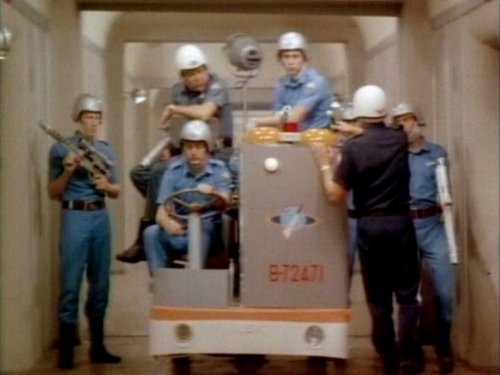
Flora, a “class two asteroid” suddenly takes a left turn starts hurtling toward a collision course with Earth. The only man qualified to stop this menace and save the world is studly rocket jock Jack Rankin (Robert Horton), who must team up with arch-nemesis Capt. Elliott (Richard Jaeckel) to destroy the killer rock. They’re successful, but they find out on the way home that they’ve mistakenly picked up an alien slime that spawns silly tentacle creatures with a taste for human flesh. Meanwhile, in between rousing bouts of square-jawed heroism, Rankin and Elliott fight over sexy doctor Lisa Benson (Luciana Paluzzi).
So basically, this starts out as “Armageddon” and then turns into “Alien.”
This Japanese production is filled with the cheap effects and clunky performances you’d expect from your favorite Godzilla movie, but with a cast of American and Italian actors. It’s completely laugh-worthy, of course, but the best thing about it is the swinging title by Richard Delvy, quite possibly the best theme song of any movie ever.
Best Bit:
Besides the theme song? It’s the groovy welcome back party. It’s too swingin’ for Earth, so they had to hold it on a space station.
Side Note:
All the extras are American military personnel who were based in Japan at the time.
Companion Viewing:
“The Wild, Wild Planet” (1965).
Links:
IMDb.
BadMovies.org.
Monster Island News.
Take a Look:
The trailer:
The theme song!
 Desuko Movie Spot.