Turkey Day Marathon, Day 3: The Mole People (1956).
One of the many fun things about the late, great “Mystery Science Theater 3000” was their annual all-day Turkey Day Marathons for Thanksgiving. Hour after hour after hour of bad movies — what’s not to love? So this year we’re doing a Desuko Turkey Day Marathon of our own — five days of Desuko reviews of movies that have been featured on MST3K. Here’s experiment #803, “The Mole People.” (Originally published Feb. 6, 2009):
 The Scoop:
How dreary can the subterranean world be? Very.
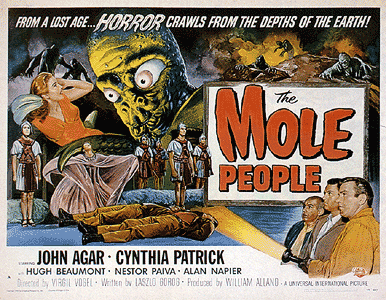
This lovely little film starts off with a professor giving the audience a strange, rambling lecture on the history of various crackpot theories about ancient civilizations underground. When the story finally gets started, we find an archeological team headed by smug know-it-all John Agar that discovers an underground colony of albino Sumerians and their mole-like slaves. Agar’s sidekicks include Hugh Beaumont (TV’s Ward Cleaver) and the evil underground high priest is Alan Napier (best known as Alfred the Butler from the “Batman” TV series).
When the heroes’ chief weapon in a flashlight, you know you’re in trouble.
Luckily, this foolishness doesn’t last long before the mole slaves revolt, the albino society crumbles and Agar and Beaumont escape in just the nick of time, along with their Sumerian love interest, played by the luscious Cynthia Patrick.
“The Mole People” isn’t as bad as some critics make it out to be, but that’s not saying it’s a good film, either. Director Virgil Vogel put together a solid, if unremarkable, genre piece that only suffers because some of the absurdities in László Görög’s script. If you can get past the questionable science and the fact that the mole people look like beatniks dressed for trick-or-treating, it’s not a bad little film.
Best Line:
“Do you think anybody’s ever tried to smoke dried mushrooms?”
Side Note:
The professor from the beginning is Dr. Frank Baxter, who in the mid-’50s left his job teaching English at the University of Southern California to lend his authoritative aura to introducing various educational TV shows. In addition to his star on the Hollywood Walk of Fame, he was also the recipient of the first ever Golden Gavel from Toastmasters International.
Companion Viewing:
“She” (1935).
Links:
IMDb.
Take a Look:
The trailer:
Science! Brilliant!:
The MST3K version:
Turkey Day Marathon, Day 2: The Beast of Yucca Flats (1961).
One of the many fun things about the late, great “Mystery Science Theater 3000” was their annual all-day Turkey Day Marathons for Thanksgiving. Hour after hour after hour of bad movies — what’s not to love? So this year we’re doing a Desuko Turkey Day Marathon of our own — five days of Desuko reviews of movies that have been featured on MST3K. Here’s experiment #621, “The Beast of Yucca Flats.” (Originally published April 8, 2008):
 The Scoop:
Forget about all the hype about “Plan 9 From Outer Space” being the worst movie of all time. There are plenty of other contenders for that title that are far more deserving, and “The Beast of Yucca Flats” is one of them.
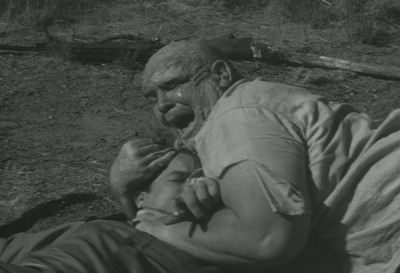
Not only is this writer/director (and bottom-of-the-barrel-scraper) Coleman Francis’ first film (produced by good pal and eternal lead actor Anthony Cardoza), but it also stars the inimitable Tor Johnson. A respected nuclear scientist (played by Johnson, which immediately shoots down any credibility the film might have) wanders too close to an A-bomb test and is turned feral. It’s then up to the local sheriff and a pal to hunt him down.
Or something.
Believe me, after five minutes, you won’t even bother to keep track of the plot anymore. That’s because what plot there is simply involves the actors wandering aimlessly about the desert landscape to no good purpose. And because all the audio got accidentally erased during postproduction, all the dialogue is summarized in nonsensical voice-over narration.
There was nowhere for Francis’ career to go from here but up. So his two follow-up movies — “The Skydivers” from 1963 and 1966’s “Night Train to Mundo Fine” (better known as “Red Zone Cuba”) — are still incompetent in their own right, but at least are a marked improvement over this one. Simply having meaningful action and onscreen dialogue will do that.
Best Line:
“Flag on the moon. How did it get there?”
Side Note:
Between directing projects, Francis tried to make his living as a bit actor, playing blink-and-you’ll-miss-them parts in a number of films, including “This Island Earth” (1954) and “Beyond the Valley of the Dolls” (1970).
Companion Viewing:
“The Creeping Terror” (1964).
Links:
IMDb.
The Astounding B-Monster’s interview with Anthony Cardoza.
Daddy-O’s Drive In Dirt.
Take a Look:
Thrill to this exciting hand-to-hand combat!
The YouTube gods have blessed us with the entire film. Repay them by watching it, won’t you?
The MST3K version:
 One of the many fun things about the late, great “Mystery Science Theater 3000” was their annual all-day Turkey Day Marathons for Thanksgiving. Hour after hour after hour of bad movies — what’s not to love? So this year we’re doing a Desuko Turkey Day Marathon of our own — five days of Desuko reviews of movies that have been featured on MST3K. Here’s experiment #1006, “Boggy Creek II.” (Originally published Feb. 19, 2008):
The Scoop:
“Gross-out” movies may be all the rage these days, but simply making poop jokes or constructing horror scenarios that break a few taboos is not all that gross. True grossness comes from other, somewhat unexpected places, usually involving ugly people and their bodily functions. Something like this movie.
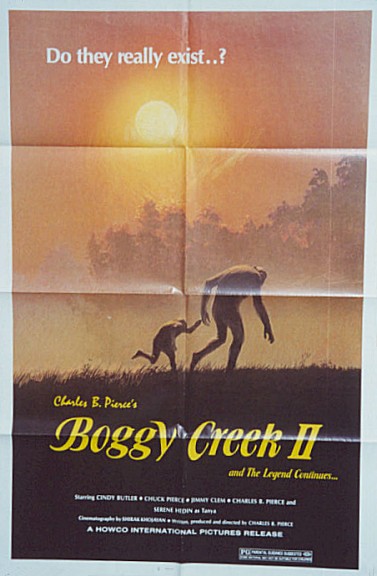
Although it is labeled part two, this film is actually the third in the series about the Boggy Creek Creature, a sorry attempt to build a horror franchise around an allegedly real Bigfoot-like monster that stalks the Arkansas wetlands. The plot this time around concerns a University of Arkansas researcher who takes some of his students into the wilderness to find the monster. Mostly he just relates incidents from the earlier movies, from which footage is taken to pad out the running time.
But this has the distinction of being probably the grossest movie you’ll ever see. There are lots of inbred hillbilly stereotypes, big hairy guys without much clothes, ugly people sweating profusely, and the piece de resistance — a hick so scared by the creature that he steps in his own diarrhea in the outhouse and has to have his wife hose him off. The Arkansas Tourism Board has their work cut out for them to counteract the effects of this movie.
Best Line:
“I’ve seen the little creature!”
Side Note:
Written, produced, directed and starring Charles B. Pierce, who made a string of low budget crap in the ’70s and early ’80s. Most of the films featured Jimmy Clem, the fat, ugly guy who plays Crenshaw in this movie.
Companion Viewing:
“The Legend of Boggy Creek” (1972), “Return to Boggy Creek (1977), “The Giant Spider Invasion” (1975) and “Squirm” (1976).
Links:
IMDb.
Some information on the Fouke Monster, the inspiration for the films.
Take a Look:
The trailer:
I Walked With a Zombie (1943).
The Scoop:
This is, quite simply, the greatest voodoo movie ever made. I realize that’s not saying much, given the consistently sorry state of the genre, but even if they weren’t all so bad, this film would stand out above the rest.
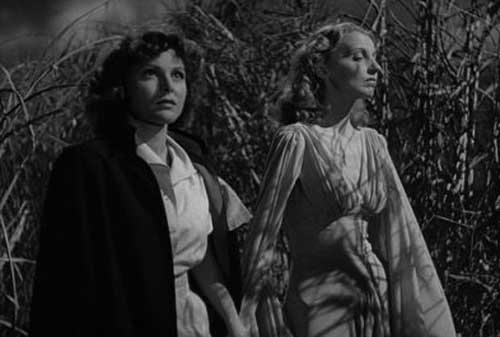
One of greatest triumphs of legendary producer Val Lewton and director Jacques Tourneur, the story follows Frances Dee as a nurse who travels to Haiti to care for the comatose wife of plantation owner Tom Conway. But the wife’s condition isn’t necessarily medically explainable, and the nurse turns to the local voodoo priest for help.
Lewton was a master at taking lurid b-movie fare and turning it into moody, exciting art. His best work came in a short stretch in World War II during his partnership Tourneur. The pair created a singular aesthetic that seemed to work every time out. “I Walked With a Zombie is a prime example — their trademark creepy atmospherics and a complicated love triangle highlight this classic — but “Cat People,” “The Ghost Ship” or “Bedlam” would work just as well. So just watch them all.
Best Bit:
The first walk across the cane fields.
Side Note:
Very, very loosely based on Charlotte Brontë’s novel “Jane Eyre.”
Companion Viewing:
“White Zombie” (1932), “Cat People” (1942) and “The Seventh Victim” (1943).
Links:
IMDb.
The screenplay.
Take a Look:
The trailer:
Roky Erickson’s classic (and much covered) tune, based on the movie:
Uncle Sam (1996).
 The Scoop:
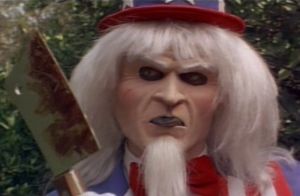
Celebrities can do embarrassing things when they’re down on their luck. So, before Robert Forster got a career boost from being in “Jackie Brown” and Isaac Hayes got one from being on “South Park,” they both starred in this slasher dreck.
Sam (David Shark Fralick), a Gulf War vet who is bitter because he was killed by friendly fire in Iraq (hey, who wouldn’t be?), returns from the dead on the Fourth of July to terrorize a generic Small Midwestern Town. Sam’s worshipful nephew must team up with Sam’s old army buddy Chef (er, I mean Jed, played by Hayes, who doesn’t even get to sing here) and a blind kid in a wheelchair to stop him. Forster is a politician of some sort who gets to die one of the most humiliating deaths in slasher-dom. Joining them on the humiliation train are Timothy Bottoms, P.J. Soles and Bo Hopkins.
The script by veteran schlockmeister Larry Cohen is not even up to his usual z-grade standards and the direction by William Lustig is just as bad. The effects are especially low-rent — in one shot, the strings are literally showing. Good for laughs, but not scares.
More interesting to me, though, is that “Uncle Sam” was shot almost entirely in my (adoptive) hometown of La Verne, California. Lots of films have been shot here over the years — almost all of them better — but none of them show quite as many recognizable locations as this one. All you La Vernians who read this blog should really check out the film so you can see plenty of Heritage Park, downtown (including exteriors of Warehouse Pizza) and some of the familiar houses along both D Street and Second Street.
Best Bit:
The unintentional comic relief of the blind wheelchair kid.
Side Note:
“Uncle Sam” pretty much put an end to future film production in La Verne. When the crew set off some major pyrotechnics at 2 a.m. one night on a residential street without informing anyone beforehand — resulting in lots of broken house windows and angry neighbors — the city council stopped granting film permits.
Companion Viewing:
“Jack Frost” (1997).
Links:
IMDb.
Eccentric Cinema.
All Things Zombie.
Take a Look:
The trailer:
 Desuko Movie Spot.