Hercules and the Captive Women (1961).
The Scoop:
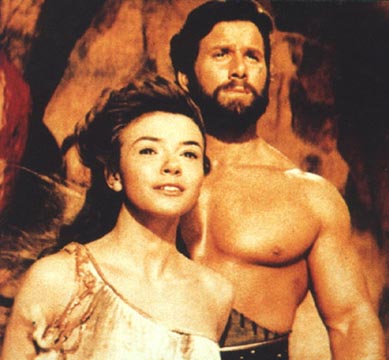
Herc is up to his usual shenanigans in yet another Italian muscle epic, the third entry in the “Hercules” series that Joseph E. Levine brought to America. Unfortunately, Steve Reeves isn’t around, so Hercules is played by Reg Park, who mostly sleepwalks through the role. Seriously, several important plot points rely on Hercules being asleep. And when he’s awake, he mostly just throws things and looks confused.
The title is somewhat misleading, since there’s only one captive woman and she doesn’t figure too much into the plot. Instead, the story concerns Hercules trying to overthrow an evil queen (played by Fay Spain) who is ruling the hidden island of Atlantis. All the Atlanteans worship the god Uranus, leading to plenty of unintentional crude humor in the dialogue.
This one is actually somewhat fun, if you don’t think about it too much.
Best Line:
“Uranus has abandoned us!”
Side Note:
This was the first of Park’s five films. He did two more as Hercules, and one each as Maciste and Ursus, a couple of Italian Hercules-knock off characters.
Companion Viewing:
“Hercules” (1958).
Links:
IMDb.
Eccentric Cinema.
Take a Look:
The trailer:
Watch the full film at the Internet Archive.
Dragnet (1954).

The Scoop:
Man, I love me some “Dragnet.”
After the success of his 1940s radio series and 1950s TV series, Jack Webb brought “Dragnet,” his life’s work, to the big screen in this enjoyable adaptation. The story, involving the investigation into a gangland murder, uses the luxury of its expanded budget and running time to offer much more detail about the nitty gritty of detective work and the legal process than the television series. But the hard-boiled, straight-as-an-arrow Boy Scout spirit makes the big screen leap intact, and it positively sizzles.
Ben Alexander reprises his role as Friday’s partner Frank Smith, while Webb also directs from a script by Richard L. Breen.
This was the first of three “Dragnet” feature films. It was followed first by a color film in 1966 that paired Webb with Harry Morgan and served as the springboard for the late ’60s TV series. And then came the 1987 entry starring Dan Aykroyd and Tom Hanks, which doesn’t even deserve to be considered part of the canon.
With excellent direction, the film captures some of the same mix of earnestness and cheesiness of the series, without being quite as camp as some of the 1960s TV series. Of course, by then the generation gap sparked by the counterculture was enough to make Webb’s brand of law and order seem downright outdated. But in this film, in its element, it’s still exciting stuff.
Best Bit:
Friday explains the deductions on his paycheck.
Side Note:
This was the first feature film ever spun off from TV show.
Companion Viewing:
The ’50s TV series.
Take a Look:
Friday and Smith lay the smack down:
Sgt. Friday gets his $20 worth:
Deep Impact (1998).
 The Scoop:
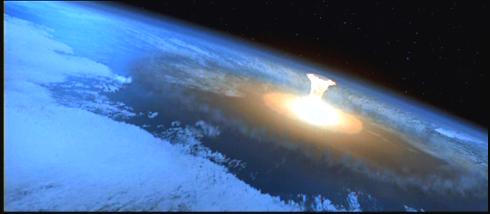
The less commercially successful of 1998’s two killer asteroid movies, this is the more creatively successful (not that “Armageddon” provided much competition in that area), creating what could be termed a kinder, gentler disaster movie.
Téa Leoni is an ambitious television reporter on the trail of a government cover-up, only to discover that the fact being covered up is the existence of a giant comet on a collision course with Earth, which the government is trying to destroy without alarming the public. The story gets out, though, with all the usual results.
Director Mimi Leder and writers Bruce Joel Rubin and Michael Tolkin shift the focus away from the pyrotechnics in favor of the human reactions to impending disaster (and a less-than-happy ending), creating a film that, though occasionally predictable, still manages to stand out among its genre. The cast is filled with solid actors, but the standouts include Robert Duvall as the gruff astronaut leading the comet destruction team; Morgan Freeman, lending his commanding presence to the role of the president; and Elijah Wood and Leelee Sobieski as the young amateur astronomer and his girlfriend who discover the asteroid.
Sure, “Deep Impact” is still a Big Dumb Blockbuster, but it is at least one with more heart than one would otherwise expect.
Best Line:
“Look on the bright side. We’ll all get high schools named after us.”
Side Note:
The scene of the president’s address to the world originally included the line, “This is not armageddon.” But that was cut out when the studio realized that the film would be in theaters around the same time as “Armageddon.”
Companion Viewing:
“Armageddon” (1998).
Links:
IMDb.
Disaster Movie World.
Take a Look:
The trailer:
BOOM! The money shot. (Spoilers!):
Turkey Day Marathon, Day 5: Red Zone Cuba (1966).
 One of the many fun things about the late, great “Mystery Science Theater 3000” was their annual all-day Turkey Day Marathons for Thanksgiving. Hour after hour after hour of bad movies — what’s not to love? So this year we’re doing a Desuko Turkey Day Marathon of our own — five days of Desuko reviews of movies that have been featured on MST3K. Here’s experiment #619, “Red Zone Cuba.” (Originally published Aug. 7, 2009):
The Scoop:
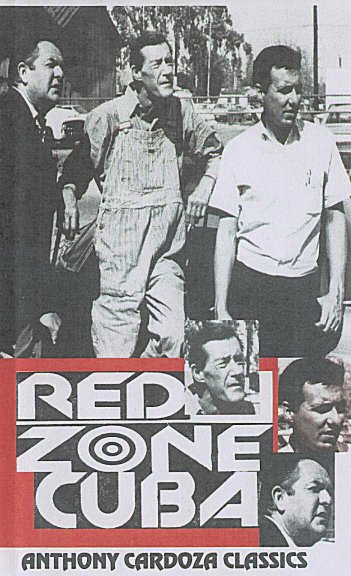
This is yet another Coleman Francis/Anthony Cardoza turd, only this time it is apparently Francis’ grand artistic statement.
Back in the ’60s and ’70s, just about anybody could get John Carradine to appear in their film for about the cost of a ham sandwich, so Francis apparently blew his budget on that, and then wasted the whole thing in the first two minutes of the movie. In the opening scene, Carradine turns up as a grizzled railway worker who is telling this story to a nondescript bystander. After this incredibly short day’s work, Carradine disappears from the movie forever, but not before croaking the horrendously awful theme song.
From there, the real story starts. An escaped convict (played by the auteur himself, who also wrote, directed, produced and edited this red-baiting debacle) gets mixed up with five or six revolutionaries who try to invade Cuba. After an excursion that makes the Bay of Pigs look like an epic triumph, our intrepid non-heroes get captured, and a couple of them try a semi-daring escape before getting hunted down by a half-hearted posse back in the States.
At least, that’s what the plot seems to indicate. Mostly, “Red Zone Cuba” just meanders from scene to scene, without much differentiation between one setting and the next. In fact, if this film is to be believed, Cuba is just a little town in the California desert. And I think the guy with the cigar and glued-on beard is supposed to be Fidel Castro.
Best Line:
“I’m Cherokee Jack!”
Side Note:
Apparently Cherokee Jack’s plane is still in use, and is currently being flown out of a small airport in Alaska.
Companion Viewing:
“The Beast of Yucca Flats” (1961) and “Invasion U.S.A.” (1952).
Links:
IMDb.
The Agony Booth.
Daddy-O’s Drive-In Dirt.
Take a Look:
Just try to be entertained. I dare you:
Red Zone Cuba: the first 5 minutes @ Yahoo! Video
The MST3K version:
Turkey Day Marathon, Day 4: Gamera vs. Barugon (1966).
One of the many fun things about the late, great “Mystery Science Theater 3000” was their annual all-day Turkey Day Marathons for Thanksgiving. Hour after hour after hour of bad movies — what’s not to love? So this year we’re doing a Desuko Turkey Day Marathon of our own — five days of Desuko reviews of movies that have been featured on MST3K. Here’s experiment #K04 and #304, “Gamera vs. Barugon.” (Originally published March 9, 2009):
 The Scoop:
The flying turtle madness continues!
Let’s move on to the second installment in the Gamera franchise, “Gamera vs. Barugon.” This time around not only is the action in color, but Gamera also makes the leap from nuclear-spawned menace to friendly protector of the Earth, just like Godzilla did in his series a decade earlier.
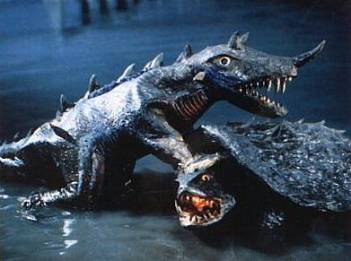
The bad guy role is filled by Barugon, a four-legged dinosaur/lizard/dog type thing who shoots a hilariously non-menacing rainbow ray from his back, and who can also freeze things with his tongue. Quite the odd combination, but trust me, this is one of least strange things we’ll see in this series.
Some treasure hunters set the plot in motion when they bring a giant opal back to civilization, only to discover that the opal is actually an egg. Pretty soon, out pops Barugon, who proceeds to stomp the crap out of the parts of Tokyo that hadn’t previously been stomped in the other kaiju movies. Finally, Gamera shows up to put the critter in his place.
On the human side we get the usual roles we’re used to seeing in these movies — committed scientist, bland girlfriend, rigid military brass, etc. They’re played ably enough by the likes of Kojiro Hondo, Kyoko Emani, Yuzo Hayakawa and Takuya Fujioka, but there’s really not much for them to do. Even Gamera doesn’t get much to do other than show up at the end to lay the smack down.
This is pretty much the Barugon show from start to finish, resulting in what is easily the most boring of the Gamera series.
Best Line:
“That monster destroys everything with his tongue!”
Side Note:
The original Japanese title is “Daikaiju Keto: Gamera tai Barugon” (literally translated, “Giant Monster Duel: Gamera Against Barugon”). When American International Pictures bought the film for U.S. distribution in the late 1960s, they cut 14 minutes of footage and retitled it “War of the Monsters.” In the 1980s, Sandy Frank secured the video distribution rights. He restored the missing footage, redubbed the dialogue and retitled the whole thing “Gamera vs. Barugon.” So which version should you see? Frankly, it doesn’t really matter since the missing footage is so yawn-inducing, it doesn’t actually detract from the movie. But it sure makes it go by quicker.
Companion Viewing:
Any other Gamera or Godzilla film you can get your hands on.
Links:
IMDb.
1,000 Misspent Hours.
The Shrine of Gamera.
Take a Look:
The opening titles:
The MST3K version (from their KTMA season):
 Desuko Movie Spot.