The Quiller Memorandum (1966).
 The Scoop:
The success of the new James Bond franchise kicked off a mad wave of spy movies in the 1960s, most of them trying to compete with 007’s swinging, lady-killing brand of cool.
Despite being a part of this flood of spy flicks, “The Quiller Memorandum” tries to set itself apart from the competition by ignoring the groovy vibe in favor of being a serious, realistic look at the world of international espionage. Unfortunately, that wasn’t the best choice. The result is a talky “thriller” (and I use the term loosely) that is notable mainly for being written by playwright Harold Pinter, who adapted it from the novel, “The Berlin Memorandum,” by Adam Hall (a.k.a. Elleston Trevor, a.k.a. Trevor Dudley Smith).
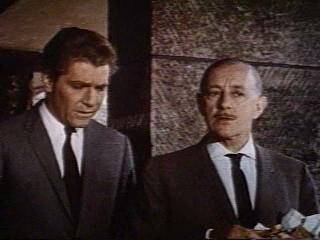
George Segal is unconvincing as an American secret agent working for the British who must go undercover to root out Nazis in Berlin. Senta Berger does a decent but unremarkable job as the obligatory femme fatale, and the aging George Sanders turns up as well. But the best performances come from Alec Guinness as the spy boss and Max von Sydow as the chief Nazi.
Director Michael Anderson doesn’t accomplish much with this film, but that’s not entirely his fault since he isn’t given much to work with. Besides Guinness and von Sydow, the biggest bright spot is the score by the always excellent John Barry.
With little action and almost none of the classic ’60s swinging, this is a bore for anyone but the most ardent spy movie fans. It packs all the excitement of… well, a memorandum.
Best Bit:
Quiller: “At the end of our conversation, he ordered them to kill me.”
Pol: “And did they?”
Side Note:
“The Quiller Memorandum” was meant to be the start of a Quiller film franchise, but it’s lack of commercial success made it dead on arrival. However, the character was resurrected for a short-lived BBC TV series starring Michael Jayston. There have been 19 novels, though.
Companion Viewing:
“Torn Curtain” (1966).
Links:
IMDb.
The Unofficial Quiller Web Site.
Take a Look:
The trailer:
Some of Barry’s score (and spoilers):
Sugar (2008).

The Scoop:
Baseball is king in the Dominican Republic. Of course, it is throughout Latin America. (In 2008, the year “Sugar” was made, Latin Americans accounted for more than 25 percent of all players in the major leagues.) But the Dominican tops the region as a baseball factory, producing more major leaguers than all other Latin nations combined. This unbelievably poor nation has produced some of the giants of the modern game, including Juan Marichal, Pedro Martinez, Albert Pujols, Manny Ramirez, Sammy Sosa and David Ortiz. Teenagers from the slums of San Pedro de Macoris to the rural sugarcane fields flock to baseball academies run by dozens of MLB teams or former players, hoping to catch the eyes of scouts and cash in on American baseball riches. But the road these players travel is a difficult one.
“Sugar” tells the story of one such player, Miguel “Sugar” Santos (Angelis Perez Soto), a serious, introspective 19-year-old pitcher who makes the journey from a Dominican baseball academy, to spring training, to the American minor leagues. Along the way, culture shock and the difficulties of competition make him begin to question his passion for the game. It’s a thoughtful, caring movie that tackles a subject not typically handled on film, and it does so with great sensitivity.
Soto’s range as an actor is pretty limited, but that serves the material well as he plays an introvert facing a strange culture and a huge language barrier. (Soto himself spoke very little English when he took the role.) Because Sugar’s journey takes him to so many destinations and introduces him to so many people, most of the other roles are little more than bit parts. But the standouts in those parts include Andre Holland as up-and-coming second baseman Brad Johnson, Michael Gaston as Sugar’s minor league manager Stu Sutton, and Jaime Tirelli as Osvaldo, the carpenter who gives Sugar a new father figure.
The storytelling here is top-notch. Writers/directors Ryan Fleck and Anna Boden give the film an understated documentary feel that makes its points with gentle subtlety. While some parts of the script fall victim to a kitchen sink approach that tries to throw in glimpses at all sorts of problems like racism, performance-enhancing drugs and agent graft, it mostly stays on target by focusing on Sugar’s loneliness and isolation as a stranger in America , as well as his struggles in throwing the spike curve.
In fact, it’s the little baseball details like the spike curve that give the movie one of its strength. It is written and directed with a firm understanding of the inside nuances of baseball, and all the actors, from the leads down to the extras, are current or former ballplayers who are doing it for real on camera. It’s a level of authentic on-field performance that is still pretty rare for baseball movies.
“Sugar” was made in 2008, but not released until 2009, when HBO Films sent it straight to DVD with barely any theatrical exposure outside of the festival circuit. That’s a shame, because this is a film that deserves to be seen.
Best Bit:
The Vic Power story.
Side Note:
The director of Sugar’s baseball academy in the Dominican is played by former major leaguer Jose Rijo, who pitched for 14 seasons for the Yankees, Athletics and Reds. After he retired, he went to work as a special assistant to Washington Nationals General Manager Jim Bowden and opened his own Dominican academy. In February 2009, after shooting his scenes for “Sugar” but before the film was released, he was fired by the Nationals after fraud was discovered among some of his player signings, and his academy was shut down. One week later, Bowden resigned following an FBI investigation into the skimming of bonus money paid to Latin American players.
Companion Viewing:
“Bull Durham” (1988).
Links:
IMDb.
Official site.
Cardboard Gods.
A history of baseball in the Dominican Republic.
How to throw the spike curve.
Take a Look:
The trailer:
Nine (2009).

The Scoop:
Rob Marshall tries to recapture some of the magic of “Chicago” with “Nine,” the film version of Arthur Kopit and Maury Yeston’s 1982 Broadway musical, but is ultimately sabotaged by the thin source material.
At the center of the story is Daniel Day-Lewis playing Guido Contini, a world famous Italian film director who deals with personal and professional crises by turning to the many women in his life. If that plot sounds familiar, that’s because it is swiped wholesale from Federico Fellini’s much better “8 1/2.”
The women who parade through Contini’s life and fantasies — each offering their brutally honest advice while belting out big musical numbers — are his wife (Marion Cotillard), mistress (Penélope Cruz), mother (Sophia Loren), leading lady (Nicole Kidman), costume designer/confidant (Judi Dench), fondly remembered first sex partner (Fergie) and a novice American reporter (Kate Hudson). Cotillard and Cruz really steal the show here (which isn’t hard to do against Day-Lewis’ mopey screen presence) and Dench has some nice moments as well. Kidman is bland, Hudson is out of her league, Fergie doesn’t do much but sing and dance (thankfully), and frankly I’m not sure how the glorious Loren got through this with a straight face.
The songs are fun but insubstantial, except for Cotillard’s great “Take It All,” which was written specifically for the film. However, Marshall, cinematographer Dion Beebe and choreographer John Deluca redeem even the weakest numbers with some energetic stagings.
But besides Cotillard and Cruz, the real stars of the show are art directors Simon Lamont, Peter Findley and Phil Harvey, and costume designer Colleen Atwood who create a vibrant, detailed and glamorous simulation of mod 1960s Rome. “Nine” may not have much going on under the surface, but thanks to them it’s wonderful to look at.
Best Bit:
Cotillard laying it all out for the Oscar-nominated “Take It All.”
Side Note:
Oddly enough, the play’s title song “Nine” was one of several musical numbers cut from the film.
Companion Viewing:
“8 1/2” (1963), if you want to see this sort of thing done right the first time.
Links:
IMDb.
Official site.
Take a Look:
The trailer:
“Take It All”:
The music video for Kate Hudson’s “Cinema Italiano”:
Catalina Caper (1967).
 The Scoop:
Get your flippy-floppies, people, because we’re going on a boat!
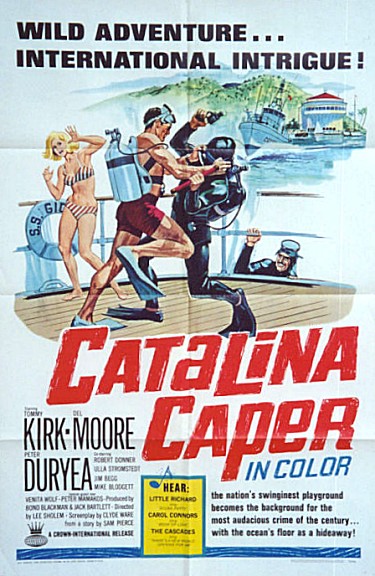
The 1960s was awash in “Beach Party” knockoffs, and “Catalina Caper” was one of the worst of the bunch. While on a sunny summer vacation to Catalina Island, a group of groovy teens stop an inept group of upper crust thieves who are trying to smuggle some sort of valuable scroll out of the local museum, while rocking out to the occasional musical guest star. The intentions here are good and the acting and filmmaking are technically competent, but the story is a sorry mishmash.
If you’re a B-movie fan, you find a lot of familiar faces here, including Tommy Kirk (“Mars Needs Women”), Del Moore (“Bachelor Father”), Jim Begg (“Village of the Giants”), Sue Casey (“Beach Girls and the Monster”), Michael Blodgett (“Beyond the Valley of the Dolls”) and even Wonder Woman’s” Lyle Wagonner. The musical numbers come courtesy of the Cascades, Carol Connors and the wildly out of place Little Richard.
These ’60s teens-in-the-sun movies are always a fun diversion and worth your time — even the ones with as many shortcomings as this one. It’s worth checking out, even for the unintentional laughs.
Best Line:
“Look! The water fuzz!”
Side Note:
The Cascades’ song “There’s a New World Just Opening For Me” was written by Ray Davies of the Kinks.
Companion Viewing:
“Beach Party” (1963).
Links:
IMDb.
Daddy-O’s Drive-In Dirt.
Take a Look:
Little Richard! On a boat! Singing about scuba diving! I know, right?
 Desuko Movie Spot.