House of the Long Shadows (1983).
 The Scoop:
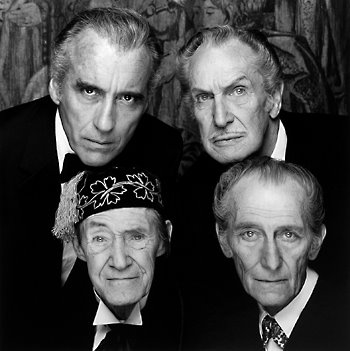
Director Pete Walker’s creaky old dark house thriller takes a long time to get going, and then doesn’t do much once it gets there. The best thing this film has to recommend it is the casting of veteran horror warhorses Vincent Price, Peter Cushing, Christopher Lee and John Carradine. The worst thing is Desi Arnaz Jr.
Best-selling novelist Kenneth Magee (Arnaz) accepts a bet from his publisher that he can’t write a gothic romance novel in 24 hours. To concentrate on the task, he travels to an abandoned manor in Wales where he figures he can get some peace and quiet. He doesn’t get much writing done, though, as he’s interrupted by his publisher’s secretary (Julie Peasgood). The youngsters then discover that they and a realtor who wants to buy the place (Lee) have stumbled onto a reunion of the aging family that owns the manor (Price, Cushing, Carradine and Sheila Keith) who have plenty of macabre secrets.
If the material seems ancient, even by 1980s standards, that’s because it is. Michael Armstrong’s script is based on the play “Seven Keys to Baldpate” by George M. Cohan, which opened on Broadway in 1913. The play, in turn, was based on an early novel by Earl Derr Biggers, who went on to create the Charlie Chan detective series. The story is a product of the early 20th century wave of old dark house thrillers, and it’s not one of the better examples of the genre. It’s filled with the sort of sub-Poe clichés that were rendered passé by the Second World War and finally killed by “Rocky Horror.” Walker and Armstrong try to dress up the film with a few nods toward the slasher trend of the early ’80s, but they seem horribly out of place.
The only reason to watch “House of the Long Shadows” is to see the legendary foursome of Price, Cushing, Lee and Carradine strut their stuff. They’re always a treat individually, and work well together. (In fact, this would be Cushing and Lee’s 26th and final screen pairing.) Arnaz is too lightweight to hold his own with these giants, and it’s unfortunate that far too much screen time is wasted on him and the other younger characters. And then there’s the pathetic twist ending(s), which you will probably see coming a mile away.
And it’s a shame because the film had so much promise. These legends of classic horror deserved so much better.
Best Line:
“Don’t interrupt my while I’m soliloquizing.”
Side Note:
Keith’s role was originally intended for another aging horror icon, Elsa Lanchester, but by then she was in her 80s and too ill to work.
Companion Viewing:
“Ghost Story” (1983) and “The Old Dark House” (1932).
Links:
IMDb.
Take a Look:
The trailer:
Dinner with the old folks:
Plan 9 From Outer Space (1959).

The Scoop:
“Plan 9 From Outer Space” is the piece de resistance of the Ed Wood ouevre. And if you think French words are a little too high-falutin’ to be used in talking about his movies, you’re probably right. But Wood’s distinctively idiosyncratic filmmaking voice also deserves another French label — auteur.
For the uninitiated (and you shouldn’t be — find a way to watch this if you can), here’s the movie in a nutshell. A small band of self-righteous aliens try to take over the Earth using reanimated corpses in an effort to stop humans from developing a weapon that could destroy the universe. It stars Gregory Walcott, Lyle Talbot, Tor Johnson, Vampira, Criswell and horror legend Bela Lugosi in his last role. (Lugosi’s part is actually taken from a couple reels of test footage Wood shot of him before Lugosi’s death, which Wood then tried to plot around.)
“Plan 9” is famous for being considered the worst movie ever made. But don’t believe that; it’s just the trendy choice. Sure, all the bad movie elements are there — ludicrous dialogue, wooden acting, pie plates on a string, the chiropractor pretending to be Lugosi — but there are plenty of films even worse. Start with “The Beast of Yucca Flats,” “The Creeping Terror” or “Robot Monster” and keeping digging; you’re bound to uncover many more.
But what separates “Plan 9” from them and keeps it from being a truly bad movie is that it’s just so much fun. It’s actually a joy to watch, which is something you can’t say about those others. Wood, for all his faults, had a flamboyant, out-sized personality that was contagious. All those working with him picked it up and together they brought that to the screen. Wood’s movies, particularly those made before his descent into alcoholism, have a bouncy, energetic spirit that easily compensates for whatever incompetence they might display. You find yourself laughing with them just as much as laughing at them, which is a rare feat.
And it’s that spirit that makes Wood’s body of work so worthy of rediscovery and examination. He’s certainly the king of the B-movie auteurs, more so than Coleman Francis, Ted V. Mikels or Fred Olen Ray. (Ray Dennis Steckler comes close, but that’s a topic for another post.)
There’s something distinctly American about Ed Wood’s inexhaustible self-esteem and can-do attitude. That’s why “Plan 9” deserves its place alongside “Citizen Kane,” “Midnight Cowboy” and other essential American movies. Believe it.
Best Bit:
Eros the alien explaining how stupid Earthlings are.
Side Note:
Lugosi supplied his own wardrobe for the test footage, wearing one of the same capes he wore 30 years earlier for his star-making performances in the stage version of “Dracula.”
Companion Viewing:
Tim Burton’s “Ed Wood” (1995) and the documentary “Ed Wood: Look Back in Angora” (1994).
Links:
IMDb.
Badmovies.org.
Rifftrax.
Take a Look:
The trailer:
The classic opening, featuring celebrity psychic hack Criswell:
Some highlights:
The Brothers Bloom (2008).

The Scoop:
“The Brothers Bloom,” from writer/director Rian Johnson, is the sort of overly self-conscious, overly quirky crime caper story that has dominated indie filmmaking since the 1990s. But after nearly 20 years, it’s hardly original anymore.
The Bloom brothers are Stephen (Mark Ruffalo) and Bloom (Adrien Brody), a pair of grifters who travel across Europe staging elaborate cons with the help of their mysterious accomplice Bang Bang (Rinko Kikuchi). Bloom has a bout of conscience and wants to get out of the racket. But Stephen pulls him back in to work one last con on eccentric American millionaire recluse Penelope (Rachel Weisz). However, their carefully crafted plans soon fall apart as Penelope turns out to be more than they can handle, and Bloom falls in love.
As you might guess from the blatant James Joyce references, this is a movie with artistic aspirations. But Johnson is no Joyce, of course, and his stabs at profundity just come off as pretentious.The tone swings wildly from quirky comedy to serious drama but never quite adds up to a cohesive whole.
The lone bright spot is Brody, who is excellent as always and is the only one in the cast to invest his role with any sort of three-dimensional vitality. Ruffalo and Weisz — two indie favorites who manage to get a lot of work with their solid but unremarkable performances — stay true to form with their solid but unremarkable work here. And then there are old warhorses Maximilian Schell and Robbie Coltrane, who are wasted in bit parts.
Johnson tries to sanctify the honesty that can come from lying as he constructs cons within cons, blurring the line between grifter and mark. But in the end it’s the audience that will feel like the biggest mark of all.
Best Bit:
Penelope gets off on the thunderstorm.
Side Note:
For the montage early in the film in which Penelope shows off her skills in playing various instruments, juggling, break dancing and riding a unicycle and skateboard, Weisz learned all of those skills specifically for that scene — which lasts less than five minutes.
Companion Viewing:
“Brick” (2005).
Links:
IMDb.
Official site.
Official tumblr site.
Take a Look:
The trailer:
The prologue:
Igor and the Lunatics (1985).
 The Scoop:
Oh, Troma…. Is there no pile of turd you can’t turn into a movie?
Actually, “Igor and the Lunatics” is a Troma film in distribution only. It was made by wannabe filmmakers Billy Parolini and Jocelyn Beard over the course of several years before it was bought by the Troma team, who created a “director’s cut” of the film (whatever that means) and released it.
The meandering, shambling plot about ’60s cult leader Paul (T.J. Michaels) who whips his acolytes into a frenzy and kills an escaping cult member with a big timber saw. They wind up in jail and 16 years later get released, only to start killing again. There are also a former cult member (Jospeh Eero) bent on vengeance , a feral teenage boy (Buddy Durrant), a pseudo-Indian guy called The Hawk (Peter Dain) and a dumb-as-rocks damsel in distress (Mary Ann Schacht). And then there’s Igor (Joe Niola), who is not the cult leader as the title might lead you to believe, but who really, really likes sharp objects.
Given all this background, I shouldn’t have to tell you that it’s terrible. Every aspect of the production, from the writing to the direction to the acting to the music to the gore effects, is clueless and incompetent. However, the sheer lunacy of it all does provide for some fun and unintentional hilarity. Niola in particular is insanely hammy, and probably the best part of the whole thing. “Igor and the Lunatics” is strictly sleazy and bottom of the barrel, and just right if you’re into that sort of thing.
Best Bit:
Paul: “Come to me, Sarah!”
Lackey: “Come to him, Sarah!”
Side Note:
T.J. Michaels is actually T.J. Glenn, who has gone on to a long career as an actor and stunt coordinator plenty of straight-to-video trash films like “Deadtime Stories,” “Lord of the G-Strings” and “The Bog Creatures.”
Companion Viewing:
“The Last House on the Left” (1977).
Links:
IMDb.
The ’80s Movie Rewind.
Take a Look:
The Tromariffic (i.e., NSFW) trailer:
Loudquietloud: A Film About the Pixies (2006).
The Scoop:
Every generation needs to have its brilliant band that implodes too soon. It may be due to personal animosities, drugs or even “creative differences.” But the story is usually the same. Earlier generations had the Beatles or The Clash. For my generation it was the Pixies.
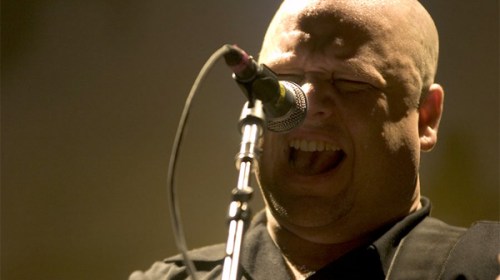
The band formed in Boston in 1986 and released five albums of brisk, minimalist, surf-inspired punk before the in-fighting got so bad that in 1992 vocalist/guitarist Charles “Black Francis” Thompson announced in the press that the band had broken up without bothering to tell his bandmates. In the years since, the band’s reputation has only grown as the four band members went their separate ways and never looked back. Of course, that just meant that there was still money to be made from their legacy, which made a reunion inevitable.
“Loudquietloud,” by documentary filmmakers Steven Cantor and Matthew Galkin, is the chronicle of that reunion, a 2004 tour through the U.S. and Europe. And to their credit, they don’t flinch in detailing the personal conflicts that led to the initial breakup, as well as the conflicts that continued on to the tour.
The film starts with the obligatory “where are they now” recap of everyone’s lives since they broke up. Thompson maintained a critically (though not necessarily commercially) successful solo career under the name of Frank Black and started a family. Bassist Kim Deal started a new band, the Breeders, with her twin sister Kelley, scoring a massive hit in 1993 with the song “Cannonball.” She struggled with alcohol abuse before getting clean in 2003. Guitarist Joey Santiago also started a family, while working as a producer and film composer. Drummer Dave Lovering eventually got out of music and was trying to make a living as a professional magician.
The foursome begins rehearsals full of excitement to be playing the old songs again. But as the grind of the tour wears on some of the old tensions resurface and they quickly settle into their four separate worlds when off-stage — Thompson working the promotional/press circuit, Deal meeting her rabid female fans while sharing a separate bus with her sister Kelley (who gets an associate producer credit on the film), Santiago struggling to finish a film score while keeping in touch with his wife and young kids via video chat, and Lovering wrapped in a cocoon of wine and his iPod. They remain cordial and friendly with each other on camera, but the awkward silences and side comments speak volumes.
But all that melts away on stage as the band rips through terrific renditions of all their best songs to sold out crowds at every stop. The contrast is dramatic and shows that the band still has some life in it yet. The result is a film that’s essential viewing for Pixies fans, as well as younger viewers who want to discover just what all the fuss is really about.
Best Bit:
Thompson trying to show Lovering a card trick. And failing.
Side Note:
The Pixies have continued to tour sporadically since 2004, but they have not recorded any new material together.
Companion Viewing:
“Instrument” (1998).
Links:
IMDb.
Official site.
The Documentary Blog.
Take a Look:
The trailer:
The opening:
“Something Against You”:
 Desuko Movie Spot.