The Mermaids of Tiburon (1962).
 The Scoop:
“The Mermaids of Tiburon” is just more forgettable drive-in filler from the early 1960s. In fact, if it weren’t for the steady stream stock footage, voice-over narration and unfortunate Mexican stereotypes, there wouldn’t even be a movie at all.
Not that it’s all bad; there are certainly many worse films from this same period. The use of actual Mexican locations is a nice change of pace from the usual cheap settings in the suburbs of Los Angeles, and writer/director John Lamb should get some points thinking up a story that’s a little different than the usual alien invasion fodder.
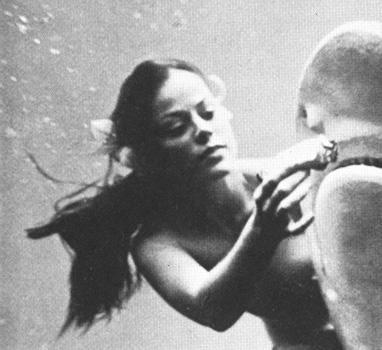
In the ocean around the island of Tiburon, off the coast of Mexico, studly marine biologist Samuel Jamison (George Rowe), following rumors of an uncatalogued new species, clashes with boozy pearl hunter/thief Milo Sangster (Timothy Carey) and his buffoonish lackey Pepe (Jose Gonzales-Gonzales, poor guy), only to discover a colony of mermaids, featuring the slinky former Playboy centerfold Diane Webber.
The plot is slow and plodding, only to wind up taking you exactly where you suspected it would. But at least watching a bevy of frolicking mermaids is certainly a lot more interesting than just another guy in a bad rubber suit.
Best Line:
“Just then the question came to me, how feminine was this creature… this mermaid, if that’s what she was?”
Side Notes:
1) After this film bombed in its initial release, Lamb edited in some new nudie footage of women cavorting topless underwater and released it under the title “The Aqua Sex.”
2) The real island of Tiburon is located in the Gulf of California, not far from Hermosillo, Sonora. It is the ancestral territory of members of the Seri Indian tribe, but today is an uninhabited wildlife preserve. Public access is not allowed without a permit from the Mexican government. (And no, there are no mermaids living there.)
Companion Viewing:
“War Gods of the Deep” (1965) and “Zaat” (1975).
Links:
IMDb.
FimFanatic.
Never Sea Land.
A tribute to Diane Warren.
Sonora Turismo.
Take a Look:
Some choice clips:
Godzilla vs. Space Godzilla (1994).
 The Scoop:
When done right, the films from Toho’s early-1990s Godzilla revival more than live up to the legacy of the first wave — better effects, but the same charm. Fortunately, this is one of the few that is done right.
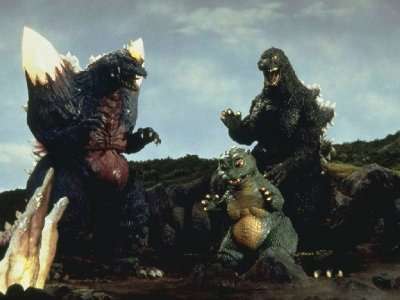
The story is generally beside the point with Godzilla films, but here it is anyway. A giant asteroid threatens Earth, so Mothra flies into space to destroy it and save the planet. However, through a really elaborate and ridiculous string of circumstances, this results in some of Godzilla’s DNA traveling through a black hole and becoming Space Godzilla. Naturally, S.G. (who looks just like Godzilla, except with crystals growing out of his back, and laser and flying powers) decided to head to Earth to confront the original himself. So, Godzilla teams up with Little Godzilla and a giant robot named Mogera to repel the invasion.
It’s still cheesy (just witness the scientist’s explanation of Space Godzilla’s origin), but the climatic fight scene is actually exciting. The plot winds up being pretty convoluted, but if you can shut that part of your brain off, “Godzilla vs. Space Godzilla” actually becomes fun. It’s easily one of my all-time favorite Godzilla films, despite the fact that the title is really pretty silly when you think about it.
Best Line:
“You know, too many stupid meetings can change a man’s destiny.”
Side Note:
The role of Mogera was originally intended for MechaGodzilla, but it got changed for reasons that haven’t been fully explained (nor really matter, probably).
Companion Viewing:
The old-school Godzilla films.
Links:
IMDb.
Million Monkey Theater.
The evolution of the Godzilla suit on History Vortex.
Take a Look:
Sci-fi special effects throwdown!:
Rise and shine!:
Marihuana (1936).
The Scoop:
Oh, the joys of the 1930s roadshow picture. Essentially highly moralistic propaganda films, these movies were produced by churches, family groups and other conservative organizations as a way to crusade against the evils of society. They tackled such topics as drug use and sexuality, and promoters sent them on tours around the country, where they played in church basements, American Legion halls, and sometimes in tents erected outside of town. This wonderful subgenre flourished in the Great Depression, particularly in rural areas of the U.S. that had few proper movie theaters. The movies — all dirt cheap, ham-handed productions with little professional talent — were popular not just with reform-minded civic leaders, but also with youngsters who wanted a look at the kind of subject matter that the production code had made taboo in mainstream Hollywood productions. Sermonizing and titillation lived side-by-side in these films, and the filmmakers knew which side their toast was buttered on. They often slipped in bits of nudity or other bits of exploitation alongside the moral edification to keep the crowds coming.
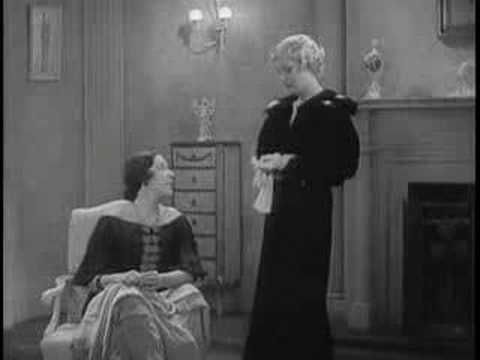
“Marihuana” (which also ran under the titles “The Devil’s Weed” and the clever “The Weed with Roots in Hell”) is a pretty typical example of the genre. The plot is pretty predictable and bargain basement — a bunch of 30-year-old teens bounce from odd house party to odd house party while a couple of greasy dealers keep the kids supplied with pot and booze. Eventually one drowns while skinny-dipping, one gets killed while smuggling drugs and one gets pregnant out of wedlock, which turns her into an immoral drug dealer. And its all delivered with the kind of low rent acting, writing and production values that make Ed Wood look like a genius.
“Marihuana” doesn’t quite hit the giddy heights of “Reefer Madness” (which is forever king of the genre), but it certainly does try, and you have to admire it for that. In fact, watching the film is kind of like being high — lots of activity passes in front of your eyes, but only makes intermittent sense, and cause and effect no longer have any meaning. It’s like 57 minutes of contact high. Rent it now for your next 4/20 movie marathon.
Best Bit:
The guy pissing at his barstool.
Side Note:
Companion Viewing:
“Reefer Madness” (1936) and “The Cocaine Fiends” (1935).
Links:
IMDb.
Internet Archive.
Take a Look:
The trailer:
The first 10 minutes:
Myra Breckinridge (1970).
 The Scoop:
The tagline for this film read, “Who is Myra Breckinridge?” But a better question might be, what is “Myra Breckinridge”?
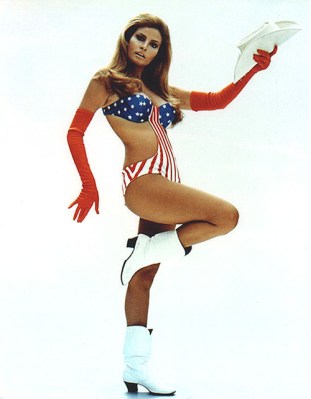
In short, this adaptation of the Gore Vidal novel is about an author (legendary film critic Rex Reed in a rare acting role) who becomes fed up with male dominance of American culture as perpetrated by Hollywood. So he undergoes gender reassignment surgery and becomes Myra Breckinridge (Raquel Welch), who sets out to bring down the male establishment wreaking havoc on the movie studio of his/her uncle (John Huston). She also gets to tangle with a horny talent agent/singer (Mae West, returning to the screen after a three decade absence) and an impressionable, up-and-coming starlet (Farrah Fawcett). To call it an odd product from a major Hollywood studio with front line talent is an understatement From its preachy philosophizing to its outre sexuality to its highly odd casting, “Myra Breckinridge” is an unmitigated disaster — but a highly entertaining one.
But to understand just what the hell is happening here, it’s important to understand the state Hollywood was in for a brief period at the end of the 1960s.
The old school studio moguls from Hollywood’s golden age were breathing their last dinosaur breaths at the same time that American society as a whole was undergoing unprecedented social change. The dismantling of the vertically integrated film business in the previous decade, plus the arrival of a new competitor in television, had left the older studio bosses trying to figure out to survive in an economic landscape they no longer quite understood. For a few years, the major studios had managed to completely ignore the social upheaval and counterculture movement sweeping the nation, until the runaway financial success of “Easy Rider” in 1969 meant they could no longer keep their heads in the sand.
Being completely clueless about how to reach a youth audience, the dinosaurs tackled the problem the only way they knew how — they threw money at it. So, for a stretch of about three or four short years, anyone with long hair, a little film school background and a big idea could walk into a studio executive’s office and walk out with a movie deal. This resulted in a few unconventional classics (like “Midnight Cowboy,” the only X-rated film to win a Best Picture Oscar, and titty flick auteur Russ Meyer’s only studio film, “Beyond the Valley of the Dolls”) but mostly a lot of oddball disasters (like Dennis Hopper’s drug-fueled money hole, “The Last Movie”).
Enter British wunderkind Michael Sarne, who had generated some buzz in Europe with his second film, 1968’s “Joanna.” Twentieth Century Fox decided that was resume enough and gave him the keys to the kingdom and turned him loose on the novel, which many critics considered unfilmable. Flush with studio money, an inflated sense of self-importance and a few pharmaceuticals, Sarne hacked and slashed his way through the source material, threw together a volatile mix of old Hollywood talent (West, Huston, John Carradine, Jim Backus) and free-thinking newcomers (Welch, Fawcett, Reed, Tom Selleck) to create an unintentional camp classic.
Sarne does bring in some nice visual touches and his use of old film clips as meta-commentary on the story is inspired and ahead of its time. And Welch is at her gung-ho best as Myra. But all that’s undercut by the chaotic storytelling and weird chemistry between the different generations of actors. (In fact, West and Welch hated each other so much that their scenes together had to be filmed separately and spliced together.)
But connoisseurs of trashy cinema will be rewarded with plenty here. Where else can you see aging plastic surgery disaster West tarnish her film legacy by lusting after 20-year-old hunks and warbling Otis Redding’s hit “Hard to Handle”? Or see Welch play a MTF transsexual who anally rapes a cowboy to the accompaniment of fireworks and patriotic music? Oh, and did I mention that Rex Reed sings?
Needless to say, after this brief free-for-all period, Hollywood finally came to its senses and began its evolution into the blockbuster driven juggernaut it is today. Fox managed to regain its footing enough to become the megasuccessful home of the “Star Wars” franchise, while Sarne never worked in Hollywood (and barely even worked in movies) again and Vidal spent the next 40 years of his life trashing them both. But together they left us a monument to a rare and fleeting moment in the history of the industry.
“Myra Breckinridge” is so far over the top that labels like “good” and “bad” no longer apply. All that matters is if it’s entertaining, and “Myra Breckinridge” is certainly sleazy, mind-blowing fun.
Best Bit:
The insanely ludicrous rape scene.
Side Note:
Several of the stars whose old film clips were used in the movie objected to the sexual nature of the story and some, including Loretta Young, Shirley Temple and Betty Grable, successfully sued to get their clips removed from the final print.
Companion Viewing:
Links:
IMDb.
The Agony Booth.
Take a Look:
The trailer:
Farah Fawcett makes her film debut:
In one of those special moments in movie history that are boon to people who like to play “six degrees” games, 77-year-old Mae West sexes up 25-year-old, un-mustachioed Tom Selleck:
And finally, there’s this. It starts off strange enough then enters the stratosphere at about 2:25:
Kung Fu Panda (2008).
The Scoop:
The animated feature revival of the last 15 years has been led by two prolific rival studios, Pixar and Dreamworks, who each take very different approaches to their work.
Pixar has taken a self-contained, original approach, while Dreamworks has found success being much more derivative. While Pixar does have the “Toy Story” franchise, the rest of its filmography features fresh stories with a focus on character and nuance. And as its exploration of animated storytelling has evolved, it has struck an inspired balance between kid-friendly entertainment and meditations on more complex, adult subject matter. (“WALL-E” and “Up” are particularly good films in that regard.)
Dreamworks, on the other hand, doesn’t have such high aspirations. While the filmmakers there are capable of some clever humor that can appeal to adults, their fare is aimed squarely at the children’s audience. They’re more sequel happy (witness four incarnations of “Shrek” and a couple of “Madagascar”) and TV spinoff happy. They also get more of their material from outside sources. (“Shrek” came from the William Steig book, “Over the Hedge” is a comic strip, and “Flushed Away” was produced outside of Dreamworks, by Nick Park’s Aardman Studios.) The stories are often uninspired and derivative too, as is the music — reworked versions of older Top 40 songs, while Pixar tends to opt for new tunes by Randy Newman and others.
So, Pixar seems to be the winner here.
Yet, Dreamworks has been known to hit the mark once in a while, mainly when it uses its biggest weakness — it’s derivativeness — as a strength. When the studio sticks to detailed parodies of specific genres, such as fairy tales with the first “Shrek” or 1950s B-grade sci-fi in “Monsters vs. Aliens,” it comes out a winner.
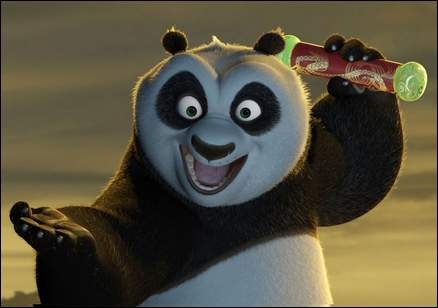
That’s what makes “Kung Fu Panda,” Dreamworks’ take on Hong Kong martial arts flicks, so wonderful.
In the Valley of Peace, clumsy panda Po (Jack Black) works at his father’s noodle shop and idolizes the Furious Five, renowned fighters from the local martial arts academy. When Po finds himself accidentally chosen as the school’s prophesied Dragon Warrior, who must defend the valley from an attack by evil former student Tai Lung (Ian McShane), the hijinks begin. There’s not much to the story, and there doesn’t need to be. The film is briskly paced and held together with good humor, a nice message about believing in oneself and some stunningly crafted action sequences.
In fact, the fight sequences are the highlight of the movie, drawing inspiration from several different styles of martial arts movies, from the traditional kung fu stylings of the Shaw Brothers to the intricate, balletic humor of Jackie Chan (who is also in the cast as Master Monkey, one of the Furious Five). These scenes — especially the fight on the rope bridge and the epic final battle — are not just loving tributes to their antecedents, but also take their place alongside them in quality.
The voice acting is well done and despite some of the big names on hand (including Dustin Hoffman, Angelina Jolie and Seth Rogen), the egos mostly stay out of the way of the story.
Now, if only Dreamworks could make every one of its movies this good…
Best Line:
“He was so deadly, in fact, that his enemies would go blind from over-exposure to pure awesomeness!”
Side Note:
Tai Lung is named after Shaw Brothers leading man Lung Ti.
Companion Viewing:
“Monsters vs. Aliens” (2009) and “Project A” (1983).
Links:
IMDb.
Official Site.
Take a Look:
The trailer:
The great, stylized opening:
In true Dreamworks fashion, an faddish 1970s hit is adopted as the movie’s theme song:
 Desuko Movie Spot.