The Mystery of the Leaping Fish (1916).
 The Scoop:
Movies have been around long enough now that the artifacts from their early days now seem like postcards from some strange, alien land. It’s not just the clothes and language that are so different, but also a lot of the assumptions and creative decisions which seem so odd in light of everything that has happened in the past century.
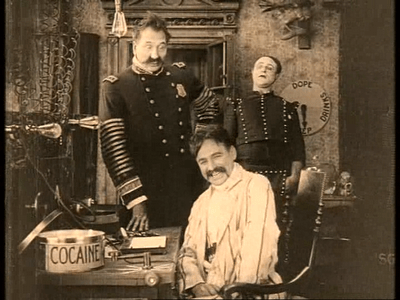
For example, there’s “The Mystery of the Leaping Fish.” This comedy short stars early action hero Douglas Fairbanks as an eccentric “scientific detective” named Coke Ennyday. And, yes, he’s named that for a reason — he shoots smack on a regular basis to give him the “pep” to solve his cases. He’s sort of an extreme parody of Sherlock Holmes.
In this case, he has to track down an opium smuggler (A.D. Sears) at a seaside resort, where he also falls for a beautiful employee (Bessie Love) whose job is to blow up the resort’s inflatable water toys (the “leaping fish” of the title) which are being used to hide the drugs. The story — courtesy of two other soon-to-be legends, Tod Browning and Anita Loos — is pretty slight and the sight gags are tepid at best. Of course, it wouldn’t be a Fairbanks film without his trademark swashbuckling and derring-do, but even that is pretty mild compared to his better, later films. Instead, the movie gets by mostly on its bizarre premise, which affords us a glimpse of the strange, strange world of yesteryear.
Best Bit:
The completely ridiculous twist ending.
Side Note:
This is a product of the short-lived Triangle Film Corporation, a studio founded by three of the industry’s top directors — D.W. Griffith, Thomas Ince and Mack Sennett — as a creative utopia away from commercial, product-driven mentality of the other studios of the time. (Imagine a slightly more naive version of Dreamworks.) Despite producing some classics of the silent era — such as Griffith’s epic “Intolerance” and Sennett’s Keystone Kops shorts, plus memorable films from Mary Pickford, Lilian Gish and Fatty Arbukle — the studio was financial mess and went under in less than four years. It was eventually bought by Samuel Goldwyn and became one of the building blocks of his MGM empire.
Companion Viewing:
“The Ghost of Slumber Mountain” (1918) and “Zero Effect” (1998).
Links:
IMDb.
Only the Cinema.
Take a Look:
The entire film is available at the Internet Archive.
Josie and the Pussycats (2001).
The Scoop:
The classic 1970s cartoon gets a turn-of-the-century update from Deborah Kaplan and Harry Elfont, and you know what? It’s not half bad. However, most of the show’s original mystery solving premise gets jettisoned in favor of a three-fun-chicks-hit-the-big-time storyline. While it’s simply a matter of trading in one cliché for another, it’s a trade that lets the filmmakers indulge in a little social commentary along with their fun.
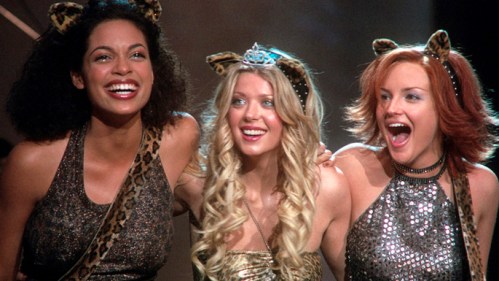
The Pussycats — Josie (Rachel Leigh Cook), Val (Rosario Dawson) and Melody (Tara Reid) — are just another spunky little band trying to make a go of it in Riverdale until they get found by an unscrupulous manager (Alan Cumming) and a megalomaniac music mogul (Parker Posey). The two execs are trying to control the youth of America by planting subliminal consumer messages in pop songs and after they eliminate their insubordinate boy band Dujour, they need a new front. So they scoop up the girls and whisk them away to the Big City along with their pals — skunk-haired Alexandra (Missi Pyle), her clotheshorse brother Alexander (Paolo Costanzo) and Josie’s sensitive singer-songwriter crush Alan M. (Gabriel Mann). There are ups and downs, trials and tribulations, plenty of products placement spoofs and a terrific cameo scene with Carson Daly and Aries Spears. Finally, good conquers evil and Josie gets her boy.
The script hits all the usual notes you’ve come to expect in a light road-to-stardom flick, but “Josie and the Pussycats” mixes them with a strong message about thinking independently and not giving in to our consumer culture. This is entertainment aimed squarely at tweens, so both the dramatic conflicts and social commentary are painted in pretty broad strokes. But it’s a message that’s important for youngsters to hear, and it’s a damn sight more rewarding that anything like “Hannah Montana” or “Big Time Rush.”
The film was released nearly a decade ago, which is an eternity in the pop culture universe. That means a lot of its parodies of specific personalities and products (and there are plenty) may fly over the heads of today’s tween viewers. But let your kids see it anyway. Not only does it have a good message, but they just might have some fun with it too.
Best Line:
“Whatcha sayin’, man? That a brother can’t be Carson Daly?”
Side Note:
Cook, Dawson and Reid learned to play their own instruments for the soundtrack, although Cook’s vocals are dubbed by Kay Hanley, the lead singer of Letters to Cleo.
Companion Viewing:
“Spice World” (1997) and “Beyond the Valley of the Dolls” (1970).
Links:
IMDb.
Official site.
Take a Look:
The trailer:
The video for “Three Small Words.” Just look at all that fresh-faced energy:
Dujour sings “Back Door Lover” (presented by Target):
Inglourious Basterds (2009).
The Scoop:
America is an angry country. Passions are running high in just about every public debate these days, with hate-filled rhetoric coming from all across the political spectrum. And that anger is always threatening to bubble over into physical violence at a moment’s notice. But that shouldn’t be so surprising since violence has always been such an integral part of the American identity. (Carving a society out of the wilderness while conquering the rightful natives will do that to a nation.)
It also shouldn’t be too surprising that the natural expression of this anger and confusion at the state of the world is vigilantism. And as they have before, filmmakers are dipping into this zeitgeist to bring us another wave of vigilante movies, from “Taken” to “Kick Ass” to the forthcoming “Machete.” Even the Brits have gotten into the act with “Harry Brown.” But leave it to Hollywood’s reigning poet of violence, Quentin Tarantino, to project our national vigilante anger backward onto one of the worst injustices in human history.
“Inglourious Basterds” is a loud, ultra violent revenge fantasy undertaken on behalf of all the Jews victimized by the Holocaust, as well as the rest of Europe trampled under the Nazis’ boot heels during World War II. But the question is, what does all this righteous violence get us?
The film begins with a terrifically riveting sequence in which steely Gestapo officer Col. Landa (played with conniving brilliance by Academy Award winner Christoph Waltz) plays a tense cat-and-mouse game with a French farmer (Denis Menochet) whom he suspects of harboring a fugitive Jewish family.
Talk about starting your film off with a bang. The tension is slow, luxurious and crackling, showcasing not just the great performances by Waltz and Menochet, but also cinematic maturity of writer/director Tarantino. He created the sequence with a steady hand, especially given that all of the dialogue is in French and German, who languages which he does not speak. It was arguably the high point of 2009 in film.
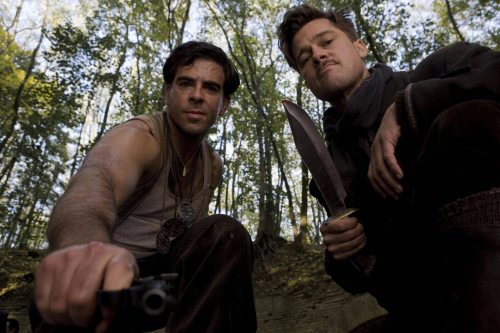
From such a great beginning, “Inglourious Basterds” takes off on a roller coaster ride from one well-constructed set piece to the next. We meet Lt. Aldo Raine (an over-the-top Brad Pitt) and his Basterds (including Eli Roth, Daniel Brühl, Til Schweiger and others), a unit composed mainly of Jews who conduct Apache-inspired raids deep into enemy territory, killing Nazis and collecting their scalps. They eventually receive a mission to rendezvous with a glamorous double agent (Diane Kruger) and hatch an audacious plan to assassinate Adolph Hitler at a movie premiere. Meanwhile, the theater owner (the very glorious Mélanie Laurent), who happens to be the survivor of Landa’s earlier farmhouse raid, has plans of her own to take down Der Führer. These storylines converge in a powerfully explosive finale.
This is Tarantino’s most mature, most assured film to date. He juggles the large ensemble cast of mostly European unknowns (who speak four languages onscreen) with aplomb, constructs elaborate and gripping set pieces, and even weaves in his extensive knowledge of mid-century European film. He proves that he’s more than just a recycler of old exploitation genres (not that there’s anything wrong with that) and that’s he’s fully capable of making sophisticated suspense thrillers in the Hitchcock mold.
Tarantino is also a frightfully original screenwriter, completely rewriting history for what is essentially a juvenile revenge fantasy. And here is where the problem with “Inglourious Basterds” lies. Sure, it feels good to vicariously strike back and maim and kill the oppressors who murdered millions of innocents. (Nazis, along with zombies, are the last PC-safe villains left in fiction.) But what does it accomplish, especially when it is translated into the real world?
For decades the Jewish community has been able to maintain the moral high ground with peaceful Holocaust remembrances that speak to the power of nonviolent resistance against hatred and racism. But Aldo Raine and his men aren’t exactly disciples of Gandhi and Dr. King, and they certainly aren’t troubled by the tragic consequences implied by King’s famous aphorism that “an eye for an eye leaves everyone blind.” “Inglourious Basterds” has struck a chord with many audiences, particularly young Jews, who find satisfaction in a response to past injustices that goes beyond simple peaceful rhetoric.
But these are dangerous times, and history has shown over and over again that violence just begets more violence. And no matter how much fun this film is — and believe me, it is — or how skillfully Tarantino wields the power of cinema, the lure of violence can never overcome the strength of peace and love.
Best Bit:
That tense opener. A fantastic movie in itself.
Side Note:
The role of Sgt. Donny “The Bear Jew” Donowitz, played so memorably by horror film director Roth, was originally offered to Adam Sandler.
Companion Viewing:
“The Dirty Dozen” (1967) and “Reservoir Dogs” (1992).
Links:
IMDb.
Official site.
Take a Look:
The trailer:
A German wants to die for his country:
A little love for the clapper:
The Source (1999).
The Scoop:
This celebration of the Beats is not so much a documentary as a cinematic mash note, but even non-fans will find this an intriguing history lesson and literary excursion.
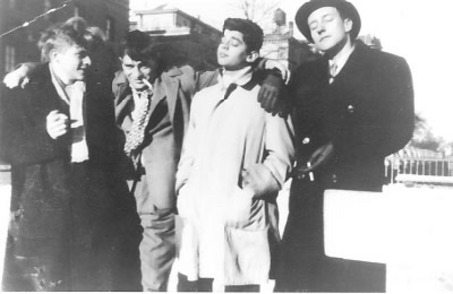
Filmmaker Chuck Workman focuses on the three usual suspects (Jack Kerouac, Allen Ginsberg and William S. Burroughs), interspersing archival footage with interviews and readings by Johnny Depp (as Kerouac), John Turturro (Ginsberg) and Dennis Hopper (Burroughs). Discussion of their work is liberally mixed with discussion of their friendship and personal lives, as well as loving tributes from a whole host of famous admirers, like Jerry Garcia, Philip Glass, Timothy Leary and Ken Kesey. It’s a great big hipster bebop lovefest.
“The Source” is not objective by any documentary standards, but a wonderful tribute to the personalities behind this landmark literary movement. The film is a valuable resource to anyone wanting to understand the Beats, but not as valuable as reading their work itself. Go read “On the Road,” “Howl” or “The Naked Lunch,” then go out and start your own revolution.
Best Line:
“He’s the first person I met who, he himself, was the art.” (Garcia describing Kerouac’s muse, Neal Cassady.)
Side Note:
Workman has also produced and directed documentaries about Andy Warhol, Martin Luther King, John F. Kennedy and the Three Stooges.
Companion Viewing:
“Naked Lunch” (1995) and “The Last Time I Committed Suicide” (1996).
Take a Look:
Depp as Kerouac:
Turturro reads “Howl”:
The Beats light the fuse of the ’60s counterculture explosion (plus the deaths of Cassady and Kerouac, all with Japanese subtitles):
 Desuko Movie Spot.