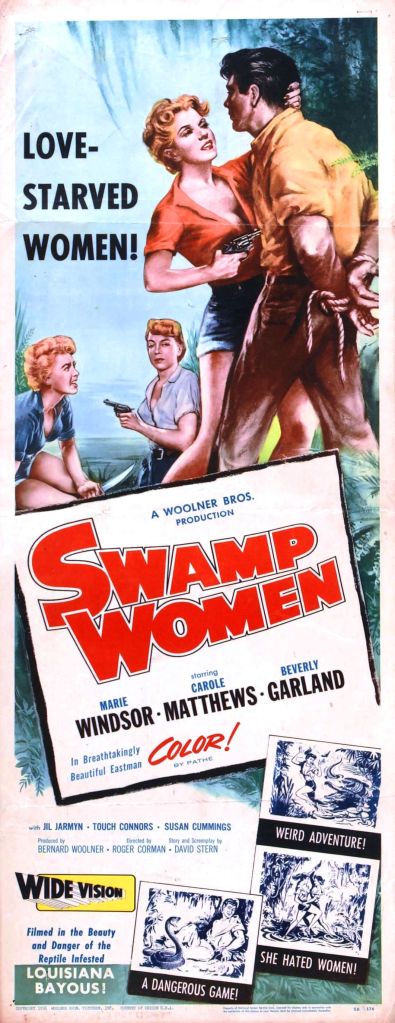
Swamp Women (a.k.a., Swamp Diamonds) (1955).
 The Scoop:
A guy gets stuck in the swamp with five beautiful women in pastel shirts and hair. It sounds like a dream come true, except that one of the women is his ineffectual girlfriend and the rest are escaped prisoners who are trying to recover a hidden stash of diamonds. As if that’s not enough right there, it turns out that one of the prisoners is an undercover cop who infiltrated the gang in prison in order to find out where they hid the diamonds. Tempers flare, faces get slapped and it all ends pretty badly.
Director Roger Corman’s minimal plot taps into the women-in-prison vibe he would go on to perfect in his 1970s work, with plenty of overheated passion, catfights and short-shorts. And the cast of familiar faces — including Marie Windsor, Beverly Garland, Mike “Touch” Connors of “Mannix” and a host of Corman regulars — rises to the challenge, throwing themselves into the material. (And the brackish water.) But of course, since this is Corman, he has to take this strong core and pad it out extensively with B-roll footage of Mardi Gras and the Louisiana Bayou.
And so a potentially strong idea turns into an endurance test, albeit at campy one. Still, at times it’s one of the more fun early Corman flicks. You could do much worse, I suppose.
Best Line:
“I’m gonna louse ’em all up!”
Side Note:
If the melodramatic pickpocket at the beginning looks familiar, that’s because he’s played by Corman regular Jonathon Haze, who whose best role came in “The Little Shop of Horrors” (1960).
Companion Viewing:
“The Big Bird Cage” (1972).
Links:
IMDb.
1,000 Misspent Hours.
Ryan Watches 50 Movies.
Take a Look:
It’s a slappy, punchy good time!
The daring prison escape:
Frankenstein Must Be Destroyed (1969).
The Scoop:
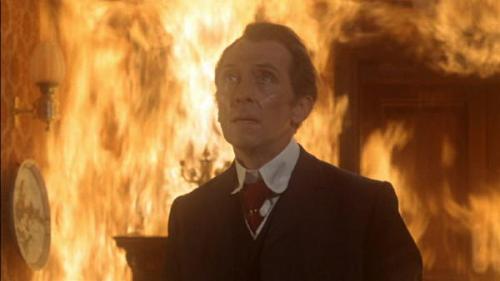
This fifth entry in Hammer’s Frankenstein series is among the studio’s strongest work, but also one of its bleakest films. All the familiar trademarks are here — atmospherics, tension, lurid color and heaving bosoms — but they are mixed with a mean spiritedness that is unusual, even for the evil doctor.
Peter Cushing returns as Baron Frankenstein, still traveling the countryside and trying to stay one step ahead of the authorities as he continues his grisly medical research. While seeking out former brain transplantation research partner Dr. Brandt (George Pravda), Frankenstein finds him going mad in an insane asylum. The Baron then blackmails a young medical student (Simon Ward) and his fiancee (Veronica Carlson) into helping him to spring Dr. Brandt, only to have the whole thing spin predictably out of control.
Cushing gives another typically fine performance that is powerfully icy and seemingly effortless. Director Terence Fisher and writer Bert Batt also do tight, solid work to maintain the suspense throughout. However, they infuse the story with a darkness that is practically nihilistic.
Frankenstein’s habitual evil is now infused with a casual cruelty that not only destroys those around him, but does so for reasons that go beyond his single minded pursuit of forbidden medical knowledge. It is no longer enough to just hurt and kill people because they stand in the way of his research. This time around he also does it just because he can. By the end of the film, the body count is positively Shakespearean, and there’s even a completely unnecessary rape scene that serves no function to the central plot.
No wonder he must be destroyed.
It’s not often that a film series still has something worthwhile to say in its fifth time around the block. But “Frankenstein Must Be Destroyed” not only manages to be the best of the Frankenstein series, but also arguably one of the best Hammer films, period.
Best Bit:
Dr. Brandt’s gripping reunion with his wife.
Side Note:
The rape scene was added at the last minute, just before the film wrapped, because studio head Sir James Carreras wanted to sex up the film a bit. Cushing objected, but shot the scene anyway, and then apologized to Carlson immediately afterward.
Companion Viewing:
“The Curse of Frankenstein” (1957).
Links:
IMDb.
Dictionary of Hammer Horror.
Take a Look:
The trailer:
The opening sequence:
Yellow Submarine (1968).
The Scoop:
Love, love, love…
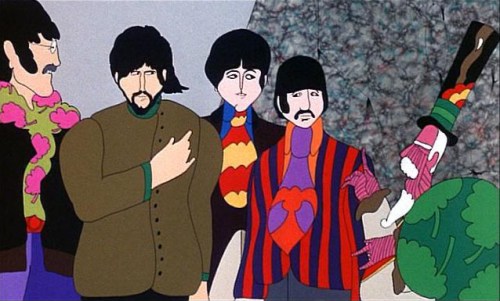
It’s more than just the chorus of a Beatles song; it was also the overriding philosophy of their short recording career. And, of course, it pervades “Yellow Submarine” — a film designed as just another product of the Fab Four’s marketing machine, but which transcends it despite featuring almost no contributions from John, Paul, George and Ringo themselves.
Al Brodax, who produced the Beatles’ Saturday morning cartoon series, approached the band members about making an animated feature film, but they were resistant because they hated the show. However, they also wanted out of their movie contract with United Artists, to whom they still owed one more film, and Brodax’s proposal was just the ticket. So the Beatles gave Brodax four new songs (actually unused outtakes from the “Sgt. Pepper’s” sessions) and permission to use selections from their back catalogue, and sent him on his way.
Thus left to their own devices while the band traveled to India, Brodax, director George Dunning and a small team of voice actors and writers (including “Love Story” novelist Erich Segal) created a fun adventure that turns the rare trick of being entertaining for both children and adults and not feeling dated, even more than 40 years later.
When the peaceful, music loving citizens of Pepperland are attacked by the vicious Blue Meanies, sea captain Old Fred escapes in the Yellow Submarine and seeks out the Beatles, the only band that can save Pepperland. On their long journey, the boys have various adventures, sing several Beatles favorites and even meet a Nowhere Man. When they finally make it to Pepperland, they team up with their local doppelgangers, Sgt. Pepper’s Lonely Hearts Club Band, to free the citizens and win over the Blue Meanies through the power of music and love.
Besides the four original songs (“It’s All Too Much,” “Hey Bulldog,” “All Together Now” and “Only a Northern Song”) the soundtrack includes “All You Need is Love,” “Nowhere Man,” many of the songs from the “Sgt. Pepper’s” album and, of course, the title track. The animation is supple and vibrant, drawing inspiration from the best pop art of the late 1960s, but executing it in a way that’s timeless. The script is a gas, too, capturing the Beatles ethos with the kind of fast-paced wit and clever allusions that reward repeat viewing.
And the thread that weaves through it all is love. This is Love with a capital L, the idealistic brand of love that embraces everyone. In fact, the main message of the film is the importance of loving even one’s enemies — a message that is all too rare today.
Best Line:
Paul: “I think it’s Beatle-proof.” / John: “Nothing is Beatle-proof!”
Side Note:
Peter Batten, who voiced George, was a deserter from the British army and was arrested while the film was in production. His part was finished by Paul Angelis, who also voiced Ringo and the Chief Blue Meanie.
Companion Viewing:
“Magical Mystery Tour” (1967).
Links:
IMDb.
Take a Look:
“Yellow Submarine”:
“Lucy in the Sky With Diamonds”:
Monsters Crash the Pajama Party (1965).
The Scoop:
This 30-minute trifle comes to us from the golden age of ballyhoo. There was a time in the early 1960s when theaters could draw in customers (mostly teenagers) with traveling “spook show” spectaculars, featuring innocuous horror-themed films, a gimmick or two, actors in costume, some audience participation and plenty of “spine-tingling” hype.
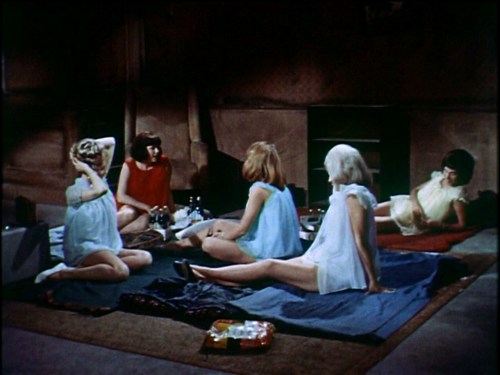
“Monsters Crash the Pajama Party,” from writer/director David L. Hewitt, is a classic example. Five sorority girls decide to spend a night in the local spooky old house, only to be teased by their boyfriends, then chased around by a mad doctor, a guy in a gorilla suit and a couple of other ghouls. Although the material is presented with tongue planted firmly in cheek, the writing is clunky, the humor is forced and the acting is completely amateurish.
But all that’s beside the point. What matters is the film’s role in the spook show as a whole, which provided a fun and cheesy — even, dare I say, wholesome — evening of entertainment for a predominately young audience. This was especially true in the rural parts of the United States where entertainment options at that time were pretty limited. While the movies were part of the draw, there were also live acts by the costumed entertainers and opportunites — and encouragement — for the audience to talk back and interact. While the spook show trend didn’t last too long, its spirit was revived in a more risqué fashion by midnight movie audiences in the 1970s as they created the live performance cult that surrounds “The Rocky Horror Picture Show.”
But spook shows have disappeared from the cultural landscape, leaving us with a film that can no longer be seen in context. It’s kind of sad, really. “Monsters Crash the Pajama Party” can be fun to laugh at as just another bad movie, and although it is available on DVD now with a host of other shorts and extras so that you can create your own campy spook show evening at home, it just isn’t the same. Instead it has just become another postcard from a bygone era that we can’t properly experience — albeit one that does give a certain amount of fun of its own.
Best Line:
“Igor like red!”
Side Note:
Hewitt went on to a modest career in visual effects. His credits include “Superman IV: The Quest for Peace” and “Honey, I Shrunk the Kids.”
Companion Viewing:
A “Rocky Horror” midnight show. But be sure to dress up!
Links:
IMDb.
Mania.
Eccentric Cinema.
Take a Look:
A trailer:
Slaves in Bondage (1937).
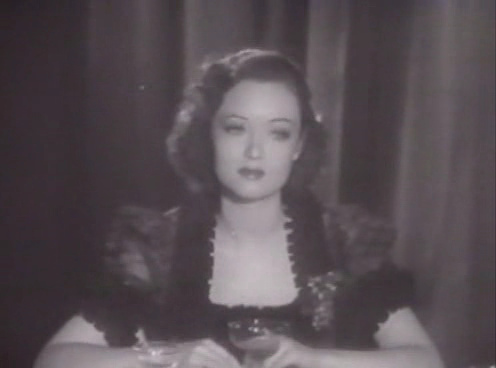
The Scoop:
It’s more road show exploitation madness in this clunky cautionary tale about naive young country girls who are lured into prostitution in the big city. As is typical, the title makes it sound a whole lot more lurid than it really is, but it does have it’s moments.
At the center of the story are a pretty manicurist (Lona Andre) and her aspiring reporter boyfriend (Donald Reed) who find their tepid courtship inconvenienced by the leaders of a sex trafficking ring (Wheeler Oakman and Florence Dudley). Things work out exactly as you’d expect they would, but not before some mild lingerie-clad titillation that’s far tamer than usual for the genre. The film starts out slow, but picks up steam as it goes along, eventually turning brisk, weird and campy. It actually winds up being quite fun, although not nearly as operatically absurd as “Reefer Madness.”
Perhaps that’s because, unlike many of the anti-drug exploitationers, the core issue here isn’t quite as wildly misrepresented. Although it may look strange to see it portrayed like this in an American setting, this type of racket isn’t that much different than the human trafficking operations that are still at work across many Third World countries today. It’s a reminder that, beneath all the unintentional laughs, there are serious issues that these cheapo films were intended to tackle.
Best Bit:
The odd vaudeville acrobatic act.
Side Note:
The fan dancer is played by Suzanna Kim, who also appeared in the classic “The Good Earth” in the same year she shot “Slaves in Bondage.”
Companion Viewing:
“Reefer Madness” (1936) and “Sex Madness” (1938).
Links:
IMDb.
HumanTrafficking.org.
Take a Look:
The full film is available for free online via the Internet Archive.
 Desuko Movie Spot.