It’s summer vacation time here at Desuko World HQ, which means it’s time to revisit some favorite reviews from the past. [Originally posted June 30, 2009.]
 The Scoop:
If you haven’t become acquainted with Larry “Wild Man” Fischer, this is an excellent opportunity to do so.
Fischer was born with the double whammy of manic depression and paranoid schizophrenia, but buried inside that troubled mind is a strongly melodic musical sensibility. After an adolescence filled with family troubles and a stay in a mental institution, Larry found himself on the streets of Hollywood in the mid-1960s, where he survived by offering his songs – frenzied, a cappella outbursts of childlike enthusiasm mixed with the pathos of his life story – to passersby for a dime. He was found and befriended by Frank Zappa, who helped corral Fischer’s chaotic musical (and personal) energy for his memorable, if not always listenable, 1968 debut album, “An Evening With Larry ‘Wild Man’ Fischer.” After falling out with Zappa, the Wild Man continued his music career through partnerships with Rhino Records and Barnes & Barnes, punctuated by troubled interpersonal relationships and a growing cult of fans.
This documentary, by Josh Rubin and Jeremy Lubin, covers all this rich history, following the 60-year-old Fischer through his transient daily life as he tells stories, makes up songs, spins his paranoid theories and occasionally acts out. There are also revealing interviews with Wild Man acquaintances and fans, such as Mark Mothersbaugh, Billy Mumy and Robert Haimer of Barnes & Barnes, Dr. Demento, Weird Al Yankovic, Irwin Chusid and Gail Zappa.
Listening to Fischer’s music can be a difficult experience. Even those songs with professional backing sound raw, primal and disturbing. But they can also be fun and catchy; once you get one in your head, you’ll be humming it for days.
And therein lies the trouble, not just in considering Fischer, but also other mentally ill songwriters like Daniel Johnston, Roky Erickson or Wesley Willis. How much are fans and collaborators supporting the efforts of talented (although troubled) musicians, or how much are they simply exploiting the talents of people who can’t otherwise look out for themselves? And how much of their musical talent is merely a manifestation of untreated mental illness?
These are questions with no easy answers, and ones which Rubin and Lubin mostly choose to ignore. “Derailroaded” is a fascinating look at the inner workings of a talented, but very difficult man. But any insights into the larger questions will have to wait for another time.
Best Bit:
Wild Man’s two performances of the title song. When he sings it on the beach at the beginning of the film, it comes off as just a fun, catchy little earworm. But when we see him do it again in concert near the end, it becomes something more, a desperate cry of pain from someone who has no tools to articulate it properly.
Side Note:
Because of his split with Zappa (allegedly prompted by Fischer throwing a glass bottle at then-infant Moon Unit), his debut album has not been re-released on any format since 1968. If you want to hear it, you have to either spend big bucks on eBay, or hunt it down on a torrent site.
Companion Viewing:
“The Devil and Daniel Johnston” (2005) and “You’re Gonna Miss Me” (2005).
Links:
IMDb.
Official site.
eFilmCritic interview.
The Wild Man discography.
Take a Look:
The strange four-way conspiracy between Wild Man, Weird Al, Dr. Demento and Barnes & Barnes, that exists only in Larry’s mind:
“Merry Go Round,” Fischer’s biggest hit:
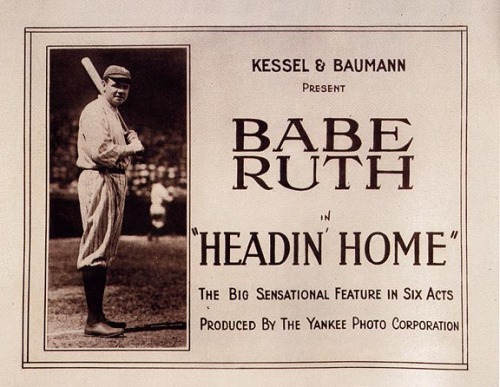
Summer Rerun: Headin’ Home (1920).
It’s summer vacation time here at Desuko World HQ, which means it’s time to revisit some favorite reviews from the past. Since today marks the return of the midsummer classic, Major League Baseball’s All-Star Game, here’s a film starring baseball’s all-time all-star. [Originally posted Oct. 9, 2007.]
The Scoop:
Terrific vintage baseball footage highlights this film, which was designed as a vehicle to showcase the New York Yankees’ newest slugger, Babe Ruth.
Ruth was the first great media superstar in the world of sports, becoming a household name as much for his appetites (for food, booze and women, not necessarily in that order) as for the way he single-handedly changed the face of baseball. And “Headin’ Home” marked the start of this. It was his film debut (he plays himself, a role he would return to often) and purports to tell the story of his rise from a mispent youth in Haverlock, Maryland, to the baseball superstardom.
The scenes that bookend the movie are authentic, shot at actual Yankees games in the old Polo Grounds (their home before Yankee Stadium opened) and are a real treat for fans of baseball history.
Of course, the story that comes in between is more fanciful than factual. We’re treated to scenes of Ruth carving his own bats from trees he chopped down, saving little girls’ beloved pets from the evil dogcatcher, and rescuing damsels in distress. But the film catches him at his youthful best — slim and full of energy, not the broken down older Babe we would see is his later, better known films and newsreel footage.
However, through all the trite silent comedy shenanigans and slow second half, Ruth’s larger-than-life personality shines through and it is that, along with the game footage, that makes “Headin’ Home” worth a look.
Best Bit:
The dog-in-the-meat-grinder dream sequence. Eep!
Side Note:
The Babe’s love interest is played by Ruth Taylor, who would later become the mother of writer/comedian/actor Buck Henry.
Companion Viewing:
“The Babe Ruth Story” (1948) and “The Natural” (1984).
Links:
IMDb.
Silents are Golden.
Take a Look:
This clip strings together scenes from several silent baseball films, but the first features the Babe hitting his big home run in “Headin’ Home”:
Summer Rerun: The Mask (1961).
It’s summer vacation time here at Desuko World HQ, which means it’s time to revisit some favorite reviews from the past. [Originally posted March 18, 2008.]
The Scoop:
No, this isn’t that Jim Carrey flick, although the plots are vaguely similar. You can tell the difference because this one doesn’t have a dog, any intentional humor or a co-star as ferociously shagadelic as Cameron Diaz.
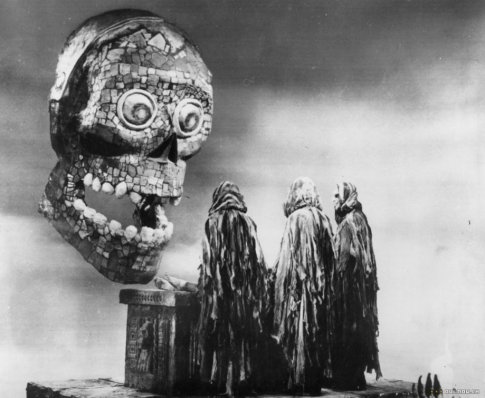
In this version, a psychologist (played by Paul Stevens) acquires an ancient African mask from an unbalanced patient who has just killed himself. The mask exerts some strange power over the dopey doctor, and when the off-screen narrator starts urging him to put the mask on, he can hardly resist. Every time the mask is on, the doc (along with the audience) is whisked away into 3-D hallucinations full of cheap costumes and bad interpretive dance, after which he usually kills someone (just like the audience wishes it could).
It’s a ballyhoo gimmick, of course, from the golden age of the practice. When the narrator says “Put on the mask,” he isn’t just speaking (however improbably) to the main character. He’s also speaking to the people in the audience, urging them to put on their own masks — the 3-D glasses they got as they walked into the theater.
“The Mask” is entertaining in a so-horrible-its-fun sort of way. The 3-D sequences are definitely the highlights and still play well, even if you don’t have the 3-D glasses to watch them as they were meant to be seen. They transform this hopelessly generic Canadian film into sometime totally memorable.
Best Line:
You’ll hear it so much, you can’t resist: “Put the mask on!”
Side Note:
Not only is this the first homegrown Canadian 3-D movie, it’s also the nation’s first homegrown horror movie and the first to get widespread distribution in the United States.
Companion Viewing:
“The Mask” (1994) and, in an oddly fitting way, “Laserblast” (1978).
Links:
IMDb.
CBC.ca’s Alternative Canadian Walk of Fame.
Take a Look:
The trailer:
Summer Rerun: Scooby Doo: The Mystery Begins (2009).
It’s summer vacation time here at Desuko World HQ, which means it’s time to revisit some favorite reviews from the past. [Originally posted Nov. 3, 2009.]
 The Scoop:
So why waste your time on this? What’s the point of bothering with a made-for-cable, third generation live action adaptation of a hack cartoon, which is squarely aimed at tweens? Really, why bother?
Well, it turns out that this disposable entertainment has a thing or two to recommend it.
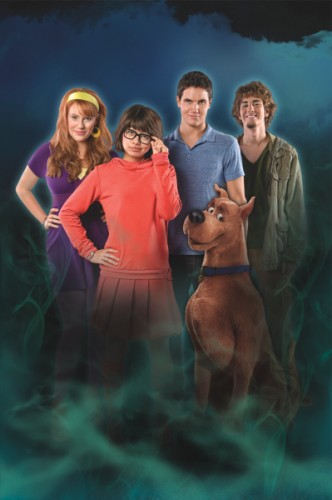
A Cartoon Network original, “The Mystery Begins” is the third live action version of “Scooby Doo,” following two big budget big screen stinkers. It’s a prequel, telling the story of how the gang got together at Coolsville High School and solved their first mystery together.
Unadoptable shelter dog Scooby (voiced by Frank Welker) accidentally gets sprung from his cage and runs off in search of someone who’ll take him in. He wanders through a cemetery at night, where he sees two ghosts rising from their graves. In a panic, he runs right through the basement bedroom window of high school burnout Shaggy (Nick Palatas) who naturally takes a liking to him and tries to sneak him into school the next day in human clothes. This winds up causing a free-for-all in the school bus, which eventually lands Shaggy in detention with football team captain Fred (Robbie Amell), drama club diva Daphne (Kate Melton) and brainy geek Velma (Hayley Kiyoko). Of course, the ghosts pick that exact time to disrupt the school pep rally, and the chase is on.
The “mystery” is just as paper-thin as you’d expect, both from a “Scooby Doo” story and a tween movie. But it’s the small, fresh details that keep this from being a complete waste.
Most intriguing is the dynamic between the four kids which — not only because it grows out of detention hall, but also because of the way it develops the relationships between members of four different high school social cliques – owes a big debt to “The Breakfast Club.” It’s actually handled quite well for tween fluff, and the cast nails it with gusto. This is where the real story is, not in the formulaic ghost hunting shenanigans.
The interesting upshot of this is that it makes the title character almost entirely irrelevant in his own movie. Unfortunately, director Brian Levant and writers Daniel Altiere and Steven Altiere try to compensate for this by making Scooby completely obnoxious, thrusting him into all sorts of situations where he isn’t needed, and making him the vehicle of lots of sophomoric, unfunny humor. That’s all bad enough, but to top it all off, the CGI work on Scooby is atrocious.
There are also some obligatory details, like the origins of the Mystery Machine (which is pretty much what you’d expect) and Scooby Snacks (which is actually a nice little twist). And Shaggy’s status as a flat-out stoner is hinted at even more strongly than before (but because this is still ostensibly children’s entertainment, he still can’t be shown for what he really is).
However, some entertaining new wrinkles are added. Like the fact that Shaggy is a few years older than the others and, thanks to being held back in school so much, is basically an adult still attending high school. Or the casting of Velma as an Asian.
However the biggest departure from the “Scooby” mythos is that the ghosts are actual undead spirits, and not mere mechanical tricks. But don’t feel too disoriented – the villain behind those vengeful spirits is straight out of the Hanna-Barbera playbook and even gets to deliver the signature “meddling kids” line after his capture. Because there are some classics you just don’t want to mess with.
Best Bit:
The gang’s ridiculously over-the-top undercover disguises — Daphne as a goth, Fred in hip hop gear (think Brian Austin Green), Velma as a hot chick, and Shaggy and Scooby as trash cans.
Side Note:
Welker is a veteran cartoon voice actor who has been working steadily since the 1960s. His roles include most of the Decepticons in the original “Transformers” series and numerous roles in “Tiny Toon Adventures” and “Animaniacs” — not to mention playing Fred in the original “Scooby Doo” series.
Companion Viewing:
The original Hanna Barbera cartoons from the early 1970s.
Links:
IMDb.
Official site.
Take a Look:
The trailer:
Hayley Kiyoko’s video blog, made during production:
The Unearthly (1957).
Note: With this post, Desuko summer vacation starts! That’s means it’s summer rerun time again, but don’t worry — I’ll try to dig up some old gems you might have missed the first time around.
The Scoop:
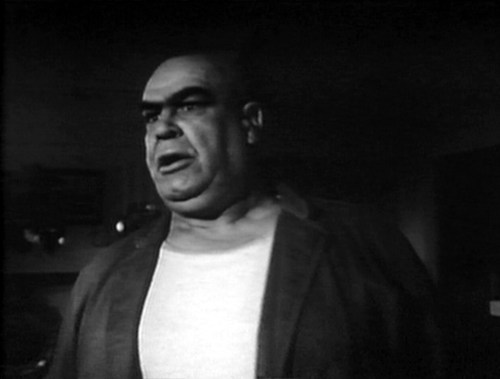
Was there ever a less talented movie star (and I use that latter term loosely) than Tor Johnson? This former professional wrestler from Sweden couldn’t do much besides stand around and look menacing, which is why that was all that was asked of him in most of his films. Although he bounced around in uncredited bit parts in Hollywood for nearly 20 years, his career didn’t take off until he was discovered by that notorious hack Ed Wood, who elevated him to a supporting actor in several of his films. But the extra work didn’t do anything to improve his acting chops. By all accounts a nice guy, he still was still pretty inept.
And if you want to see that ineptitude in full bloom, “The Unearthly” (along with the legendarily awful “Plan 9 From Outer Space”) is the place to turn. His distinctiveness as an actor rested solely on the fact that he was very, very big and very, very dumb. “The Unearthly” is one of those rare vehicles in which Tor is actually given lines to deliver, and with that privilege he reaches heights of stupidity you thought only cartoon characters were capable of.
The plot concerns the exploits of the typical 1950s low-rent mad scientist (played by B-movie staple John Carradine), who is trying to take over the world by creating mutants in his basement. In a very intuitive bit of casting, Tor is one of the mutants. A passing detective (Myron Healey) infiltrates the house and brings down the scientist. The 50-foot woman herself, Allison Hayes, is along for the ride, as are former Miss America Marilyn Buferd and Playboy playmate Sally Todd.
The whole thing is inept and slightly insane. In other words, it’s the perfect vehicle for Tor to work his magic.
Best Line:
Tor gives the signal for lights out — “Time for go to bed!”
Side Note:
Like so many other Tor Johnson creations, this character is also named Lobo.
Companion Viewing:
“Plan 9 From Outer Space” (1959) and “The Beast of Yucca Flats” (1961).
Links:
IMDb.
Monster Movie Music.
Take a Look:
The trailer:
 Desuko Movie Spot.