Robot Jox (1990).
The Scoop:
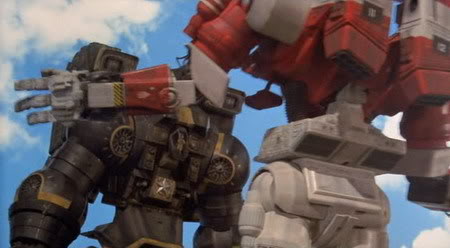
In the distant future, 50 years after a nuclear holocaust, war is outlawed and all territorial disputes between the two great global superpowers are decided by man-to-man combat between soldiers in giant mechanical suits, called “robot jocks.”
It’s just the sort of under-budgeted claptrap that producers Charles and Albert Band built they careers on, and the film manages to be somewhat entertaining despite its rather significant limitations.
During a match for control of Alaska, the champion of the Russian-ish Confederation, Alexander (Paul Koslo), uses an illegal weapon that nearly kills a group of spectators. The champion for the American-ish side, Achilles (Gary Graham), tries to save them, but winds up killing them anyway. This prompts a crisis of conscience for him as he prepares for his rematch with Alexander. Meanwhile, a young hot shot (Anne-Marie Johnson) tries to challenge Achilles’ position as the top jock, and his coach (Michael Alldredge) and weapons designer (Danny Kamekona) get tangled up in the search for a spy in their midst.

Slap fight!
Yet for all this sound and fury, not much seems to happen, aside from silly robot tricks. (Crotch-mounted chainsaws, anyone?) Fight, exposition, some yelling, another fight, more exposition, more yelling. And repeat. It’s all handled somewhat clumsily, with silly dialogue, bad stop motion animation during the robot fight sequences, and the sort of Cold War theatrics we’ve come to expect from cheap 1980s action movies.
Screenwriter Joe Haldeman and director Stuart Gordon reportedly locked horns throughout production over their visions of the story. Haldeman wanted to tell a serious, cautionary sci-fi story while Gordon wanted to create something more kid-friendly. The result is an odd mishmash of simplistic kids’ fare mixed with some darker elements.
In short, it’s the perfect brain candy for late night cable TV.
Best Line:
There are a lot of howlers here, but it’s hard not to keep quoting the jocks’ good luck mantra, “Crash and burn!”
Side Note:
“Robot Jox” is film that finally killed off the Bands’ prolific production company, Empire Pictures. The father and son team of Albert and Charles Band found success in the 1980s with cheapie productions like “Ghoulies,” “Re-Animator” and “Sorority Babes in the Slimeball Bowl-O-Rama,” which became cult hits with the emergence of the home video market. “Robot Jox” was the company’s more expensive production to date, and during filming the lira collapsed in Italy, where the Empire was headquartered. The unfinished film sat on the shelf for two years before Epic Productions bought it from the bankrupt Empire and finished and released it.
After the dust cleared, Empire would continue to exist for a few more years, mainly distributing the occasional European film for the U.S. video market. Meanwhile, Charles Band would land on his feet, forming the new company Full Moon Entertainment, responsible for such 1990s video fare as “Subspecies,” “Puppetmaster,” “Oblivion” and a host of related sequels.
Companion Viewing:
“Rocky IV” (1985), “Rollerball” (1976) and “Starship Troopers” (1997).
Links:
IMDb.
Stomp Tokyo.
1,000 Misspent Hours.
The Unknown Movies.
Take a Look:
The trailer:
Fight!
A whole bunch of the silly bits, all in one clip. (Spoilers!):
Walk Hard: The Dewey Cox Story (2007).
 The Scoop:
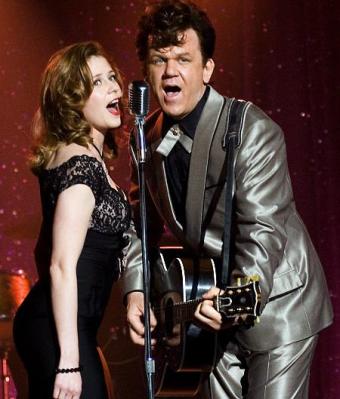
Dewey Cox is a slightly dim, hard scrabble poet of the American experience, who rises from poverty and tragedy to become an outlaw musical hero despite his battles with drugs and his temper.
And in telling Dewey’s story in “Walk Hard,” John C. Reilly, Jake Kasdan and Judd Apatow have created pitch-perfect parody the conventional Oscar bait biopic.
The obvious inspiration here is Johnny Cash, and Kasdan and Apatow borrow liberally from his biography for material for their script. What’s more, Kasdan (who also directs) adopts and parodies the look and style of James Mangold’s 2005 Cash biopic “Walk the Line” to great effect.
It’s also wonderful to see perennial sidekick Reilly step out and carry his own movie. It’s obvious that he’s got the comedy chops to be a big star, but what wasn’t obvious before “Walk Hard” is the quality of his musical chops as well.
Music is an important part of Kasdan and Apatow’s storytelling process here. The film’s soundtrack, produced by Marshall Crenshaw, is superb, crossing genres from country to rockabilly to folk to disco to hip hop. And not only does Reilly perform all his own vocals, but he also plays guitar on most of the tracks and participated heavily in the songwriting process.
Besides Reilly, the cast is filled with familiar faces — including Jenna Fisher (“The Office”), Harold Ramis (“Ghsotbusters”), Kristen Wiig and Tim Meadows (“Saturday Night Live”), as well as Apatow regulars like Ed Helms and Jonah Hill — all of whom give nice performances.
The humor, often more subtle than you might expect from Apatow, is uneven, particularly in the early scenes. But the film quickly settles into a groove that delivers consistent laughs and culminates in the obligatory big concert number (“Beautiful Ride”) that shows the genuine heart at the core of the film. Thanks to Reilly, Kasdan and Apatow, it’s a beautiful ride indeed.
Best Bit:
The scene in which Dewey goes to India to meet the Beatles, played in uncredited cameos by Jack Black (Paul), Paul Rudd (John), Justin Long (George) and Jason Schwartzman (Ringo). The bickering between the Fab Four was largely improvised and the DVD includes an extended cut of the scene which is actually funnier than what wound up in the movie.
Side Note:
Companion Viewing:
“Walk the Line” (2005).
Links:
IMDb.
Official site.
Take a Look:
The trailer:
The title song:
Dewey meets the Beatles:
“Let’s Duet”:
Summer Rerun: Let’s Twist Again Like We Did Last Summer.
It’s summer vacation time here at Desuko World HQ, which means it’s time to revisit some favorite reviews from the past. This is the last of the summer reruns, so let’s go out with a bang. Look for new posts to return next week. [Originally posted May 8, 2007.]
*****
The last post about “Don’t Knock the Rock” got me thinking about it’s knock-off, “Don’t Knock the Twist.” That, in turn, brought up all the rest of that wave of Twist movies, so here’s your introduction to four of them.
Twist Around the Clock (1961).
 The Scoop:
After Chubby Checker’s success with “The Twist,” there was a movement afoot in the early ’60s to establish the Twist as separate musical genre to itself. Never mind the fact the music sounded identical to rock ‘n’ roll and that all the lyrics were about the Twist and nothing else — obviously, this was an effort doomed to failure. Still, that didn’t stop Hollywood from making a wave of Twist movies to cash in on the burgeoning craze. The first was, appropriately enough, “Twist Around the Clock,” which (as the title would suggest) is a remake of the pioneering rock ‘n’ roll film “Rock Around the Clock.” Only this time, instead of rock ‘n’ roll supplanting sentimental big band music, this features Checker trying to get the Twist to supplant rock ‘n’ roll. A severe miscalculation, although it is fun to see Dion and the Belmonts on hand to do a couple of their big hits, “The Wanderer” and “Runaround Sue.”
Best Bit:
The line of kids sandpapering their shoes.
Side Note:
The screenplay credit went to “Rock Around the Clock” screenwriter James B. Gordon (real name, Robert E. Kent), because the producers essentially used the same script, only changing a few Twist-related details here and there.
Companion Viewing:
“Rock Around the Clock” (1956).
Links:
IMDb.
Take a Look:
Tom Funk gets the gang rockin’:
Hey, Let’s Twist! (1962).
The Scoop:
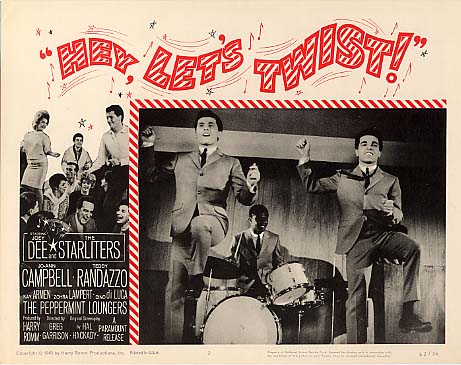
Devised as a star-making vehicle for Joey Dee and the Starliters and to capitalized on their hit “The Peppermint Twist,” “Hey, Let’s Twist!” tells the story behind the opening of New York’s famed Peppermint Lounge. Like any true Twist movie, it’s underwritten and poorly acted, but at least the music is entertaining. What sets it apart from the other Twist movies, though, is the sheer Noo Yawk Italian-ness of it. The non-musical scenes come off like G-rated Scorcese, and the fleeting presence of Joe Pesci (in his film debut) only reinforces that.
Best Bit:
The Starliters’ performance of “Shout.”
Side Note:
Joey Dee’s still working the nostalgia circuit — he’s even available to play your event!
Companion Viewing:
Oddly enough, “Mean Streets” (1973).
Links:
IMDb.
Take a Look:
Joey Dee and the Starlighters do the title track:
The Continental Twist (a.k.a., Twist All Night) (1961).
The Scoop:
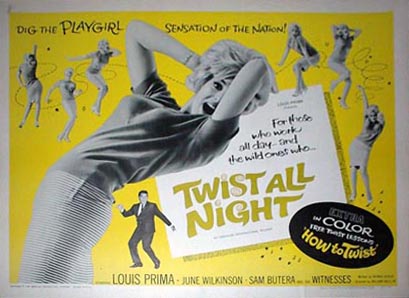
A momentary diversion in the Twist movie cycle, this one barely even features the dance. Instead, the wonderful (although very un-Twist-like and un-rock-like) Louis Prima fights to save his night club from a greedy art forger. The plot really doesn’t matter. All that matters is Prima’s incredible music, performed along with Sam Butera and the Witnesses. Watch it for that alone.
Best Line:
“Oui! Le Twist!!
Side Note:
Originally released with a 9-minute color prologue called “Twist Craze” directed by Allan David.
Companion Viewing:
“Hey Boy! Hey Girl! (1959).
Links:
IMDB.
Take a Look:
A smattering of clips:
Don’t Knock the Twist (1962).
The Scoop:
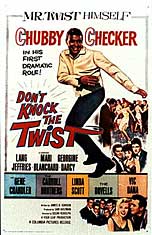 Oh, the strange, strange world of the Twist movies. It’s an alternate universe where Chubby Checker is revered as a demi-god, and where every aspect of culture is revitalized by hip youth with a special Twist flair — there is Twist music, Twist dance, Twist cuisine and Twist sociology. In this particular movie, the focus is on Twist fashion. It’s not immediately discernible how the Twist clothes on display here are different than regular clothes of the period, but they are. The filmmakers insist that they are. There’s also a plot about a TV producer having to stage a “Twist Spectacular” to save an orphanage and restore his discredited girlfriend’s good name. Odd.
Best Bit:
Vic Dana’s creepy song “Little Altar Boy.”
Side Note:
Our old screenwriting pal Robert E. Kent is back, not only writing the script, but also many of the lyrics for the Twist songs in the movie.
Companion Viewing:
Any other Twist movie you can find.
Links:
IMDb.
Take a Look:
Checker and Dee Dee Sharp perform “Slow Twistin'”:
Summer Rerun: The Godmonster of Indian Flats (1973).
It’s summer vacation time here at Desuko World HQ, which means it’s time to revisit some favorite reviews from the past. [Originally posted Feb . 13, 2007.]
 The Scoop:
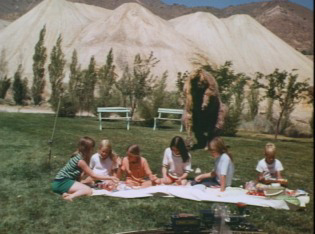
This lovely confection has it all. A dorky Basque sheep herder goes to Reno and wins a fortune at the slots, only to have it stolen by a brazen hussy. An eccentric millionaire bankrolls an authentic recreation of an Old West mining town. A phoney psychic makes predictions based upon channeling the spirits of dead miners. The entire town makes believe a dog is dead and holds an elaborate funeral. An unscrupulous real estate developer almost gets lynched. And then just when you think the madness is getting to be too much, a giant mutant sheeps descends on the town and puts an end to it all. At least you hope it’s the end, but it’s not — the film then takes a detour into “King Kong” territory and gets even more bizarre, culminating in a riot in the town dump. Whew! (And that doesn’t even cover all the madness that goes on in this movie!)
They don’t make oddities quite like this anymore, although I’m not sure that’s a good thing or a bad thing. This is the brainchild and (mercifully) final film of Frederic Hobbs, who dropped moviemaking in favor of a slightly more successful career as an abstract sculptor.
If you’re a bad movie conisseuer, definitely do not pass up a chance to see this one; no amout of description or critique can do it justice. It’s definitely earned its spot in the Desuko Weird Movie Hall of Fame. Even the most jaded viewers will find their jaws hitting the floor repeatedly.
Best Bit:
The monster’s little pas de deux in the wilderness with the scientist’s lovely young assistant.
Side Note:
It appears that this turd never had a proper theatrical release. (Gee, I wonder why?) It’s legend only started to grow with its DVD release.
Companion Viewing:
I’m not sure what else could live up to this, except for Hobbs’ other films — “Troika” (1969), “Roseland” (1970), and “Alabama’s Ghost” (1972). Unfortunately, I haven’t seen any of those, so I’ll reserve judgement for now.
Links:
IMDb.
Uncle Scoopy’s Movie House.
Take a Look:
This clip, while wonderfully inept in itself, makes the film look linear and sane. It is not. The clip lies. But watch it anyway…
Summer Rerun: Zero Hour! (1957).
It’s summer vacation time here at Desuko World HQ, which means it’s time to revisit some favorite reviews from the past. [Originally posted Jan. 22, 2010.]
 The Scoop:
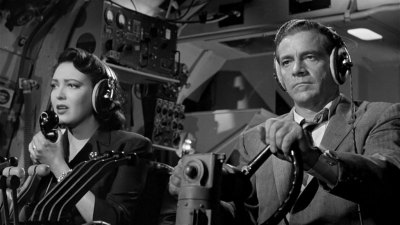
Stop me if you’ve heard this one before — a cross-country flight is put in peril when the entire crew and several passengers get sick with food poisoning and it’s up to shaky, battle-scarred former fighter pilot Ted Styker to land the plane with a little help from a tough-as-nails pilot on the ground.
This is better known as the plot of “Airplane!” but the Zucker-Abrahams-Zucker team didn’t think it up themselves. While their film was a spoof of ’70s disaster movies like the “Airport” series, they lifted their plot, characters, and even whole scenes and chunks of dialogue, wholesale from “Zero Hour!”
Dana Andrews plays Stryker, a decorated Canadian World War II pilot whose post-traumatic stress disorder keeps him out of the air until he’s forced to board a cross-country flight to keep his wife (Linda Darnell) from leaving him. Naturally, the fog gets thick and the fish is bad, so Stryker winds up in the cockpit and it’s up to Capt. Treleaven (Sterling Hayden, channeling Jack Webb) to talk him through it.
ZAZ skewered this thing so thoroughly that it’s hard to watch it seriously now. But on its own, its a taut little thriller that’s marred slightly by hamminess and some unintentional humor. Still a load of fun, though.
Best Bit:
The ventriloquist act, which belongs in a ZAZ movie.
Side Note:
The pilot is played NFL Hall-of-Famer Elroy “Crazylegs” Hirsch.
Companion Viewing:
“Airplane!” (1980), of course.
Links:
IMDb.
A transcript annotated with notes on what was later used in “Airplane!”
Take a Look:
The trailer:
A side-by-side comparison of “Zero Hour!” and “Airplane!”:
 Desuko Movie Spot.