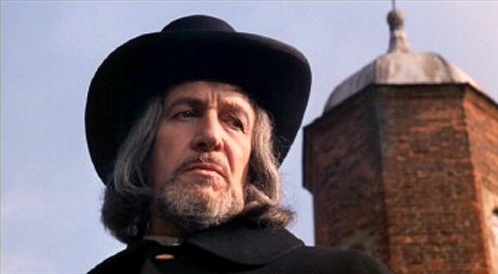
The Conqueror Worm (a.k.a., Matthew Hopkins: Witchfinder General) (1968).
The Scoop:
Don’t overlook this unsung masterpiece. The distributors tacked on the “Conqueror Worm” title and other trappings for the American audience to take advantage of the success of Roger Corman’s series of Edgar Allen Poe adaptations. But don’t be fooled — not only does this British film have nothing to do with them, it’s also much better.
Vincent Price’s usual hamminess is kept in check in his performance as 17th century English witch hunter Matthew Hopkins, who is chased across the countryside by the fiancé of a young girl he terrorized.
Price turns in one of his best performances as a truly chilling villain, and Michael Reeves’ direction matches him by being tight, suspenseful and moody. The script by Reeves and Tom Baker is also an excellent exploration of the psychology behind the witch hunts of the 1600s. The overall look is straight out of the Hammer Studios mold, but without the Grand Guignol stylings. And what’s more, it’s based on a true story. Highly recommended.
Best Line:
Price’s chilling delivery of, “I will find out the truth for you, have no fear.”
Side Note:
This was promising young director Reeves’ last film. He died of a possibly self-induced drug overdose shortly after the film was released.
Companion Viewing:
“The Crucible” (1996).
Links:
IMDb.
Cinefantastique Online.
Classic-Horror.com.
Take a Look:
Available on the YouTube installment plan, starting here:
Cleopatra (1912).
 The Scoop:
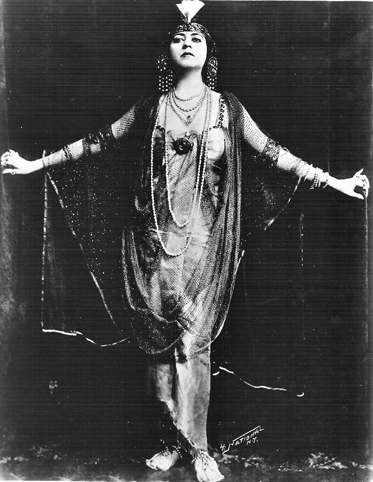
One of the first-ever feature length films in America, this silent version of the oft-told tale of the Queen of Egypt (this one based on a stage play by Victorien Sarnou) is the brainchild of cinema pioneer Helen Gardner.
Although virtually forgotten now, she was one of the biggest stage and screen stars of her day, and an important leader in the early movie industry. She owned her own studio, and was among the first stars to have their own production companies. In addition to starring in “Cleopatra” she also produced and edited it, and even designed the costumes.
The film itself is an interesting historical piece, representing a stepping stone in the evolution of filmmaking from early, stage-bound shorts to the cinematically modern features that D.W. Griffith would pioneer just a few years later. In fact, the evolution plays out on screen before our eyes as the film, which from the surviving evidence seems to have been shot in chronological order, progresses from its static, stagy early scenes to its more dynamic and intimate later scenes. It’s apparent that Gardner and director Charles Gaskill were learning and exploring as they went along.
Much of the film looks clunky and wooden to modern eyes, just as most films of the period do. But there are flashes of inspiration here, too, that make it worth seeing. The restored print features the original color tinting and a terrific new soundtrack mixing traditional and avant garde electronic music. It’s an important building-block of cinema as we know it.
Best Bit:
The trip down the Nile.
Side Note:
Sardou’s play, originally staged in 1890 with the legendary Sarah Bernhardt and adapted from Shakespeare’s “Antony and Cleopatra,” was also the basis of a 1917 film starring Theda Bara.
Companion Viewing:
“Intolerance” (1916).
Links:
IMDb.
Helen Gardner’s official site.
Take a Look:
Just look at that gown… and that hair…
A clip with an alternate score:
Beginning of the End (1957).
 The Scoop:
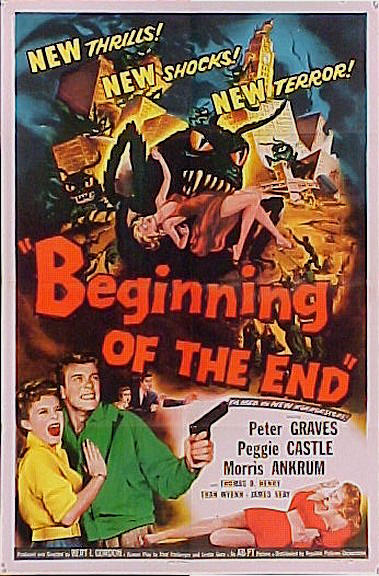
Oops! Studly, well-meaning scientist Peter Graves accidentally causes a bunch of locusts to grow to giant proportions, slaughter hundreds and attack Chicago. But he figures out a way to kill them all, so it’s okay. Because pointless scientific tinkering is always blameless.
This film is one of writer/director/producer Bert I. Gordon’s worst. And, believe me, that’s really saying something. This is the man who pioneered the “giant critter on a rampage” genre. The optical processing used to create the giant grasshoppers is awkward, and the “buildings” they swarm over are really postcards of Chicago’s skyline. The incompetence of the visual effects is positively Ed Woodian. Graves, at least, gives a professional performance, and costars Peggy Castle and Morris Ankrum hold their own.
But this movie really belongs to the horribly rendered giant insects. It’s an inauspicious addition to the B.I.G. canon, which is pretty inauspicious to begin with.
Best Line:
“To most of the public, these giants are just freaks of nature — no practical value.”
Side Note:
Gordon did the special effects to all his movies with his wife, Flora M. Gordon.
Companion Viewing:
“The Deadly Mantis” (1957).
Links:
IMDb.
BadMovies.org.
The Monster Shack.
Take a Look:
The trailer:
Death by big bug!
Frankenstein (1910).
 The Scoop:
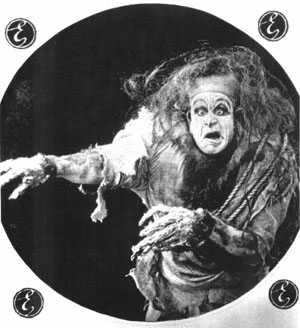
Ten minutes is all it takes to tell Mary Shelley’s classic story in this pioneering adaptation by Thomas Edison’s production company. It’s a splashy choice at a time when film was still in its infancy and considered a novelty, and it now has the status of being the first horror films ever made.
Given its one reel limit — D.W. Griffith wouldn’t pioneer the feature length film for another half decade — the story is strictly bare bones and told in three scenes. Dr. Frankenstein (Augustus Phillips) has his big idea, the monster (Charles Ogle) gets created, then it turns up to ruin Frankenstein’s wedding to Elizabeth (Mary Fuller).
J. Seare Dawley’s production is clunky and stagy, even by 1910 standards, although the creation scene is innovative. The centerpiece of the film, and taking up about half of its running time, the monster’s birth isn’t portrayed as the usual stitching together of corpses but as a creation from chemicals. The early special effects were created by burning a dummy in costume to ashes then running the film backward. Also striking is Ogle’s makeup, which he created himself.
Filmmaking of that period hasn’t aged well, so don’t expect loads of entertainment from a century old film. But it is worth a look, especially for the glimpse it gives us of the way people thought about Mary Shelley’s novel before Universal’s landmark 1931 production came along to leave its indelible stamp on Frankenstein and his monster.
Best Bit:
The creation scene, of course.
Side Note:
The film was considered missing from shortly after its release until the mid-1970s when one surviving print was finally discovered hidden in a farmhouse in Wisconsin.
Companion Viewing:
“Nosferatu” (1922) and “The Cabinet of Dr. Caligari” (1919).
Links:
IMDb.
Film Buff Online.
Take a Look:
The full film:
The White Stripes: Under Great White Northern Lights (2009).
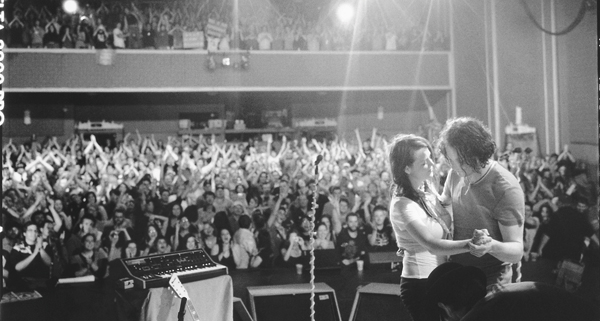
The Scoop:
Modern rock and roll tour films tend to be pretty formulaic. Shots of the band traveling to the next venue, live performance footage featuring a hit or two, some “intimate” backstage moments, a smattering of interview questions — and repeat for 90 minutes or so. The challenge for filmmakers is to find a way to break out of that mold and make their films distinctive.
“The White Stripes: Under Great White Northern Lights” does stand out a bit from the crowd. However that’s not because of the efforts of director Emmett Malloy, who mostly sticks to the tired script here, but because Jack and Meg White themselves fashioned a unique, memorable tour.
The film chronicles the band’s summer 2007 tour of Canada, which besides the usual big city stops included shows in every province and territory, in smaller and midsize cities that usually get skipped by touring bands. They visit places like Yellowknife, Whitehorse, Iqalnuit and Saskatoon. And in addition to playing in the largest halls in each town, they also do side shows wherever the locals will let them set up, in dive bars, town squares, pool halls and bowling alleys. The cameras follow Jack and Meg as they explore these towns, meet the locals and make connections with communities that otherwise feel about million miles away from the rock and roll world. It’s a fun and occasionally affecting journey that offers a glimpse of the true Canada, beyond the stereotypes and beyond the cosmopolitan dominance of its southern metropolises. It is in these moments that “Under Great White Northern Lights” becomes more a travelogue than a concert film.
But beyond these moments, the offstage footage also includes plenty of interview time, which is occasionally interesting but not very revelatory. It’s mostly information that has been rehashed in the music press for years, and as usual the stories are told almost entirely in Jack’s voice. It’s not Meg’s fault, of course, that her social anxiety has kept her out of the spotlight. (In fact, her anxiety got so acute that shortly after this tour, the band was forced to cancel a European tour and has not played in public since.) She doesn’t speak on camera at all until the midpoint of the film, and even after that she is so quiet that everything she says has to be subtitled. While her lack of input is understandable, it’s certainly a shame, because this film gives the impression that there’s a lot of interesting stuff going on behind those eyes.
Musically, the band is in top form, ripping through a body of blues-based songs that are a worthy update of the Americana tradition. And while the hits are certainly accounted for (“Seven Nation Army” is a highlight), most of the songs come from deep in the White Stripes catalog, along with a handful of carefully selected covers of artists such as Dolly Parton, Son House and Blind Willie McTell.
“Under Great White Northern Lights” catches the White Stripes at their height, both musically and personally, with the respect and admiration they show in their explorations of Canadian culture. And if this is the last we see of them, they certainly went out with a bang.
Best Bit:
Jack and Meg’s meeting with a group of First Nations tribal elders in Nunavut.
Side Note:
Malloy’s experience comes mostly from the world of music video, having directed clips for Blink 182, New Found Glory, Papa Roach, Jimmy Eat World and Avril Lavigne. He’s also directed three White Stripes videos — “Icky Thump,” “You Don’t Know What Love Is” and “My Doorbell.”
Companion Viewing:
“Festival Express” (2003) and “Loudquietloud: A Film About the Pixies” (2006).
Links:
IMDb.
The White Stripes official site.
Take a Look:
The trailer:
Performing “Icky Thump”:
From a free show in Whitehorse, Yukon:
Jack’s performance of “White Moon” that ends the film and moves Meg to tears:
 Desuko Movie Spot.