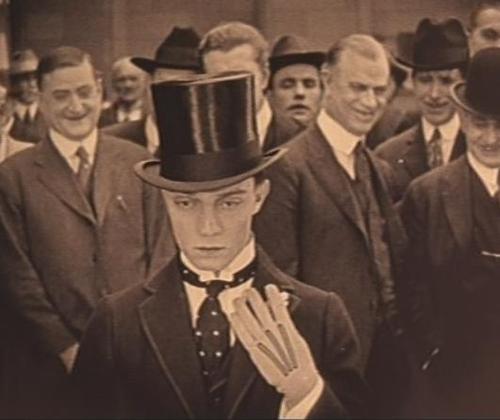
The Saphead (1920).
The Scoop:
This early outing by comic legend Buster Keaton, his first feature, is anything but legendary.
Although he had a few successful shorts under his belt by 1920, he didn’t yet have the creative control that he would use to make his later, more classic films. So he got saddled with “The Saphead” by Metro. The story of the inept son of a Wall Street tycoon trying to get into the family business, this is the second film version of the 1913 play “The New Henrietta.” It has been filmed in 1915 as “The Lamb” starring Douglas Fairbanks, who also starred in the stage production. Metro originally wanted Fairbanks for the role again, but he wasn’t interested in playing it a third time., so he personally suggested Keaton for the part.
Because it wasn’t his own material, it doesn’t quite fit with Keaton’s unique comedic talents. Except for a couple brief moments, his usual derring-do is pushed aside for the kind of genteel comedy that played better then than it does now.
“The Saphead” is a film for Keaton completists only. But the film let Buster pay his dues and show that he could carry a feature film. That, in turn, led to his classic contributions to Hollywood history, so for that we should be grateful.
Best Bit:
Buster walking on the heads of a crowd of stock traders to get off the Stock Exchange floor.
Side Note:
Gloves and a hand double were used for some shots to hide the fact that Keaton was missing the tip of his right index finger. It was the only time in the silent era that Keaton used a double in any of his films.
Companion Viewing:
Any better Keaton outing, like “The General” (1927) or “Steamboat Bill, Jr.” (1928).
Links:
IMDb.
Commentary Track: Silent Reflections.
Take a Look:
The complete film:
Robin and Marian (1976).
 The Scoop:
Sean Connery and Audrey Hepburn, two sublime performers, star in this unique take on the Robin Hood legend. It is 20 years after the events of the original story, and Robin and Little John return to Sherwood Forest for the first time since their youth. There, they discover that Maid Marian has entered a convent and the Sheriff of Nottingham is still running things with an iron hand. So, the old Merry Men must reunite for one last battle to defend the oppressed.
It’s a great, touching take on encroaching middle age and lost youth told by a group of reliable veterans — the supporting cast includes Robert Shaw, Richard Harris, Nicol Williamson, Denholm Elliott and Ian Holm, and it was written by James Goldman and directed by Richard Lester. And their ruminations on aging are mixed with just the just the right amount of romance, humor and swashbuckling action that you’d expect from classic Hollywood.
For a medium that has traditionally gone out of its way to target adolescent viewers, this is a refreshing alternative for more mature audiences. This is the best film version of the Robin Hood story to date.
Best Bit:
Maid Marian: “You never wrote.”
Robin Hood: “I don’t know how.”
Side Note:
The apples used in the final scenes are actually Golden Delicious, which didn’t exist in the Middle Ages.
Companion Viewing:
“The Adventures of Robin Hood” (1938) and “Excalibur” (1981).
Links:
IMDb.
Take a Look:
The trailer:
The final scene (very spoiler-y):
See the full film on Crackle.
Bandidas (2006).

The Scoop:
The titanic team up of Salma Hayek and Penelope Cruz is really the only reason to watch this fun but otherwise forgettable western.
In pre-revolutionary Mexico, an American banking company is stealing the land of peasant farmers to build a cross-country railroad. Sara (Hayek), the daughter of a banker betrayed and murdered by company henchman Jackson (Dwight Yoakam), and Maria (Cruz), the daughter of a displaced farmer, team up to exact revenge by robbing the company’s banks. They soon join forces with the forensic investigator (Steve Zahn) hired to bring them to justice, and the trio sets out to bring down the whole operation.
Hayek and Cruz are energetic and sexy, and they have great chemistry. These two great actresses certainly have more talent than this fluff requires, but they give it their all manage to redeem an otherwise subpar film. The script by Luc Besson and Robert Mark Kamen has all the hallmarks of the duo’s other work (“The Fifth Element,” “The Transporter”), but without the same originality and wit. The situations are cliched and predictable, many of the jokes are obvious, and the Mexican setting and characters are painting with broad, borderline stereotypical, strokes. The material perhaps could have been better served if it had been directed by Besson himself rather than newcomers Joachim Ronning and Espen Sandberg. Instead the direction is flat, with the action scenes rendered chaotic and ridiculous.
So is it worth a look? Definitely, if you’re a fan of either Salma Hayek or Penelope Cruz. They both bring personality to spare and have fun embracing both the underlying Girl Power message, as well as the sheer mindless escapism of it all.
Best Line:
“We have a microscope!”
Side Note:
Companion Viewing:
“Butch Cassidy and the Sundance Kid” (1969) and “The Fifth Element” (1997).
Links:
IMDb.
The Lightning Bug’s Lair.
Take a Look:
The trailer:
Behind the scenes:
Mary Shelley’s Frankenstein (1994).

The Scoop:
This is the most faithful adaptation of Mary Shelley’s seminal gothic novel yet made (as proudly trumpeted by including her name in the title), yet it lacks the energy and horror of the best Frankenstein movies.
This is not the fault of director/star Kenneth Branagh’s work so much as it is a shortcoming in the novel itself. While it has given birth to one of the most durable demons in our collective psyche, the novel in its original form is a pre-Victorian curio, its story-within-a-story structure serving as an elaborate China box to isolate the readers from the true horror at the heart of the concept. By dispensing with that, the successful adaptations (most notably those by James Whale and Hammer Studios) deliver the goods.
Still, Branagh and his cast put forth a valiant effort to save the material from itself. Branagh tells the story on a grand scale and Robert De Niro gives a wonderfully non-traditional rendition of the monster. And the rest of the cast – including John Cleese, Ian Holm and Richard Briers – does well too. It’s just too bad that the luscious Helena Bonham Carter, as Elizabeth, is not given more to do.
In the end, this may be the definitive adaptation of Mary Shelley’s novel. But it’s not the definitive version of the Frankenstein story.
Best Line:
“Did you ever consider the consequences of your actions? You made me, and you left me to die. Who am I?”
Side Note:
In his usual quest for perfection, De Niro studied the speech patterns of stroke victims to prepare for this part.
Companion Viewing:
“Frankenstein” (1931), “The Curse of Frankenstein” (1957), “The Bride” (1985) and “Bram Stoker’s Dracula” (1992).
Links:
IMDb.
Classic-Horror.com.
The original novel.
Take a Look:
Teaser trailer:
A slightly longer trailer:
Creator meets creation:
Yowza:
Matango (a.k.a., Attack of the Mushroom People) (1963).
The Scoop:
This slab of Toho goodness from Japan manages to be both intriguing and goofy at the same time.
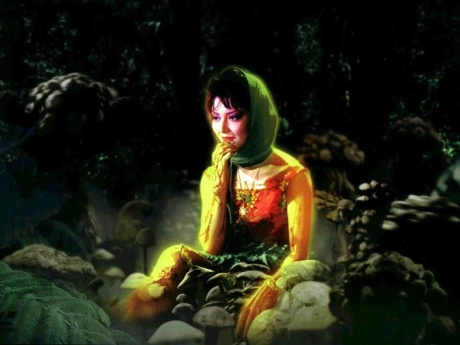
A group of mismatched travelers on a pleasure cruise get shipwrecked on a strange island after their yacht sails through a storm. When trying to survive, they eat some local wild mushrooms that turn them into silly B-movie monsters.
In the group are selfish millionaire Kasai (Yoshio Tsuchiya), mystery novelist Yoshida (Hiroshi Tachikawa), psychology professor Murai (Akira Kubo), his student Akiko (Miki Yashiro), sultry singing star Mami (Kumi Mizuno), skipper Sakuda (Hiroshi Koizumi) and his first mate Koyama (Kenji Sahara). So basically it’s “Gilligan’s Island” minus Mrs. Howell. And instead of sophomoric comedy, it’s written as a sci-fi thriller.
The script by Takeshi Kimura (based very loosely on a William Hope Hodgson short story) is tight and suspenseful, with the undercurrent of post-nuclear anxiety that Japanese sci-fi of the period did so well. But once the mushroom monsters turn up it goes off the rails a bit and it’s hard to keep a straight face any longer. But veteran director Ishiro Honda, the man behind the classic entries in the Godzilla film series, manages to hold it together the best he can, and the cast is capable, albeit a little detached.
Sadly, the promising first hour is undermined by its ridiculous and slightly confusing final act. It’s still better than “Gilligan’s Island,” though.
Best Line:
Yoshida explains why he wants to hunt down one of the mushroom people: “His reality may be more interesting than ours.”
Side Note:
The film ran into some censorship trouble in Japan because the makeup used for the early stages of the mushroom transformation looked too much like the burns and radiation sickness suffered by victims of the atomic bombings of Hiroshima and Nagasaki.
Companion Viewing:
“Gilligan’s Island,” Lost” and “From Hell It Came” (1957).
Links:
IMDb.
BadMovies.org.
Midnight Eye.
Classic-Horror.com.
Take a Look:
The Japanese trailer:
A cheesy American made trailer:
 Desuko Movie Spot.