Movie-A-Day #237: A Trip to the Moon (1902).
 Starting on this day in 1835, the New York Sun began running a series of articles about the fantastic discoveries made on the moon by a powerful new telescope – discoveries that included blue unicorns, forests, pyramids and even intelligent life in the form of primitive humanoid beavers and a race of bat-men. And thus the Great Moon Hoax was born. Some of these images and ideas were later adopted by French film pioneer Georges Mélies for his groundbreaking “A Trip to the Moon.” Although it clocks in at not much more than 10 minutes, the movie would have a tremendous impact, marking the shift of filmmaking away from mere reportage and toward fiction, fantasy and spectacle. There is a direct line to be drawn from “A Trip to the Moon” to today’s CGI spectaculars.
Movie-A-Day #236: Intolerance (1916).
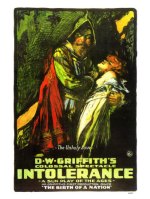 The St. Bartholomew’s Day Massacre, which began in Paris on this day in 1572, started as a series of targeted assassinations of prominent French Protestants by the Catholic royal family. But it eventually turned into a wave of mob violence as Catholics of all social classes hunted down and killed tens of thousands of Protestants throughout France in the following weeks. The episode was one of four stories that D.W. Griffith juggled in his epic film “Intolerance.” Paradoxically enough, Griffith made the film – a plea for acceptance and understanding – as a way to lash out at the critics who trashed his previous film, the wildly racist “The Birth of a Nation.”
Movie-A-Day #235: The Sheik (1921).
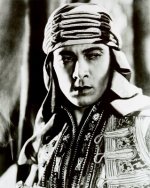 Rudolph Valentino – film’s first great male romantic idol, due mainly to his role in “The Sheik” – died on this day in 1926. It was the first movie star death to shock the world, and every year on the anniversary of his death, a mysterious woman in black would visit his grave (at the Hollywood Forever Cemetery) and leave roses. As the decades passed, other women dressed in black started making visits and now it’s starting to get a little crowded. So, ladies – if any of you are in the Los Angeles area today, you should totally dress up and do it too. Let’s make a flash mob out of it.
Movie-A-Day #234: Richard III (1955).
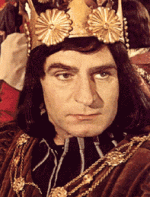 The Battle of Bosworth Field, one of the major turning points in British history, went down on this day in 1485. Richard III was killed in the battle, marking the culmination of the War of the Roses. It was also the end of the Plantagenet dynasty and the beginning of the reign of the Tudors – under whose patronage William Shakespeare wrote his tragedy “Richard III” just over a century later. There are lots of good film versions of the play out there, but Laurence Olivier’s 1955 adaptation is appropriately proper and British.
Movie-A-Day #233: Dead Poets Society (1989).
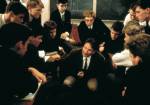 Today is Poet’s Day, making it a good opportunity to watch (or re-watch) “Dead Poets Society.” Provided, of course, that you prefer your poets in the romantic hero mold of Whitman and Byron, and not in the downtrodden boozy mold of Bukowski and Plath.
 Desuko Movie Spot.