Cars (2006).
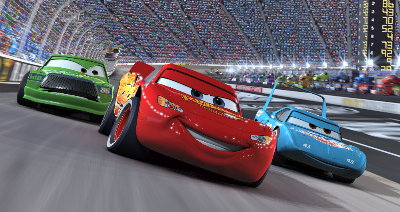
The Scoop:
Never mind the marketing blitz, and don’t think of “Cars” as a kids’ movie so much as a grown-up movie that just happens to be animated. While it’s obviously meant to be enjoyed by children, there is plenty here for adults to enjoy as well, without feeling “talked down to.”
This is the story of arrogant young race car Lightning McQueen (voiced by Owen Wilson) who learns a few lessons in maturity after taking a wrong turn on the way to his next big race and winding up stranded in the all-but-forgotten Route 66 town of Radiator Springs. Onto this simple framework, John Lassiter and the rest of the Pixar crew hang a wealth of rich characterizations, satirical jabs and terrific dialogue.
After the thrillingly-staged opening race sequence, which features a host of cameo appearances and pokes plenty of gentle fun at Nascar Nation, the film settles down and spends the bulk of its nearly two hour running time in Radiator Springs. The young ones might find their attention wavering a bit here, but the grown folks will appreciate the tribute to Route 66 and mid-20th century automobile culture, as well as the eccentric characters who populate the town. Foremost among these are Doc (Paul Newman), Sally (Bonnie Hunt), Flo (Jennifer Lewis), Ramon (Cheech Marin), Fillmore (George Carlin) and Luigi (Tony Shaloub). And then it’s all capped off with another great final racing sequence, in which McQueen gets to apply all the life lessons he learned in Radiator Springs.
The animation is top-notch, taking several steps ahead of the animation in previous Pixar efforts. Especially breathtaking is the photo-realistic background work.
As great as “Cars” is, it’s not without it’s flaws, however. Many of the Radiator Springs scenes don’t advance the story as efficiently as they could, and then there’s the subpar soundtrack. (Do we really need another bland cover of “Route 66”?)
But these are just minor quibbles. “Cars” is a winner.
Best Bit:
There’s tons of great stuff here, but as with any Pixar movie, stick around through the entire end credits, where some of the best gags can be found. My favorite is the self-referential tribute to the past Pixar voice work of John Ratzenberger (who plays Mack the truck here).
Side Note:
The voice of the Sheriff is provided by Route 66 historian and author Michael Wallis, who got the gig by serving as a tour guide for the Pixar creative team as they took a pre-production research tour of several towns along the highway.
Companion Viewing:
“Toy Story” (1996).
Links:
IMDb.
Take a Look:
Meet the cast!
1941 (1979).
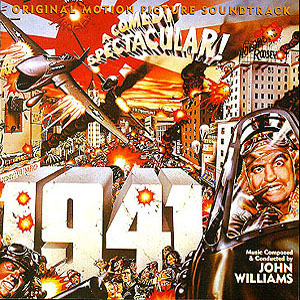 The Scoop:
Steven Spielberg is not well known for his comedic sense (despite some comic moments in his escapist fantasy films) and this, his only true comedy film, is proof why.
There are a lot of clunkers here, but it is still a fun movie, far too underrated by most critics. Featuring a huge cast (perhaps too huge), the film is set in the tense few weeks after the bombing of Pearl Harbor when the whole West Coast was nervous about further Japanese attacks. So, when a bumbling Japanese submarine crew wanders away from its fleet and turns up off the coast looking to bomb Hollywood, all hell breaks loose. John Belushi gives one of the best performances of his career in the too-small role of a lunatic fighter pilot, and Dan Aykroyd and Robert Stack are also good. Completely slumming and out of their element, though, are Christopher Lee as a German officer and Toshiro Mifune as the sub commander.
Spielberg throws in some familiar touches used in his other films (most notably an opening sequence that parodies the opening sequence from “Jaws”). “1941” is an interesting failure — equal parts laughfest and sprawling mess.
Side Note:
Charleton Heston and John Wayne both turned down the role of General Sitwell (played by Stack) because they felt the film was unpatriotic and insulting to World War II vets.
Best Line:
“I’m a bug!”
Companion Viewing:
“It’s Mad, Mad, Mad, Mad World” (1963) and “The Russians are Coming! The Russians are Coming!” (1966).
Links:
IMDb.
Take a Look:
The trailer…
First Spaceship on Venus (1960).
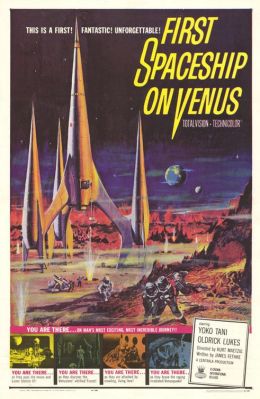 The Scoop:
Despite having the title and all the trappings of a B-grade cheesefest, this East German/Polish co-production actually provides a few compelling moments. Sometime in the near future (it’s that ’50s vision of the near future that looks hopelessly dated now), a construction crew unearths a strange metal coil. Extensive scientific investigation determines that the coil is really a log recording of a crashed Venusian spaceship, outlining the planet’s plans to conquer Earth. From there, an international expedition sets off to the morning star to get to the bottom of it all. What they find there offers a creditable anti-Cold War message and a few moments of genuine suspense. Of course, there are the usual B-movie moments, too, making an end result that is good for both a laugh and a little contemplation. Also commendable is the multi-racial cast, a rarity for the genre at that time.
Side Note:
The American release of the film (which is still the only one available in the U.S. today) is nearly an hour shorter than that original European release, which offers a tantalizing promise of an even more fascinating picture.
Best Bit:
All the alphabetized extras waving goodbye..
Companion Viewing:
“Rocketship X-M” (1951), “The Angry Red Planet” (1959) and “Forbidden Planet” (1956).
Link:
IMDb.
Take a Look:
Here’s the trailer for the original U.S. theatrical release in 1962:
A Christmas Story (1983).
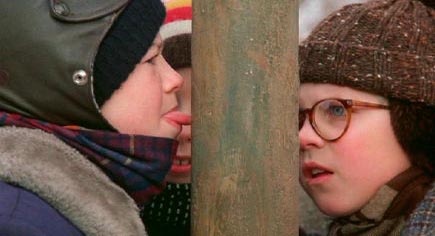
The Scoop:
Since this will be my last post before Christmas, what better time to review this beloved holiday chestnut?
Ahem.
Well, I guess it’s beloved by most, but not by me so much. I realize I’m in the distinct minority on this one, so I’m letting you know up front that your mileage may vary with my review.
Anyway, “A Christmas Story,” based on a series of semi-autobiographical stories by Jean Shepard, concerns the eventful holiday season of little Raphie Parker (Peter Billingsley) and his quirky midwestern family in the 1940s. All Ralphie wants for Christmas is a Red Ryder BB gun, but his mom is afraid he’s going to put his eye out with it. The rest of the plot is mainly a series of vignettes involving Ralphie, his family and his friends, all eventually reaffirming the importance of family ties and the holiday spirit.
It’s all meant to be heart-warming, and some of it is, but most of it just get bogs down by two crucial flaws in the film. The first is the obnoxiously relentless “quirkiness” of the family, which becomes overbearing at times. And the other flaw is the narration, in which Shepard’s florid prose is used to mythologize the smallest moments and invest them with a cloying pretentiousness. This style has been better used elsewhere to better effect (most notably on television in “The Wonder Years” and “The Adventures of Pete and Pete”) but is just too much here.
Of course, these things which turn me off to the movie happen to be the biggest draw for its many fans. Nothing wrong with that, I suppose. Just don’t ask me to watch it (again) this year.
Best Line:
“Fra-gee-lay. That must be Italian!”
Side Note:
Look for Shepard’s cameo as the angry man in line for the mall Santa.
Companion Viewing:
My perennial Christmas favorites tend to lean toward TV rather than the movies, especially the Rankin-Bass specials and “A Charlie Brown Christmas” (1965). Although I didn’t discover it until my adulthood, “The Pee-Wee’s Playhouse Christmas Special” (1988) is another favorite.
Links:
IMDb.
The official Warner Bros. DVD site.
The house from the movie. Tours available!
Take a Look:
Targets (1968).
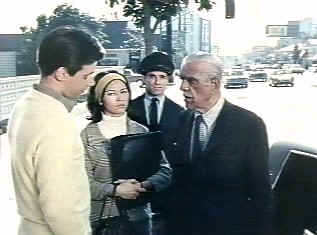 The Scoop:
While “Targets” presents the story of a moral crossroads, it also represents a cinematic crossroads — the end of the brilliant Boris Karloff’s career and the start of Peter Bogdanovich’s.
In this writing and directing debut, Bogdanovich crafts this cautionary, semi-autobiographical tale of aging horror movie star Byron Orlok (played by Karloff), who decides to leave the business when he realizes his life’s work can’t compare to the real horrors taking place on America’s streets everyday. The clips of Orlok’s past work are taken from the classic performances of Karloff, and to complete the real-life parallels, Bogdanovich even casts himself as the young director making Orlok’s last film. There is also a parallel plot concerning a troubled young man who goes on a shooting spree that is sadly all too familiar in our post-Columbine world. These two plot strands cross when the young shooter takes refuge in a drive-in theater that turns out to be the site of Orlok’s last public appearance before retirement.
This film offers an interesting exploration of the role of the entertainment media in the social upheaval of the late-’60s (it was released in the late spring of 1968, shortly after the assassination of Martin Luther King, but before the shooting of Robert Kennedy) that has grown even more prescient today. And Bogdanovich challeges the viewer by filming from the point of view of the shooter, putting the audience in the killer’s shoes.
Despite his obviously failing health, Karloff gives the strongest, most human portrayal of a career marked my more depth than most horror actors’. In a perfect world, this swan song performance would’ve been recognized with an Oscar. Instead, the poverty-stricken Karloff followed his performance here with appearances (confined to a wheelchair) in a quartet of bad Mexican cheapies, filmed over the course of a couple weeks, before dying in 1969. But forget those duds — this is the true, final summation of one of the truly great acting careers in film.
Best Line:
Karloff’s summation, “Is that what I was afraid of?”
Best Bit:
The staging of the freeway shooting scene.
Side Notes:
1) Bogdanovich originally offered the lead role to Vincent Price, who turned it down. 2) The film showing in the drive-in at the end of the movie is “The Terror” (1963), in which Karloff costarred with a young Jack Nicholson. 3) The victim who dies in the phone booth is none other than Mike Farrell, who went on to a more distinguished career in television, starring in “M*A*S*H” and “Providence.”
Companion Viewing:
Two of this film’s cinematic descendents — “Taxi Driver” (1976) and “Natural Born Killers” (1994).
Links:
IMDb.
Wikipedia.
Horror-Wood.
Take a Look:
Well, my Mad Internet Skillz couldn’t turn up any “Targets” clips online, so you’ll have to settle for this…
 Desuko Movie Spot.