Dracula (Spanish Version) (1931).
 The Scoop:
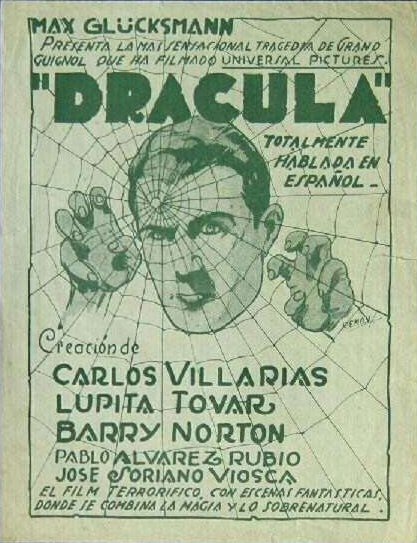
For a short time in the early days of the sound era, before subtitling and dubbing came into their own, Hollywood studios solved the problem of supplying films for the foreign marketplace by filming alternate language versions of their productions that were exact line-for-line replicas. Many were second-rate hack jobs, but some, like this version of the Bela Lugosi vehicle, are top-notch, even surpassing the English versions.
This alternate version of “Dracula,” directed by George Melford (with language assistance by Enrique Tovar Avalos), was shot after hours on the same sets as the English version. However, the stodginess of Tod Browning’s film is supplanted by a gorgeous gothic mood that is only hinted at in the more well-known version. The script, too, features little flashes of the underlying sexuality of the story which never made it into the English-language version. In addition, Melford elicited stronger performances from his Spanish-speaking cast, especially Lupita Tovar (as Eva, the count’s love interest) and Pablo Alvarez Rubio (as Renfield).
Carlos Villariás was a ham who couldn’t match Lugosi’s charisma in the title role, and Spanish speakers may notice the mismatching accents and wooden line readings. But these turn out to be minor quibbles given the excellence of the rest of the production.
The film was initially given a VHS release with English subtitles, but is most widely available now as part of the “Dracula Legacy” DVD collection without subtitles. However, the closed caption function can be used to provide English subtitles. At any rate, don’t overlook this obscure gem.
Best Bit:
Renfield’s seduction by the three brides of Dracula.
Side Note:
Shortly after production finished, Tovar married the film’s producer Paul Kohner, who went on to be one of the most powerful agents in Hollywood. Their daughter Susan Kohner was nominated for an Oscar for her supporting role in “Imitation of Life” (1959).
Companion Viewing:
“Dracula” (1931) and “El Mundo de los Vampyros” (1960).
Links:
IMDb.
Take a Look:
Renfield’s arrival at Dracula’s castle:
Soylent Green (1973).
The Scoop:
Sure, we all know the twist ending by now (so much so that’s become something of a pop culture joke), but look beyond that and you’ll find an absorbing, if somewhat slow moving, detective story set against an environmental apocalypse.
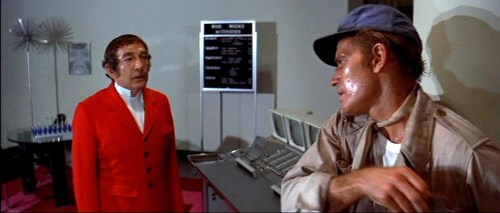
Based on Harry Harrison’s novel “Make Room! Make Room!”, the story follows New York police detective Robert Thorn (Charlton Heston) as he pursues a murder case against the backdrop of a dystopian future in which global warming and overpopulation have the planet’s delicate environmental balance. As he investigates the murder of an executive of the Soylent Corporation, Thorn gets too close to some dirty governmental secrets and is eventually targeted for death himself.
Two aspects of the film really stand out, the main one being the deft handling of the environmental issues. Screenwriter Stanley Greenberg and director Richard Fleischer keep the alarmism to a minimum and in the background. This is a stark departure from the style of the other environmental scare films of the period, and it injects a welcome dose of realism to the proceedings.
Also outstanding is the swan song performance of film legend Edward G. Robinson as Thorn’s mentor Sol Roth. Fighting a losing battle with cancer (he died just nine days after principal photography wrapped), Robinson invested his final role with a wonderful sensitivity.
Unlike so many of its contemporaries, “Soylent Green” is a film that has stood the test of time (just as long as you ignore that little video game scene) and is just as precient today.
Best Line:
Come on everybody, say it along with me: “It’s people! Soylent Green is made out of people!”
Side Note:
Those tears Heston cries in Roth’s death scene are real — he was the only person on the set who knew Robinson was in the final stages of his bout with cancer.
Companion Viewing:
“The Omega Man” (1971).
Links:
IMDb.
Take a Look:
The trailer…
The Gong Show Movie (1980).
 The Scoop:
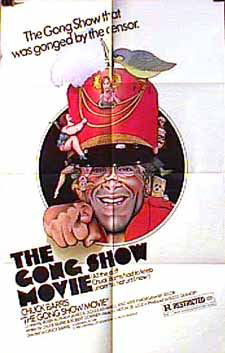
After “Mystery Science Theater 3000,” the one TV show that has never failed to turn my crank is the original version of “The Gong Show.” And here, Chuck Barris brings his unique vision to the big screen. This movie is still tragically unavailable on video and only circulated among the hardcore fans, even though reruns of the series are still readily available.
So, I was looking for this little treasure for a long time. Of course, as with anything you psyche yourself up about for that long, it didn’t quite live up to the internal hype. I was hoping for something more in the tradition of those great “backstage musicals” of the ’30s, with all the familiar characters dealing with various subplots and drama while preparing for the big show. And while there are elements of that, it mostly just follows Chuck Barris around while he has a crisis of confidence. All the great supporting players of the TV show — Jaye P. Morgan, the Unknown Comic, Della Bella, Larry Spencer — are reduced to giving brief cameos. (With such a self-serving script, it’s not surprising it was co-written by Chuckie-Baby himself.) The on-air segments from the show weren’t recreated or rewritten for the film, but were just actual clips from the show edited into the story.
But even with all that, I enjoyed it. Many of the most wacked-out scenes survive the poor acting and direction, and the uncensored clips from the original show (including Jaye P.’s infamous “exposure”) were fun to see. And the final production number made it all worthwhile.
Side Note:
One of Barris’ co-writers was none other than Robert Downey Sr. (No wonder the kid turned out so rotten…) Also, look for a bit part by a young Phil Hartman.
Best Line:
Chuck: “Promise not to talk dirty anymore?”
Jaye P.: “Cross my fucking heart.”
Companion Viewing:
“42nd Street” (1933) and the original TV series.
Links:
IMDb.
The Gong Show Fan Page.
Take a Look:
Here’s the infamous “Popsicle Twins” act, which caused so much grief with the network, and which also was used in the movie:
The Beach Girls and the Monster (1966).
 The Scoop:
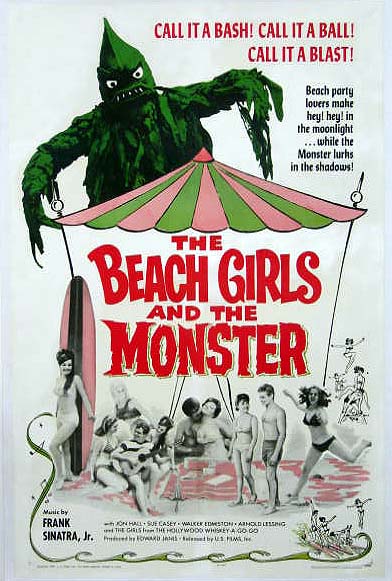
This film has everything — swingin’ beach babes, a shambling monster (that looks like a cross between the Mummy and the Creature From the Black Lagoon), bad acting, a mad scientist, tons of surfing stock footage, bongos, a singing beatnik with a fake beard and a lion puppet, gaping plot holes, bland repetitive surf music, and even some “greasy kid stuff.”
Our teen hero Richard, played by Arnold Lessing, hangs out on the beach and bickers about his future with his science-minded father, while also sharing his house with his bitchy stepmom and a freelance sculptor. Meanwhile, a kid or two walk into the grasp of the murderous, slow-moving monster.
Oh, dear lord, what a mess.
Thankfully, it’s only 70 minutes long — but it’s a jaw-dropping 70 minutes. Even the inept “Horror of Party Beach” did it better.
(The film was packaged for TV under the title “Monster From the Surf,” and is available on video under both titles.)
Side Note:
This was the last role for ’30s and ’40s action star Jon Hall, who got top billing despite his relatively small role as Richard’s father. This movie may have been his last acting job, but it was his first directing job. His one other directing gig was the even-worse “The Navy vs. the Night Monsters” (1966), although he didn’t even get his name in the credits on that one. Suffering from cancer, he committed suicide in 1979 is buried near Buster Keaton.
Best Line:
“Here’s a dive you don’t see everyday!” (Followed by an ungraceful face-first flop)
Companion Viewing:
“Horror of Party Beach” (1964).
Link:
IMDb.
Take a Look:
Here’s the trailer. See if you can count how many times the boom mike makes an appearance:
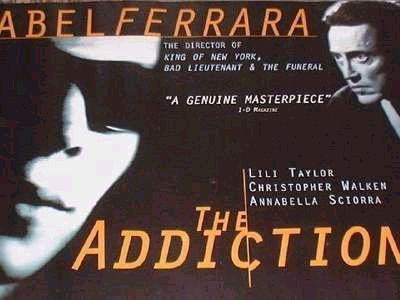
The Addiction (1995).
The Scoop:
Is there a more overrated indie director than Abel Ferrara? Now that I think of it, anything’s possible, but Ferrara’s name certainly would be near the top of the list. Aside from “Driller Killer” (1978) and maybe “Bad Lieutenant” (1992), he’s been shelling out crap for the past three decades that pretends to be provocative, but it really just pretentious.
Case in point… “The Addiction.”
Starting with an intriguing premise — the parallels between vampirism and drug addiction — Ferrara and screenwriter Nicholas St. John manage to deliver neither the shocks or eroticism we’ve come to expect from vampire stories, nor any of the insights promised by the premise. Instead, the audience gets talked to death. (Sample dialogue: “Essence is revealed through praxis. The philosopher’s words, his ideas, his actions, cannot be separated from his value, his meaning. That’s what it’s all about, isn’t it? Our impact on other egos.” Whew!)
Lili Taylor plays a graduate student who gets bitten by vampire Annabella Sciorra, which leads to a cavalcade of intellectual angst. There’s really not much more plot than that, just 84 minutes of deep philosphical speculations on what it “means” to be a vampire. I thought it meant you got to look sexy while stalking and killing people in an elaborate coital analogy. But everyone involved with “The Addiction” seems to have rejected that answer out of hand, leaving them spinning their wheels and not answering much of anything at all.
Best Bit:
There are actually two good scenes in the film — a snooty cocktail party that turns into a vampire orgy, and Christopher Walken’s cameo. They’re the only reason you should even consider watching this mess.
Side Note:
Co-produced by Def Jam mogul Russell Simmons.
Companion Viewing:
The similarly-themed “Nadja” (1995) manages to be a more successful merger of vampire and art house sensibilities — but just barely.
Link:
IMDb.
Take a Look:
Ferrara (or maybe it’s some homeless guy from Washington Square, I dunno) discusses his craft:
 Desuko Movie Spot.