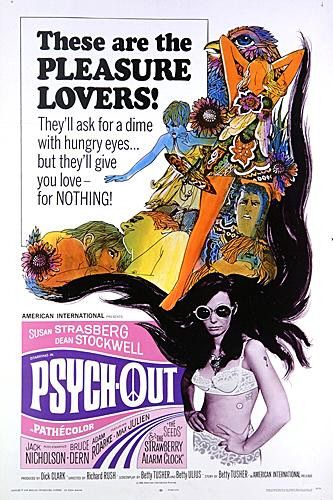
Psych-Out (1968).
 The Scoop:
This little chestnut — one of my favorite bad movies — comes from those heady days right after the Summer of Love when the mainstream entertainment media tried a little too hard to cash in on the hippie culture.
Produced by eternally-square Dick Clark, “Psych-Out” professes to be an honest, unflinching look at the counterculture. Well, it’s not. In fact, it’s pretty much the exact opposite of everything “Easy Rider” was. But it is good for a laugh, nonetheless.
It features a pre-superstardom Jack Nicholson as Stoney, the leader of a San Francisco psychedelic band (he doesn’t sing on the soundtrack, fortunately — that’s handled by The Strawberry Alarm Clock) who helps a naïve, deaf runaway (Susan Strasberg) find her long lost brother (Bruce Dern). Dean Stockwell is along for the ride, too. Along the way, there are cheesy acid freak outs, weird clothes and goofy dialogue. A must-see for anyone who mythologizes the ’60s too much.
Best Line:
It’s a tie between “You’re righteous Stoney, but you’re not very hip” and “I’ll get it; serving’s in my racial memory.”
Side Note:
1) As much as the film got wrong, it still produced a Top Ten hit for The Strawberry Alarm Clock with “Incense and Peppermints.” 2) Keep an eye out for future directors Henry Jaglom and Garry Marshall in bit parts.
Companion Viewing:
“Wild in the Streets” (1968) and “The Trip” (1967).
Links:
IMDb.
Take a Look:
Here’s the trailer:
Murder By Death (1976).
 The Scoop:
Great performances sometimes turn up in the strangest places. They are the diamonds in the rough of cinema. They come from talented actors who rise above and beyond the simple requirements of the genre picture (where most of them occur) and create something memorable. Such is Alec Guinness’ performance in Neil Simon’s “Murder By Death.”
The film is a slapstick spoof of dectective movies, featuring caricatures of such familiar screen gumshoes as Sam Spade and Miss Marple. And just look at the rest of the cast: Peter Sellers, David Niven, Maggie Smith, James Coco, Peter Falk, Elsa Lanchester, James Cromwell, Eileen Brennan, Nancy Walker, Estelle Winwood, and even author Truman Capote (who earned a Golden Globe nomination). They all do a great job, and the material is hilarious.
Guinness is the blind butler who (naturally) isn’t all that he seems. While the other actors are content just to hit their marks and keep a straight face during the jokes, Guinness takes it to another level. This is particularly true in the end, when he is confronted by all the detectives and acts out their theories on his motive. More than just running through a variety of silly voices, he creates a series of fully-realized flesh-and-blood characters, flowing effortlessly from one to the other. The movie is pretty funny on its own, but definitely worth seeing just to get to Guinness’ big scene.
Best Line:
There are tons, but here’s one at random — “Conversation like television set on honeymoon: unnecessary.”
Side Note:
Among the actors who turned down the chance to be in the film are Orson Welles, Myrna Loy and Katharine Hepburn.
Companion Viewing:
“Clue” (1985).
Links:
IMDb.
Take a Look:
The trailer…
Gimme Shelter (1970).
 The Scoop:
In retrospect, it was one of the greatest mistakes in rock history. But at the time, it should have been obvious, too. Hiring the Hell’s Angels as security for any event, much less a free rock festival sure to draw lots of hippies, was a Serious Error. Not only that, but they were paid with beer. It was just an accident waiting to happen, as this film by the Maysles brothers and Charlotte Zwerin demonstrates.
This captivating documentary follows the planning and execution of the Rolling Stones’ infamous Altamont Festival at San Francisco in December 1969. It was meant to be a West Coast answer to Woodstock, but it turned out to be a violent, unorganized mishmash, which culminated in the fatal stabbing of an armed spectator, Meredith Hunter, by the Angels.
While the tragedy justifiably takes center stage here, there is also some terrific performance footage of the Stones at their height, as well as performances by Tina Turner, the Flying Burrito Brothers and Jefferson Airplane. And interspersed with this is plenty of shots of the boys (particularly Mick Jagger) watching and reacting to the concert footage in the days immediately following. This, combined with the filmmakers’ handling of the moment of the killing, serves to best bring out the gravity of the situation.
An excellent look at the “dark side” of the late ’60s and that last frozen shot of Jagger is a killer.
Best Line:
“Something funny always happens when we start that number.” (Mick Jagger, onstage during the interruption in “Sympathy for the Devil,” in which Hunter was killed.)
Side Note:
One of the cameramen was none other than film student George Lucas.
Companion Viewing:
“Woodstock” (1970).
Links:
IMDb.
Take a Look:
A trailer for the release of the restored print:
The Fastest Guitar Alive (1967).
 The Scoop:
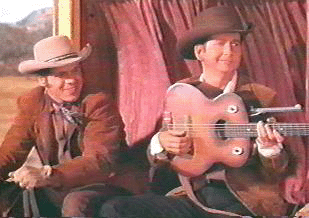
Once upon a time, Roy Orbison wanted to have the same movie career Elvis Presley had. Fortunately, the only remaining evidence of that misguided thinking is this silly little contraption.
Orbison (looking lost without his trademark dark glasses) plays a Confederate spy trying to steal some Union gold in the last days of the Civil War with the help of a sidekick (who gets more screen time than him) and a bevy of chorus girls. While he may be a legendary singer (which he proves by performing eight songs here, all but one of which are excellent), he was a lousy actor. The only reason Orbison got this part is because Elvis turned down the script. Orbison had to (very obviously) read all his lines off of cue cards, and what little performance he gives looks like it was bolstered in post-production. Even aside from this, the movie doesn’t fare too well — dumb jokes, inept dancing and racist Native American stereotypes. Good for curiosity value and a hearty laugh, but that’s about it.
Best Lines:
1) “Men are so stupid! When a woman wants something from a man, she makes love to him. When a man wants something from a man, he goes to war!” 2) Roy describes his guitar, which can transform into a gun: “In case you’re interested, I can kill you with this. And play your funeral march at the same time!”
Side Note:
Although most of the Indian tribe was played by white actors, there was one Native American among the group — Iron Eyes Cody, who later became famous for crying in a television commercial promoting environmentalism.
Companion Viewing:
Only “F-Troop” can approach the quality of this one. Maybe reading “Tumbleweeds” will do, too.
Links:
IMDb.
Hollywood Teen Movies.
Take a Look:
Roy sings the song “Pistolero”:
El Mundo de los Vampiros (1961).
 The Scoop:
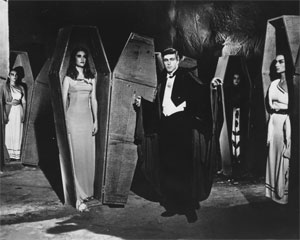
My last post about the Spanish language version of “Dracula” got me to thinking about this film. “El Mundo de los Vampiros” (a.k.a., “The World of the Vampires”) is a terrifically moody, atmospheric Mexican horror movie that is a throwback to the classic Universal horrors of the 1930s.
Unfortunately, I’ve only seen the non-subtitled version of the film (shown on a local Spanish language station), so I have virtually no idea what the plot entails (something about a deadly song), or if it’s as good as I imagine it. Given the pedigrees of the folks involved, it’s quite possible that it sucks. But, man-oh-man, is it beautiful and creepy to look at. Definitely worth a look-see if you come across it, especially if you don’t speak Spanish and can fill in your own more-interesting plot as it goes along.
Best Line:
No habla Español. Sorry.
Side Note:
Director Alfonso Corona Blake also directed those two Mexican wrestling/horror epics, “Santo vs. the Vampire Women” (1961) and “Santo in the Wax Museum” (1963).
Companion Viewing:
The Spanish version of “Dracula” (1931).
Links:
IMDb.
Cinefania Online.
Fan Tribute Page.
Take a Look:
Unfortunately, I haven’t been able to turn up any clips online. Anyone else care to tackle the challenge?
 Desuko Movie Spot.