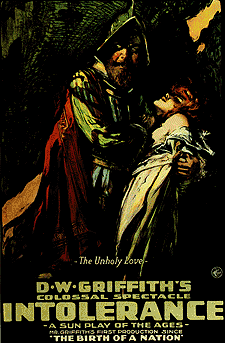
Intolerance (1916).
 The Scoop:
It’s been a non-stop B-movie cheesefest here the past couple weeks, so let’s take a break from that and get back to the classics.
One of the landmarks of cinema, and D.W. Griffith’s second masterpiece, “Intolerance” was made in response to the public outcry over the rampant racism in his previous film, “The Birth of a Nation.” In this film, Griffith’s artistic ambition tackles the huge subject of religious and social intolerance throughout history, with interwoven stories set in four different eras — ancient Babylon (in which in an innocent girl gets caught up in a rivalry that destroys the civilization), biblical Jerusalem (featuring scenes from the life of Jesus Christ), 15th century France (in which a young couple’s love is torn apart by the St. Bartholomew’s Day Massacre) and modern America (in which a young couple’s love is tested by turn-of-the-century labor unrest).
The American and Babylonian stories take center stage in lavish style — Griffith’s work here pretty much created the term “a cast of thousands.” At the time, and for many years afterwards, it was the longest (at anywhere from 160 to 200 minutes, depending on which print you see) and most expensive (with a budget of nearly $400,000) movie ever made. It was also a hit with the critics and stands up today much better than “The Birth of a Nation.” Griffith’s ornate visual style relied on intertitles much less than his contemporaries, and many of the Babylon sequences have a sensuality (even some surreptitious nudity) that would not seem out of place in the music videos of today.
Among the wild extravagances of the production was the full-size palace set for the Babylonian segments. It was constructed in the middle of Hollywood and remained standing for several years afterward. The distinctive set design has been incorporated into the design of the Kodak Theatre, the permanent home of the Academy Awards.
The less cinema-savvy viewers at that time, though, had a much harder time with Griffith’s groundbreaking style. The four tales are intercut at a deliberate pace that accelerates to the parallel chase scenes at the end. To an audience just getting used to basic linear storytelling, this was a real eye-opener. It was spoofed and parodied in a number of places, most notably by Buster Keaton in “The Three Ages” (1923).
Best (and Most Wildly Inappropriate) Intertitle:
“When women cease to attract men, they often turn to reform as a second option.” (Ouch!)
Side Note:
Griffith’s cowriters were a pair of newcomers to moviemaking — Tod Browning, best known for going on to direct a series of moody horror films, including “Dracula” (1931) and “Freaks” (1932); and Anita Loos, who was one of the pioneering women in Hollywood and whose later writing credits include “The Women” (1939) and “Gentlemen Prefer Blondes” (1953).
Companion Viewing:
“The Birth of a Nation” (1915) and “The Ten Commandments” (1923).
Links:
IMDb.
Take a Look:
For a sample, here’s a fan edit (with new music and sound effects) of the seige of Babylon:
Or, if you’ve got an afternoon to kill, you can see the entire film at MovieFlix.
Horror Hotel (a.k.a., The City of the Dead) (1960).
 The Scoop:
If H.P. Lovecraft had written “Psycho,” it might have gone a little something like this.
Nan Barlow (Venetia Stevenson) is a likeable young co-ed learning about witchcraft from Professor Driscoll (Christopher Lee) who visits the town of Whitewood, Mass., to continue her studies firsthand. Unfortunately, she discovers more than she bargains for and soon her brother, her boyfriend and a sympathetic local bookseller join forces to find out what happened to her.
Despite Lee’s limited role, this British cheapie zips right along with gothic creepiness, atmosphere and style to spare. If you’re looking for some late-night Halloween viewing, you can’t go wrong with this one.
(Word is, there’s a remake of this in development. This news doesn’t fill me with hope, especially if it winds up anything like the “Wicker Man” remake.)
Best Bit:
The climax, with the huge, backlit cross and burning witches.
Side Note:
Producer Milton Subotsky also wrote episodes for the long-running British television and film series “Dr. Who,” where at least two members of the “Horror Hotel” supporting cast (Valentine Dyall and Norman Macowan) have also made appearances.
Companion Viewing:
“Black Sunday” (1960), “Burn, Witch, Burn!” (1962) and “The Blair Witch Project” (1999).
Links:
IMDb.
Take a Look:
The trailer is at YouTube:
But you can find the whole thing online through Archive.org.
Metapost: Brief Intermission.
 Sorry for the longer than usual delay in updating, folks. Real life — in the form of a heavy work schedule, a toddler ER visit, and a bout with the flu for me — has kept me away from the blog. Expect a new review posted by Tuesday. In the meantime, have a good weekend… and let’s all go out to the lobby and get ourselves a snack!
The Godmonster of Indian Flats (1973).
 The Scoop:
This lovely confection has it all. A dorky Basque sheep herder goes to Reno and wins a fortune at the slots, only to have it stolen by a brazen hussy. An eccentric millionaire bankrolls an authentic recreation of an Old West mining town. A phoney psychic makes predictions based upon channeling the spirits of dead miners. The entire town makes believe a dog is dead and holds an elaborate funeral. An unscrupulous real estate developer almost gets lynched. And then just when you think the madness is getting to be too much, a giant mutant sheeps descends on the town and puts an end to it all. At least you hope it’s the end, but it’s not — the film then takes a detour into “King Kong” territory and gets even more bizarre, culminating in a riot in the town dump. Whew! (And that doesn’t even cover all the madness that goes on in this movie!)
They don’t make oddities quite like this anymore, although I’m not sure that’s a good thing or a bad thing. This is the brainchild and (mercifully) final film of Frederic Hobbs, who dropped moviemaking in favor of a slightly more successful career as an abstract sculptor.
If you’re a bad movie conisseuer, definitely do not pass up a chance to see this one; no amout of description or critique can do it justice. It’s definitely earned its spot in the Desuko Weird Movie Hall of Fame. Even the most jaded viewers will find their jaws hitting the floor repeatedly.
Best Bit:
The monster’s little pas de deux in the wilderness with the scientist’s lovely young assistant.
Side Note:
It appears that this turd never had a proper theatrical release. (Gee, I wonder why?) It’s legend only started to grow with its DVD release.
Companion Viewing:
I’m not sure what else could live up to this, except for Hobbs’ other films — “Troika” (1969), “Roseland” (1970), and “Alabama’s Ghost” (1972). Unfortunately, I haven’t seen any of those, so I’ll reserve judgement for now.
Links:
IMDb.
Uncle Scoopy’s Movie House.
Take a Look:
This clip, while wonderfully inept in itself, makes the film look linear and sane. It is not. The clip lies. But watch it anyway…
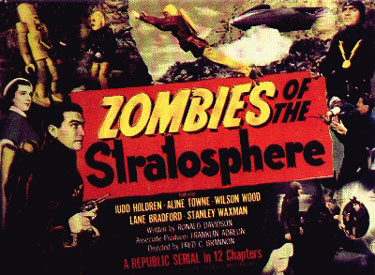
Zombies of the Stratosphere (1952).
 The Scoop:
If you’re in the mood for a classic Republic serial, this is probably the one to see. All the iconic elements are in place, and there actually seems to be some sort of energy put into the production.
However, the thing about these old serials is that they invariably lose a little something when taken out of their original context — one episode a week, shown to kids at a matinee before the main feature film. Sitting through every single episode consecutively gets mind-numbing very quickly, and not just because of the fact that as much as a third of the footage is dedicated to updating the story from previous episodes. There’s also the fact that, in order to crank them out quickly, the filmmakers stuck to the same formula for every episode. They’re practically the same scenes, with only slightly different dialogue. Without so much repetition, the nearly three-hour running time could easily be condensed into a tighter, sub-feature length film. (In fact, most of them were cut down this way for later TV broadcasts, and some of those versions are still available on video.)
But still, the serials churned out by the Republic Studios assembly line (mostly directed by Fred C. Bannon and written by Ronald Davidson) have their own special charm — the rocket ships equipped with office furniture, the hero’s silly flying costume, the lone alien hiring a couple two-bit thugs to help him take over the Earth. They can be hilarious… in small doses.
The plot for this one? Does it matter? (Just for the record, though, there are no zombies in this serial. Nor does anyone come from the stratosphere. The bad guys are actually aliens from Mars.)
Best Lines:
Thug: “You mean you can build a machine to rob a bank?”
Martian leader: “That’s what it amounts to. Although you would call it a robot.”
Side Note:
One of the Martian underlings, who is barely around long enough to even warrant a screen credit here, is a young Leonard Nimoy.
Companion Viewing:
“King of the Rocket Men” (1949) and “Radar Men From the Moon” (1952).
Links:
IMDb.
Take a Look:
The trailer tells you all you need to know…
 Desuko Movie Spot.