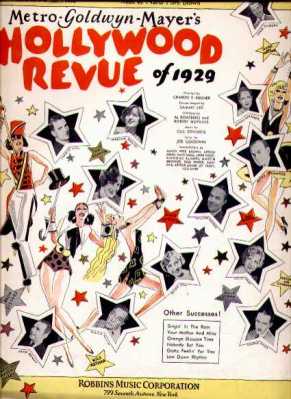
The Hollywood Revue of 1929 (1929).
 The Scoop:
This slow-moving affair was conceived as a showcase for MGM’s roster of stars, as well as their new sound equipment. Basically, this means we get a string of musical numbers broken up by quasi-comedic exchanges between the stars. Mostly for fans of music from that period (ukeleles!), although there are plenty of historical curiosities (Marion Davies!) as well. Probably more fun to watch at the time than it is now. Still, it would be fun to see today’s stars do something like this…
Best Bit:
Bessie Love’s solo number, with its self-deprecating lyrics and athletic dancing.
Side Note:
Includes an early Technicolor sequence of Norma Shearer and John Gilbert, two of the most popular romantic leads of the time, doing the balcony scene from “Romeo and Juliet.” Seven years later, Shearer would finally get make the full-length movie version of the play she had been pushing for for years, but because Gilbert had destroyed his career by that point, her Romeo was Leslie Howard.
Companion Viewing:
“Hollywood Party” (1934) and “Hollywood Canteen” (1944).
Links:
IMDb.
Take a Look:
Laurel and Hardy work their magic:
Megapost: Let’s Twist!
The last post about “Don’t Knock the Rock” got me thinking about it’s knock-off, “Don’t Knock the Twist.” That, in turn, brought up all the rest of that wave of Twist movies, so here’s your introduction to four of them.
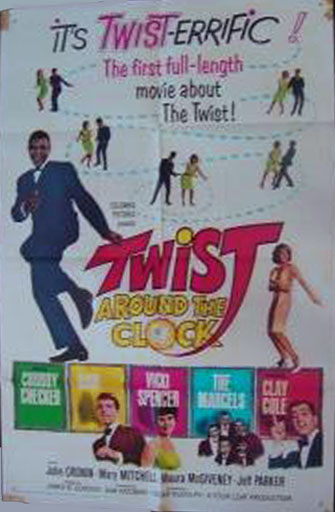
Twist Around the Clock (1961).
 The Scoop:
After Chubby Checker’s success with “The Twist,” there was a movement afoot in the early ’60s to establish the Twist as separate musical genre to itself. Never mind the fact the music sounded identical to rock ‘n’ roll and that all the lyrics were about the Twist and nothing else — obviously, this was an effort doomed to failure. Still, that didn’t stop Hollywood from making a wave of Twist movies to cash in on the burgeoning craze. The first was, appropriately enough, “Twist Around the Clock,” which (as the title would suggest) is a remake of the pioneering rock ‘n’ roll film “Rock Around the Clock.” Only this time, instead of rock ‘n’ roll supplanting sentimental big band music, this features Checker trying to get the Twist to supplant rock ‘n’ roll. A severe miscalculation, although it is fun to see Dion and the Belmonts on hand to do a couple of their big hits, “The Wanderer” and “Runaround Sue.”
Best Bit:
The line of kids sandpapering their shoes.
Side Note:
The screenplay credit went to “Rock Around the Clock” screenwriter James B. Gordon (real name, Robert E. Kent), because the producers essentially used the same script, only changing a few Twist-related details here and there.
Companion Viewing:
“Rock Around the Clock” (1956).
Links:
IMDb.
Take a Look:
Tom Funk gets the gang rockin’:
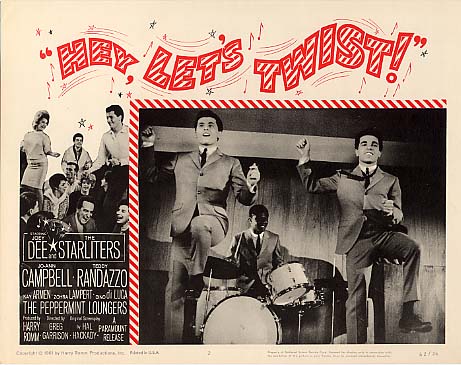
Hey, Let’s Twist! (1962).
The Scoop:
Devised as a star-making vehicle for Joey Dee and the Starliters and to capitalized on their hit “The Peppermint Twist,” “Hey, Let’s Twist!” tells the story behind the opening of New York’s famed Peppermint Lounge. Like any true Twist movie, it’s underwritten and poorly acted, but at least the music is entertaining. What sets it apart from the other Twist movies, though, is the sheer Noo Yawk Italian-ness of it. The non-musical scenes come off like G-rated Scorcese, and the fleeting presence of Joe Pesci (in his film debut) only reinforces that.
Best Bit:
The Starliters’ performance of “Shout.”
Side Note:
Joey Dee’s still working the nostalgia circuit — he’s even available to play your event!
Companion Viewing:
Oddly enough, “Mean Streets” (1973).
Links:
IMDb.
Take a Look:
Joey Dee and the Starlighters do the title track:
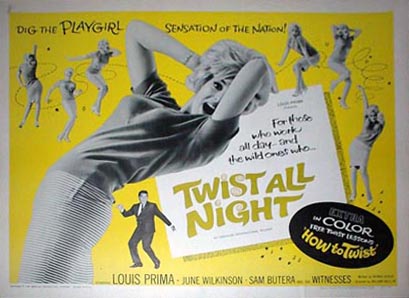
The Continental Twist (a.k.a., Twist All Night) (1961).
The Scoop:
A momentary diversion in the Twist movie cycle, this one barely even features the dance. Instead, the wonderful (although very un-Twist-like and un-rock-like) Louis Prima fights to save his night club from a greedy art forger. The plot really doesn’t matter. All that matters is Prima’s incredible music, performed along with Sam Butera and the Witnesses. Watch it for that alone.
Best Line:
“Oui! Le Twist!!
Side Note:
Originally released with a 9-minute color prologue called “Twist Craze” directed by Allan David.
Companion Viewing:
“Hey Boy! Hey Girl! (1959).
Links:
IMDB.
Take a Look:
A smattering of clips:
Don’t Knock the Twist (1962).
The Scoop:
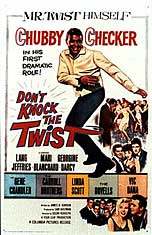 Oh, the strange, strange world of the Twist movies. It’s an alternate universe where Chubby Checker is revered as a demi-god, and where every aspect of culture is revitalized by hip youth with a special Twist flair — there is Twist music, Twist dance, Twist cuisine and Twist sociology. In this particular movie, the focus is on Twist fashion. It’s not immediately discernible how the Twist clothes on display here are different than regular clothes of the period, but they are. The filmmakers insist that they are. There’s also a plot about a TV producer having to stage a “Twist Spectacular” to save an orphanage and restore his discredited girlfriend’s good name. Odd.
Best Bit:
Vic Dana’s creepy song “Little Altar Boy.”
Side Note:
Our old screenwriting pal Robert E. Kent is back, not only writing the script, but also many of the lyrics for the Twist songs in the movie.
Companion Viewing:
Any other Twist movie you can find.
Links:
IMDb.
Take a Look:
Checker and Dee Dee Sharp perform “Slow Twistin'”:
Don’t Knock the Rock (1956).
 The Scoop:
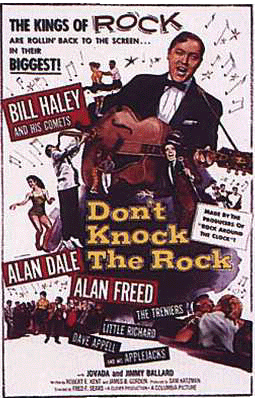
Another of the vast crop of early rock ‘n’ roll films, this isn’t among the best, but it has its own charm nonetheless. The wholly incidental plot (about a famous singer, played by Alan Dale, who goes back to his hometown to fight anti-rock prejudice) is beside the point. The whole reason to see this movie is for the terrific performances by the likes of Bill Haley and the Comets and Little Richard (who does his classics “Tutti Frutti” and “Long Tall Sally”). Alan Freed is also along for the ride, for no good reason other than self-aggrandizement. But the music — woo-hoo!
Best Bit:
“Rock ‘n’ roll is for morons!”
Side Note:
Screenwriter Robert E. Kent, who wrote for the original “Wild, Wild West” TV series, wrote this using the pseudonym James B. Gordon, which he also used to write “Rock Around the Clock.”
Companion Viewing:
“Rock Around the Clock” (1956) and “Mr. Rock and Roll” (1957).
Links:
IMDb.
Take a Look:
Everybody jitterbug!
Cop Land (1997).
The Scoop:
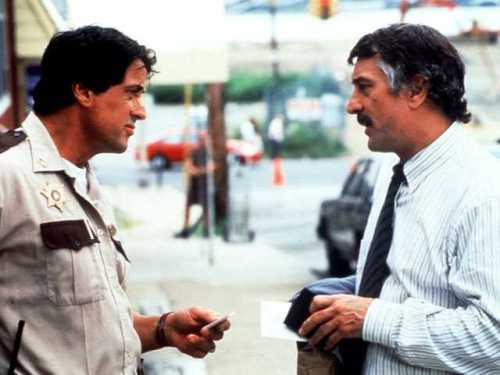
James Mangold’s film packs a punch. Oh, sure, it has it’s flaws — namely, Sylvester Stallone’s lunkheaded acting (the role presented a bigger physical stretch for him, with its self-induced “flabbiness,” than an acting stretch), the mere presence of Michael Rapaport, and that constant pet peeve of mine, having characters talk to themselves as a means of exposition — but these shortcomings don’t amount to much when compared to the rest of the movie.
Sly’s character Freddy is the sheriff of Garrison, New Jersey, a small town just across the river from New York City and populated almost entirely by crooked NYPD officers. An old injury has kept Freddy from realizing his dream of working in the City, so he must occupy himself with turning a blind eye to the actions of the cops on the take. Eventually, the moral abuses pile up too high and Freddy must make a critical decision.
The cast of Oscar-caliber heavyweights do what they do best, and it’s great to see Robert De Niro and Harvey Keitel play off each other again, two and a half decades after “Mean Streets” (1973), even if it is only for one scene. Unfortunately, De Niro’s small role does not also give him the opportunity to reunite with Cathy Moriarity, who plays Keitel’s wife and was De Niro’s costar in “Raging Bull” (1980).
Despite the “Joisey” trappings and the heavy debt to Martin Scorcese’s ’70s work, the film is, at heart, a classic western — the sheriff must clean up his small town by taking on a gang of gun-toting desperadoes by himself. Here, the “cowboy” mentality of many cops is given a more literal rendering and the elastic conventions of the movie western are enlarged even futher.
Best Line:
“Being right is not a bullet-proof vest, Freddy!”
Side Note:
Stallone gained 40 pounds for the role, and was only paid scale.
Companion Viewing:
“High Noon” (1952).
Links:
IMDb.
Henancius Entertainment.
Take a Look:
Here’s the trailer, although the audio doesn’t appear to be synced right:
A Bridge Too Far (1977).
The Scoop:
Just like the World War II battle it chronicles, this film is full of good intentions but is too ambitious for its own good. In the wake of D-Day, the Allies hatched an ambitious plan to invade Germany that involved the capture of seven bridges across the Rhine River. It was the largest single military operation in history up to that point, but the fight to secure the last bridge — the Battle of Arnhem — proved to be just a little too much, and the Germans prevailed. The Nazis’ victory was short-lived, of course, but the preparations for the battle offer a textbook example of how even the most powerful army in the world, with a drastic tactical advantage, can easily spread itself too thin and fail. And much like the Allied commanders, the filmmakers found themselves in the same boat.
The film (directed by Richard Attenborough, who only agreed to do it in exchange for funding to make “Gandhi” next) gives an excellent look at the strategic decisions that go into any military operation. In fact, this general’s-eye view of World War II makes an ideal counterpart to the grunt’s-eye view in “Saving Private Ryan.” But with too many plotlines and too many characters, the movie eventually collapses under its own weight. The performances by a host of familiar actors (including Sean Connery, Laurence Olivier, Michael Caine, Ryan O’Neal, Elliott Gould, Anthony Hopkins, Liv Ullmann and Gene Hackman) keep the viewer from getting too lost, but the appearances by Robert Redford and James Caan are just plain extraneous. However, despite all these shortcomings, “A Bridge Too Far” is still worth viewing, particularly by those interested in military history.
Best Line:
“I’ve got lunatics laughing at me from the woods. My original plan has been scuppered now that the jeeps haven’t arrived. My communications are completely broken down. Do you really believe any of that can be helped by a cup of tea?”
Side Note:
Received eight nominations for the British Academy Awards, but not a single Oscar nomination.
Companion Viewing:
“Saving Private Ryan” (1998).
Links:
IMDb.
British Cinema Greats.
Take a Look:
The trailer:
The first air drop:
The Germans are coming!
 Desuko Movie Spot.