Texas Chainsaw Massacre: The Next Generation (1994).
 The Scoop:
This fourth entry in the too-long running horror franchise should have remained unreleased and forgotten, if not for the fact that the two leads in the cast of unknowns went on to greater fame — Matthew McConaughey and Renée Zellweger. They both give energetic performances here, hinting at the success that was to come for them. The rest of the film, though, is pretty unredeemable, despite offering many unintentionally hilarious moments.
The plot starts with a group of losers on their way home from the prom, and from there it is essentially a rehash of the first “Texas Chainsaw Massacre,” complete with many shots and sequences shamelessly stolen from that gem. The brainchild of writer/director Kim Henkel, this sat on the shelf for three years before finally seeing the light of day. And the only reason it got its release was because McConaughey’s and Zellweger’s careers took off, not because of any intrinsic value in the film itself.
The whole effort hardly seems worth the trouble, although it is now worth a look for the morbidly curious, I suppose.
Best Bit:
McConaughey struggling with his remote control leg brace.
Worst Bit:
Leatherface in drag. (Don’t say we didn’t warn you.)
Side Note:
Look for Paul Partain and Marilyn Burns, stars of the original, in brief cameos.
Companion Viewing:
The first “Texas Chainsaw Massacre” (1974). Accept no substitutes.
Links:
IMDb.
Take a Look:
The trailer:
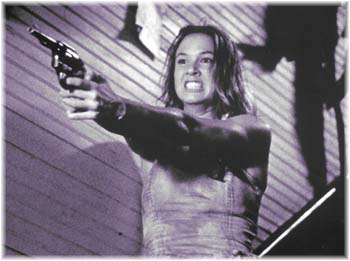
The girliest beatdown ever:
Volcano (1997).
 The Scoop:
“Volcano” isn’t just a dumb movie — it’s a Big Dumb Movie. And they don’t get much dumber or goofier than this.
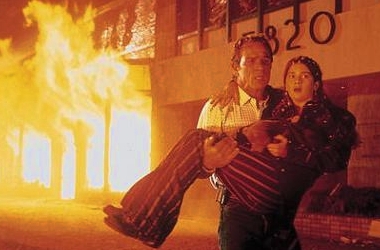
Basically, a great big hidden volcano tries to push its way up through Wilshire Boulevard in Los Angeles. Tommy Lee Jones, Anne Heche, Gabby Hoffman and Don Cheadle try to stop it. Or something. The plot doesn’t make much sense, and the characters make even less. But what you do get is plenty of bogus geological information, plenty of fire and explosions, plenty of L.A. landmarks being destroyed, plenty of running around, and plenty of bad dialogue and overacting. But most of all, you get clichés — lots and lots of your favorite movie clichés.
The end result is a cheeseball classic for the ages.
Best Lines:
Oh, there are just so many, where do I begin?
“You don’t understand — he’s my responsibility!”
“It burns! It burns!”
“Man, this Hieronymous Bosch is heavy!”
“I’m about to become the volcano version of Rodney King!”
“There’s no history of anything until it happens. Then there is.”
Side Note:
This was nominated for a Razzie for “Worst Reckless Disregard for Human Life and Public Property,” but lost out to “Con Air.”
Companion Viewing:
“Dante’s Peak” (1997).
Links:
IMDb.
Take a Look:
Oh no! Not Angelyne!
Um… Can 12″ of concrete really stop a raging lava flow?
The Beverly Center is demolished by unnecessary zooms:
Headin’ Home (1920).

The Scoop:
Terrific vintage baseball footage highlights this film, which was designed as a vehicle to showcase the New York Yankees’ newest slugger, Babe Ruth.
Ruth was the first great media superstar in the world of sports, becoming a household name as much for his appetites (for food, booze and women, not necessarily in that order) as for the way he single-handedly changed the face of baseball. And “Headin’ Home” marked the start of this. It was his film debut (he plays himself, a role he would return to often) and purports to tell the story of his rise from a mispent youth in Haverlock, Maryland, to the baseball superstardom.
The scenes that bookend the movie are authentic, shot at actual Yankees games in the old Polo Grounds (their home before Yankee Stadium opened) and are a real treat for fans of baseball history.
Of course, the story that comes in between is more fanciful than factual. We’re treated to scenes of Ruth carving his own bats from trees he chopped down, saving little girls’ beloved pets from the evil dogcatcher, and rescuing damsels in distress. But the film catches him at his youthful best — slim and full of energy, not the broken down older Babe we would see is his later, better known films and newsreel footage.
However, through all the trite silent comedy shenanigans and slow second half, Ruth’s larger-than-life personality shines through and it is that, along with the game footage, that makes “Headin’ Home” worth a look.
Best Bit:
The dog-in-the-meat-grinder dream sequence. Eep!
Side Note:
The Babe’s love interest is played by Ruth Taylor, who would later become the mother of writer/comedian/actor Buck Henry.
Companion Viewing:
“The Babe Ruth Story” (1948) and “The Natural” (1984).
Links:
IMDb.
Silents are Golden.
Take a Look:
This clip strings together scenes from several silent baseball films, but the first features the Babe hitting his big home run in “Headin’ Home”:
Pretty Poison. (1968).
 The Scoop:
Those who don’t know Anthony Perkins as anything but Norman Bates in “Psycho” owe it to themselves to hunt down this hard-to-find film.
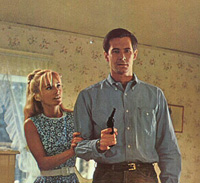
In this low-key black comedy, Perkins is a pathologically lying arsonist, newly paroled from the mental hospital, who convinces a naive teenage girl (Tuesday Weld) that he’s really a secret agent. The trouble is, she may just be crazier than he is, and things quickly get out of his control.
Noel Black’s direction and Lorenzo Semple Jr.’s script (based on the Stephen Geller novel) are incisive and full of dry wit. Weld gets a chance to tear it up, playing against her squeaky-clean Disney image. And, in many ways, Perkins plays a fun variation on the character he created in “Psycho.” In fact, the dumping-the-body sequence in “Pretty Poison” is a pretty sly tweak on the similar sequence in the earlier film.
An obscure gem. Unfortunately, it was horribly difficult to find for decades — only a meager theatrical run, few TV or revival house showings, and absolutely no video release. (In fact, the copy I first saw of this years ago was a VHS dub of a late night showing from the early, early days of AMC, which found its way into my hands through a really complicated set of circumstances.) Thankfully, 20th Century Fox has finally seen fit to give it a full DVD release, so there’s no longer any excuse not to pick this up at your local entertainment peddler’s establishment.
Best Line:
“I used to practice unlicensed tree surgery. It seems I once performed an unnecessary abortion on a peach tree.”
Side Note:
The film being shown in the movie theater scene is the Roger Corman quickie “St. Valentine’s Day Massacre” (1967).
Companion Viewing:
“Heathers” (1988) and “Natural Born Killers” (1995).
Links:
IMDb.
Take a Look:
This scene probably isn’t the best example of the mood of the whole film, but it’s entertaining nonetheless:
Outrage (1950).
The Scoop:
More than a half century ago, Ida Lupino was blazing a trail where too few have followed: A career as a female director in Hollywood. Working within the studio system, she made small, modest pictures — many in the noir vein — that still outclassed the output of many of her male colleagues.
And “Outrage” is one of her finest, an unvarnished examination of the consequences of rape, told from the woman’s point of view. It’s a perspective few others of the day could offer and Lupino drives her message home with full force, over the rough road from the terror of the initial attack, to the humiliation, acceptance and healing that follow.
Lupino’s direction and Mala Powers’ fine performance as the victim should have combined to make this a landmark in social commentary — instead, it has become an unjustly forgotten treasure.
Best Bit:
“It’s our fault, all of us. Our generation has produced too many neuroses, too many mentally displaced people right here at home. We need more hospitals, more men to turn human scrap back into useful human beings.”
Side Note:
Lupino not only gave a small part to her sister Rita, but also worked in an unbilled cameo for herself in the country dance scene.
Companion Viewing:
“The Accused” (1988).
Links:
IMDb.
Take a Look:
 Desuko Movie Spot.