Duck Soup (1933).
The Scoop:
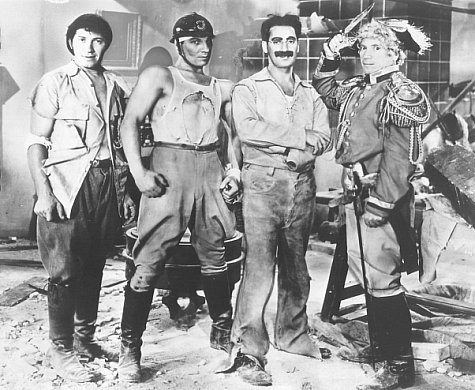
This brilliant political farce from the Marx Brothers features their finest work. And it’s one of those true classics that, if you haven’t watched it in a while, you owe it to yourself to revisit it. And if you haven’t seen it at all, then by all means close this window right now and surf straight on over to Netflix or Amazon to pick it up.
Groucho is Rufus T. Firefly, the new leader of the bankrupt nation of Freedonia, who declares war on a neighboring nation to impress a wealthy dowager (played by that eternal Marx foil, Margaret Dumont). Harpo, Chico and Zeppo are assorted hangers-on who get in on the fun. While the Marxes had had great success in film before this, “Duck Soup” is where they really came into their own as movie stars. It is the first film in which they managed leave behind the staginess of their early productions to combine the lessons they learned from years on the vaudeville stage with the strengths of the film medium.
Besides being one of the funniest movies ever made, with the trademark Marx anarchy in its full flower, it is also one of the most astute political satires ever put on film. The script (credited to four different writers, but obviously heavily expanded upon by the brothers themselves) expertly skewers the contemporary European politics that would eventually lead to World War II. But don’t think it’s dated — it still has plenty to say to us today, because nations at war are not so different from each other, no matter the time or place.
Best Bit:
Rufus: “Awfully decent of you to drop in today. Do you realize our army is facing disastrous defeat? What do you intend to do about it?”
Chicolini: “I’ve done it already.”
Rufus: “You’ve done what?”
Chicolini: “I’ve changed to the other side.”
Rufus: “So you’re on the other side, eh? Well, what are you doing over here?”
Chicolini: “Well, the food is better over here.”
Side Note:
At the time of the film’s release, the town of Fredonia, N.Y., complained about the similarity to the town’s name and requested that it be changed in the script. In response, the Marx Brothers insisted that the town change its name instead, and the matter was eventually dropped.
Companion Viewing:
“Dr. Strangelove, or How I Learned to Stop Worry and Love the Bomb” (1964) and “A Night at the Opera” (1935).
Take a Look:
The trailer:
Presenting… Rufus T. Firefly!
The mirror scene, a classic of comic timing:
High School Confidential (1958).
The Scoop:
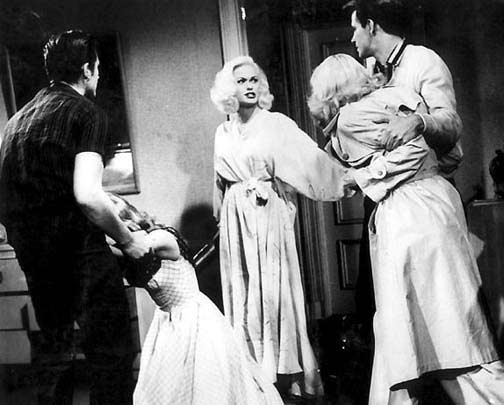
Another in the long line of ’50s teen exploitation movies, “High School Confidential” has all the makings of a campfest. However, this one sets itself apart by featuring a script (by Robert Blees and Lewis Meltzer) that presents a mature and insightful handling of drug use among teens. While this could have been another predictable screed against wild youth, it instead turns the tables by making the adults the real drug pushers and having the kids band together to bring them down.
Russ Tamblyn stars as an undercover cop who teams up with student Jan Sterling to infiltrate a high school pot and heroin ring run by local big shot Jackie Coogan. The film also features performances by less-successful Hollywood scions (and ’50s teen movie mainstays) John Drew Barrymore and Charles Chaplin, Jr., as well as Mamie Van Doren in the improbable role of Tamblyn’s sex-crazed aunt. Jerry Lee Lewis makes a couple of brief appearances performing the title song.
The place to start exploring this genre is “Blackboard Jungle,” the one that started it all. But after that, make “High School Confidential” your next stop.
Best Line:
“If you flake around with the weed, you’ll end up using the harder stuff.”
Side Note:
Van Doren and Chaplin later appeared together in the much campier “Girls’ Town” (1959).
Companion Viewing:
“Blackboard Jungle” (1955).
Links:
IMDb.
Hollywood Teen Movies.
Take a Look:
You get two for the price of one — the trailer AND Jerry Lee Lewis throwing it down in the opening credits:
Mamie does her thing:
Lobster Man From Mars (1987).
 The Scoop:
This campy tribute/parody of ’50s B-movies starts with potential but quickly peters out. A movie producer (Tony Curtis) learns he needs to release a money-losing film in order to evade the IRS, and who should walk in the door but a nerdy kid (Dean Jacobsen) with his “opus,” the movie of the title.
This, of course, is very reminiscent of the plot of “The Producers.” But instead of spending much time exploring (or re-exploring) the possibilities in this storyline, most of the movie is given over to the film-within-a-film, which contains a few interesting satiric moments, but grows old quickly. The whole thing is mostly a failure, but worth a look anyway — especially if you’re a devotee of b-grade ’50s sci-fi.
Features appearances by Patrick Macnee, Bobby “Boris” Pickett and Billy Barty.
Best Line:
“If you were a lobster man, would you go into a haunted house surrounded by hot springs?”
Side Note:
Curtis’ role was originally intended for Orson Welles, who died before production began. Curtis later said that the only reason he took over the role was to have money to pay child support.
Companion Viewing:
“The Producers” (1968), “Ed Wood” (1995) and “The Lost Skeleton of Cadavra” (2001).
Links:
IMDb.
Take a Look:
The trailer:
Psycho: Hitchcock vs. Van Sant.
Psycho (1960).
 The Scoop:
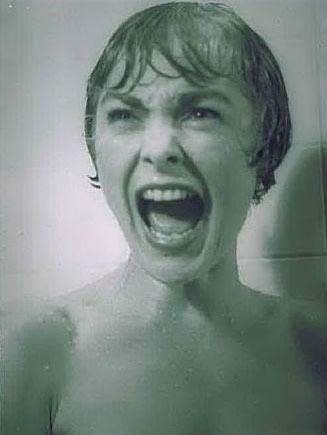
From our 21st century perspective, it’s easy to underestimate the impact this film has when it was first released. If for no other reason, it left it’s mark on film history for depicting a level of violence and brutality unseen before. Although its violent content has since been surpassed many times, Alfred Hitchcock staged it with a sympathy for the victims that is still touching. And, ever the cinematic experimenter, he and screenwriter Joseph Stefano took the bold step of murdering the main character, Marion Crane (Janet Leigh), less than halfway through the film, asking the audience to transfer its allegiance from her to the shy, awkward Norman Bates (Anthony Perkins). Then the audience’s trust is further undermined when Norman is unmasked as the killer. Norman’s psychological underpinnings may seen clichéd now, but they were revolutionary at the time. No wonder moviegoers lined up around the block repeatedly to get in.
Coming off the successes of “North By Northwest” (1959) and “Vertigo” (1958), Hitchcock was looking for a change of pace and was inspired by the plethora of B-grade exploitation thrillers flooding the drive-ins at the time. Along came the novel by Robert Bloch, very loosely based on the infamous Ed Gein murders in Wisconsin — which have also served as the basis of other movies, such as “Deranged” (1974) and “The Silence of the Lambs” (1991).
Hitchcock acquired the film rights and set about adapting it quickly and cheaply, so it was shot in black and white with a minimum of star power. The lesser-known actors he found give terrific performances, aided by the legendary score by Bernard Hermann (his music for the shower scene is, along with the themes from “Jaws” (1975) and “The Good, the Bad and the Ugly” (1967), one of the most instantly-recognizable pieces of film music ever). To build hype for the picture, Hitchcock made theaters not allow anyone in once the film had started. The result was one of his greatest triumphs.
Best Line:
“We all go a little mad sometimes.”
Side Note:
Among this film’s shocking “firsts” for the Hollywood establishment, it was the first to show a woman wearing only a bra, the first to use the word “transvestite” and the first to show a toilet flushing on-screen. Some other firsts were dropped because of studio pressure, including brief nudity and an implied shot of Norman masturbating.
Companion Viewing:
“Psycho” (1998) and “Homicidal” (1961).
Links:
IMDb.
Take a Look:
The trailer, featuring Hitch at his droll best:
The shower scene:
Psycho (1998).
The Scoop:
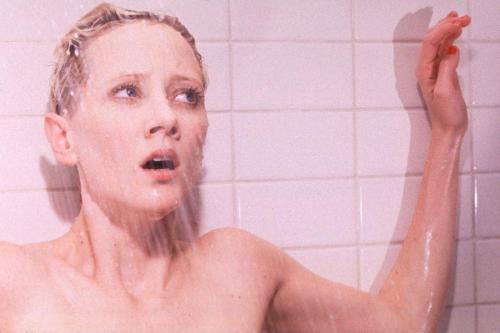
It’s director Gus Van Sant’s great experiment — remaking the Alfred Hitchcock classic, nearly (but not quite) shot-for-shot. And yet, for all it’s verisimilitude, this doesn’t have the same impact as the original. Some of this may be due to the ways the audience’s tastes had changed during the interval of nearly 40 years, but more of it boils down to one basic choice — the casting of Vince Vaughn as Norman Bates. What made Anthony Perkins so effective in that role was his innocent, harmless quality. He seemed like more of a sweet geek than a psycho, which made the ending all that more shocking. He made both Janet Leigh’s character and the audience comfortable. Vaughn, on the other hand, is sinister from beginning to end — sinister enough to make you wonder why Anne Heche’s character didn’t run from the motel screaming the first time she saw him.
Van Sant may have recreated the visuals of the original, but there is no way anyone can recreate the experience of the 1960 movie-going public seeing it for the first time. Once a bomb has gone off, there’s no way to make it unexplode.
(And one other thing that has puzzled me — why did Anne Heche get the retro wardrobe, while Julianne Moore was dressed like an extra from “90210”?)
Best Line:
“We all go a little mad sometimes.” (C’mon… They were both working from the same script. You were expecting a different selection?)
Side Note:
The use of the knife in the shower scene is credited to director John Woo.
Companion Viewing:
The original.
Links:
IMDb.
A comparison of the two versions.
Take a Look:
The big basement “reveal” scene, always good for a laugh:
And finally, the two versions of the shower scene, played side-by-side (notice the subtle changes Van Sant introduced, most notably the extra doses of naked Heche):
The Busher (1919).
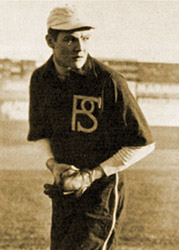 The Scoop:
This baseball themed drama is pretty standard fare for its era — perhaps even somewhat conservative, given that it is preaching the evils of big city life at a time when the film industry (and mass entertainment as a whole) was embracing the joys of urbanization.
Charles Ray (the reigning heartthrob of his day) plays Ben Harding, a small town pitching star who gets discovered by a major league club and heads to the big city. While there, he turns his back on his hometown supporters and succumbs to the requisite temptations of booze, women and gambling. He eventually washes out, returning to his hometown in disgrace. But out of that disgrace comes the chance to redeem himself and win back the girl he loves.
The look at old-time baseball is fun, but the rest hasn’t aged well and the last half of the movie is just plain tedious.
Best Line:
“Take it from me — that guy’s got more curves than a stovepipe!”
Side Note:
Ray’s costarring cast includes Colleen Moore and John Gilbert, who would both go on to eclipse his stardom in the silent era, only to find their careers stalled after the advent of the talkies.
Companion Viewing:
“Headin’ Home” (1920) and “The Natural” (1984).
Links:
IMDb.
Silents are Golden.
Take a Look:
Sorry, nothing to offer you on this one. Obviously, there are still a few holes to fill in the Internet.
 Desuko Movie Spot.