Beyond the Valley of the Dolls (1970).
 The Scoop:
It’s about time I got around to reviewing this classic.
Along with “Faster, Pussycat! Kill! Kill!” (1965), this represents the apex of the Russ Meyer canon. Finally, Meyer’s single-minded obssession with big breasts is coupled with a wonderfully campy plot — an all-girl rock band called the Carrie Nations (played by, from left to right in the photo, Marcia McBroom, Dolly Read and Cynthia Myers) comes to Hollywood, where they find drugs, violence and lots of wild sex.
In the first film of his ill-fated stint as a major studio director, Meyer teamed with future film critic Roger Ebert to create a landmark work that celebrates the excesses of the free love ’60s while also looking ahead to the crises and malaise of the ’70s. Not bad for what is, at heart, a cheap sexploitation flick.
Read, Playboy’s Playmate of the Year for 1966, is an especial revelation in her first starring role. So is John Lazar, who plays flamboyant record producer Ronnie “Z-Man” Barzell, a character based on the unhinged exploits of Phil Spector.
Fast-paced, joyous and filled with great music, “Beyond the Valley of the Dolls” is definitely of its era and wonderfully loopy fun. It is very nearly the perfect movie, despite its shocking downer of an ending.
Meyer’s joy ride as a major studio director would have a rough ending as well. Despite the smash box office success of the film, it draws controversy, too, particularly from Hollywood’s old guard, who are aghast by its excesses (it was one of the earliest films to carry an X rating). After just one more film for Fox (the disappointingly straight “The Seven Minutes” in 1971), Meyer was dropped by the studio and he returned to the exploitation underground.
Best Line:
“This is my happening and it freaks me out!”
Side Note:
The “Beyond the Valley of the Dolls” project originally began at Fox as a true sequel to their madly successful 1967 adaptation of Jacqueline Susann’s trashy novel “The Valley of the Dolls.” However, the script Susann submitted fell short of the studio’s expectations, and their contract allowed Fox to go ahead with a sequel without her involvement in such a situation. The project went through a number of incarnations in the development process before finally being given to Meyer, who the stodgy studio had signed in an attempt to get a piece of the booming youth market. The rest is history, as they say, although Susann was able to get Fox to append the now-famous disclaimer to the beginning to warn viewers that “Beyond the Valley of the Dolls” is not, in fact, a sequel to “Valley of the Dolls” after all.
Companion Viewing:
“Spice World” (1997) and the “Josie and the Pussycats” cartoon series.
Links:
IMDb.
Official Site.
As a Side Note.
Take a Look:
The totally awesome trailer:
The cross-country trip:
One of the all-time great party scenes:
Blue in the Face (1995).

The Scoop:
The title is especially appropriate given how much the actors blab in this film.
Shot by Wayne Wang and Paul Auster along with their film “Smoke,” “Blue in the Face” is nothing more than a series of improvised vignettes in and around the smoke shop run by Harvey Keitel’s character in the first film. Keitel is the only holdover from “Smoke” and the film is entirely improvised.
And boy does it show.
Most of the scenes meander to nowhere in particular, and the only interest comes in seeing so many big name actors and musicians try to ad lib off each other. Some aren’t too bad (such as Madonna delivering a singing telegram, or Lou Reed’s discussion of his fear of travel), but most of them just plain suck.
It’s like an acting class exercise gone wrong, but if you’re in the mood for pointless indulgence, this is the film for you.
Best Line:
“Yes, I am smoking cigarettes and some of my friends have died of them, but I am not downing a quart of scotch in 15 minutes. Looked at that way, cigarettes are actually a health tool.”
Side Note:
This was shot in just five days. Wang and Auster claimed to take their inspiration for the movie from Roger Corman.
Companion Viewing:
“Smoke” (1995).
Links:
IMDb.
Take a Look:
This series of clips should give you a pretty good idea of the feel of the movie. And just because it’s a random, patched-together string of clips, don’t think that the full film is any more coherent. It plays just like this, but with more aimless cameos.
Angels and Insects (1995).
 The Scoop:
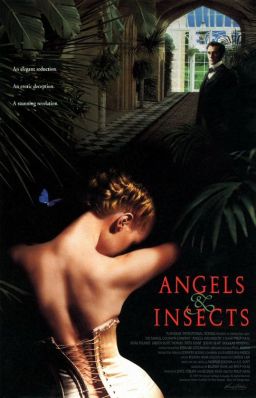
This is one of those art house period pieces that works better for what it means than for what it is — wonderfully acted and beautiful to look at, but ultimately somewhat hollow at its core.
William Rylance plays an awkward 19th century naturalist marries into a proper upper-class English family, prompting a sort of culture clash that draws out an old family secret. Patsy Kensit play his wife, the fragile Eugenia, Douglas Henshall is her oddly possessive brother Edgar, and Kristen Scott Thomas is Matty Crompton, an spinsterish cousin with a love for studying biology.
The storyline, based on A.S. Byatt’s novel “Morpho Eugenio,” is slow and only occasionally compelling, but it raises interesting issues about Darwinian evolution, the human animal and mankind’s place in the natural world. Shots of the gritty natural lives of the insects contrast nicely with the refined civilization of the family and show that we’re not really as far removed from our animal brethren as we like to think. The costume design by Paul Brown strikingly underscores this similarity by mimicking the brilliant markings of the exotic insects, and the cinematography by Bernard Zitzermann wonderfully captures the look of Victorian-era painting.
Best Bit:
The wedding night sex scene between Eugenia and William.
Side Note:
Brown received an Oscar nomination for his costume design here, in what was also his first feature film work.
Companion Viewing:
“The Age of Innocence” (1993).
Links:
IMDb.
Take a Look:
The trailer:
F For Fake (1974).
 The Scoop:
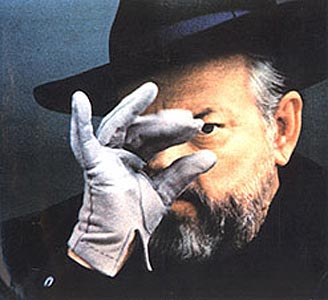
Orson Welles was the consummate trickster. Already a successful theater director, he burst into the public eye in 1939 with his infamous “War of the Worlds” radio broadcast, a pioneering piece of pseudo-documentary hucksterism. From there it was onto the capital of illusion, Hollywood, where he began a film career in which he repeatedly played with the audience’s notions of the boundaries reality and imagination, and celebrated the power of magic.
In the documentary “F For Fake,” which would ultimately prove to be his final directorial effort, he turns his lifelong fascination with trickery and illusion toward investigating the case of notorious art forger Elmyr de Hory and his equally notorious biographer (and Howard Hughes diary forger) Clifford Irving. As they tell their stories for his camera, Welles interweaves his own philosophizing on the power of fraud and the nature of art. Plus, as if that weren’t enough, the careers of Hughes and Welles himself get mixed in for good measure.
And then there’s the final 20 minutes or so, in which Welles detours into telling the story of Oja Kodar, which transcends all the indulgence and trickery that came before.
The result is an essay, really, more than a film — but one that is sprawling and fascinating.
In the end, “F For Fake” becomes a fitting tribute to his career — both thought-provoking and self-serving, dishing out equal parts brilliance and self-indulgence. And utterly ignored by the mainstream.
Best Bit:
There’s lots of good, quotable stuff here, but the discourse on the cathedral at Chartes stands out.
Side Note:
The excerpt of “War of the Worlds” that Welles includes is actually a recreation, not the original broadcast, and even includes some rewritten lines.
Companion Listening/Viewing:
Welles’ original “War of the Worlds” (1939) and “The Blair Witch Project” (1999).
Links:
IMDb.
Take a Look:
The trailer:
The Chartes monologue:
 Desuko Movie Spot.