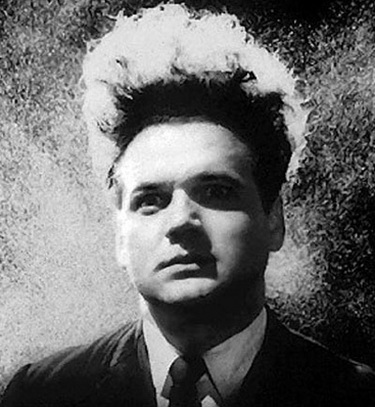
Eraserhead (1977).
 The Scoop:
Today is Leap Day, an oddity and trick of the calendar. So it seems only appropriate to mark it with a cinematic oddity.
“Eraserhead,” David Lynch’s first feature-length film, is a bizarre cornucopia of visual and audial treats. And while it may seem amateurish in comparison to his later work, many of the familiar Lynch themes are evident at this early stage, along with his usual indebtedness to Luis Buñuel and the other early surrealist filmmakers.
Lynch stalwart Jack Nance is the title character, a loser who wanders around a bleak urban landscape caring for a deformed baby (the product of an unwanted pregnancy), abandoned by his girlfriend and having weird dreams. Mostly, though, it is a completely indescribable (albeit fascinating and slightly disturbing) film that plays like a waking nightmare.
Along with “The Rocky Horror Picture Show,” this was one of the pioneering midnight movies of the ’70s and a unique viewing experience. If you’ve never seen it before, nothing can really prepare you for it, except maybe a spirit of adventure. But don’t rely on me to tell you about it — just go see it yourself.
Best Bit:
The dancing woman stomping bits of organic-like… stuff.
Side Note:
The film was shot off and on over the course of five years. Nance kept his character’s bizarre haircut the entire time.
Companion Viewing:
“The Cabinet of Dr. Caligari” (1919), “Un Chien Andalou” (1928) and “Pi” (1998).
Links:
IMDb.
FilmCritic.com.
The City of Absurdity.
Take a Look:
The trailer:
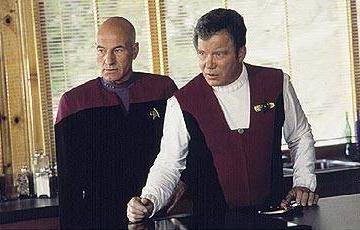
Star Trek: Generations (1994).
 The Scoop:
For a film that is such a landmark in the “Star Trek” franchise, “Generations” sure does find some ways to disappoint. This cinematic passing of the torch from the cast of the original series (represented here by William Shatner, James Doohan and Walter Koenig) to the cast of “The Next Generation” features some stirring action sequences, but is otherwise saddled with an uninspired plot.
“Generations” opens with the elder statesmen from the original Enterprise crew (Kirk, Checkov and Scotty) on hand to oversee the launching of their successor, the Enterprise-B. A distress call leads them to save a shipload of El Aurians from a mysterious energy ribbon. Among the refugees are Guinan (Whoopi Goldberg) and Dr. Soran (Malcolm MacDowell). The rescue damages the Enterprise and sweeps away Kirk, who is presumed dead.
Skip ahead to the 24th century, where Capt. Jean-Luc Picard (Patrick Stewart) and his crew of the Enterprise-D, including the mysterious Guinan, are investigating the destruction of a science station. This leads them to Soran, who will stop at nothing (including the destruction of entire civilizations) to return to the Nexus, the timeless energy realm from which he and the other El Aurians were taken by the Enterprise-B rescue. To stop him, Picard must team up with Kirk, who was trapped inside the Nexus this whole time.
As if all that weren’t enough, the android Lt. Commander Data (Brent Spiner) has also decided to install a new emotion chip, which brings him difficult consequences.
It’s a rather long and convoluted plot (courtesy of “Next Generation” producers Rick Berman and Brannon Braga, along with Ronald D. Moore) which, frankly, adds very little to the overall “Star Trek” mythos. However, director David Carson handles the action sequences well, especially the showstopper (uh-oh, spoiler alert!) — the crash landing of the Enterprise-D.
Otherwise, the performances are fairly routine. The regulars from both series stroll through the roles they’ve played hundreds of times before, with the only life coming from Shatner and Stewart’s scenes together. These two old pros know the momentousness of this for the fans and rise to the occasion. Meanwhile, guest star MacDowell provides his familiar over-the-top histrionics.
This film is a must for Trekkies, of course, particularly for the pairing of Kirk and Picard. For newcomers to the series, this is definitely not the place to start. Check your local listings for the TV episodes instead.
Best Line:
“I was out saving the galaxy when your grandfather was in diapers.”
Side Note:
Picard’s Enterprise-D was destroyed in the film for reasons that go beyond the story. Because the model was designed for the 1.33:1 aspect ratio of television, it did not look as good on film’s 2.35:1 widescreen aspect ratio. Because it had to be replaced anyway, the producers decided to destroy it onscreen (and also symbolically cut the crew’s ties with the television show), with the new widescreen-friendly version becoming the Enterprise-E of the later movies.
Companion Viewing:
The rest of the series.
Links:
IMDb.
Official Star Trek site.
Take a Look:
As you might expect, Paramount has tried mighty hard to scrub the internet clean of any sort of clips. But there are a few out there, like this fan-made trailer:
More homemade trailer-ation, this time in German and with lots of spoilers:
A montage of starship shots:
The Commies are Coming, the Commies are Coming (1962).
 The Scoop:
This video release is actually two propaganda shorts from the early ’60s packaged together to show red-baiting at its paranoid height.
A school civics lesson that made good, the first short is “Red Nightmare,” which was made as an educational film and distributed to schools (although it also had at least one primetime television showing.) It featuring Joe Friday himself, Jack Webb, narrating the story of an everyday, red-blooded, all-American father who wakes up one day to find the country overrun by Communists who take away all his rights. Boy howdy, does he learn his lesson quick not to take his freedoms for granted. With its extensive cast (most of whom went on to TV stardom in one form or another) and respectable production values, its obvious this was a love child of Jack Warner’s, whose studio produced it for the Defense Department.
The second short is a government training film with the catchy title “Army Information Film No. 7: Code of Conduct – To Resist.” It was intended for soldiers, with Webb explaining exactly what to do if captured by the enemy.
If you only ever watch one piece of Cold War propaganda, make this the one. It is anti-Communist paranoia in its purest form, soaring to operatic heights.
Best Line:
There are so many. Most of the Communist dialogue is along the lines of this chestnut: “One day we will destroy their bourgeois capitalist freedoms.”
Side Note:
The city square set on the Warner’s backlot where much of “Red Nightmare” was shot was later used for both “Bye, Bye Birdie” (1963) and “Back to the Future” (1985).
Companion Viewing:
“The Atomic Cafe” (1982).
Links:
IMDb.
“Red Nightmare” fan site.
Take a Look:
Here’s “Red Nightmare” in its entirety:
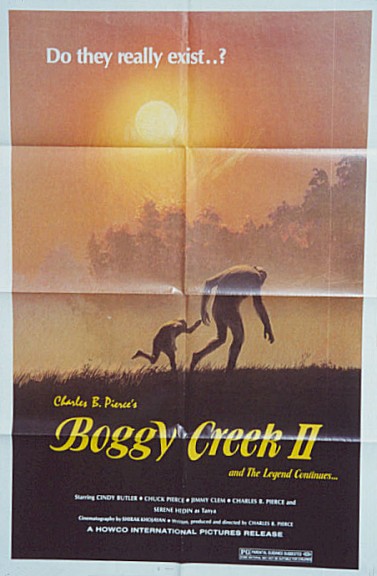
Boggy Creek II: And the Legend Continues (a.k.a., The Barbaric Beast of Boggy Creek, Part II) (1985).
 The Scoop:
“Gross-out” movies may be all the rage these days, but simply making poop jokes or constructing horror scenarios that break a few taboos is not all that gross. True grossness comes from other, somewhat unexpected places, usually involving ugly people and their bodily functions. Something like this movie.
Although it is labeled part two, this film is actually the third in the series about the Boggy Creek Creature, a sorry attempt to build a horror franchise around an allegedly real Bigfoot-like monster that stalks the Arkansas wetlands. The plot this time around concerns a University of Arkansas researcher who takes some of his students into the wilderness to find the monster. Mostly he just relates incidents from the earlier movies, from which footage is taken to pad out the running time.
But this has the distinction of being probably the grossest movie you’ll ever see. There are lots of inbred hillbilly stereotypes, big hairy guys without much clothes, ugly people sweating profusely, and the piece de resistance — a hick so scared by the creature that he steps in his own diarrhea in the outhouse and has to have his wife hose him off. The Arkansas Tourism Board has their work cut out for them to counteract the effects of this movie.
Best Line:
“I’ve seen the little creature!”
Side Note:
Written, produced, directed and starring Charles B. Pierce, who made a string of low budget crap in the ’70s and early ’80s. Most of the films featured Jimmy Clem, the fat, ugly guy who plays Crenshaw in this movie.
Companion Viewing:
“The Legend of Boggy Creek” (1972), “Return to Boggy Creek (1977), “The Giant Spider Invasion” (1975) and “Squirm” (1976).
Links:
IMDb.
Some information on the Fouke Monster, the inspiration for the films.
Take a Look:
The trailer:
 Desuko Movie Spot.