The Mask (1961).
(Before we start, one housekeeping note: The Desuko crew will be taking a brief spring break. Tune back in next week for more reviews.)
The Scoop:
No, this isn’t that Jim Carrey flick, although the plots are vaguely similar. You can tell the difference because this one doesn’t have a dog, any intentional humor or a co-star as ferociously shagadelic as Cameron Diaz.
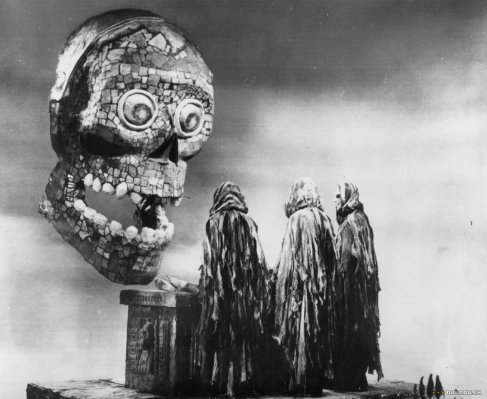
In this version, a psychologist (played by Paul Stevens) acquires an ancient African mask from an unbalanced patient who has just killed himself. The mask exerts some strange power over the dopey doctor, and when the off-screen narrator starts urging him to put the mask on, he can hardly resist. Every time the mask is on, the doc (along with the audience) is whisked away into 3-D hallucinations full of cheap costumes and bad interpretive dance, after which he usually kills someone (just like the audience wishes it could).
It’s a ballyhoo gimmick, of course, from the golden age of the practice. When the narrator says “Put on the mask,” he isn’t just speaking (however improbably) to the main character. He’s also speaking to the people in the audience, urging them to put on their own masks — the 3-D glasses they got as they walked into the theater.
“The Mask” is entertaining in a so-horrible-its-fun sort of way. The 3-D sequences are definitely the highlights and still play well, even if you don’t have the 3-D glasses to watch them as they were meant to be seen. They transform this hopelessly generic Canadian film into sometime totally memorable.
Best Line:
You’ll hear it so much, you can’t resist: “Put the mask on!”
Side Note:
Not only is this the first homegrown Canadian 3-D movie, it’s also the nation’s first homegrown horror movie and the first to get widespread distribution in the United States.
Companion Viewing:
“The Mask” (1994) and, in an oddly fitting way, “Laserblast” (1978).
Links:
IMDb.
CBC.ca’s Alternative Canadian Walk of Fame.
Take a Look:
The trailer:
Pi (1998).
The Scoop:
Today is March 14 (3/14), which the math geeks among us celebrate as Pi Day. Hence, today’s post.
Rarely has intellectual genius been so compellingly displayed on film as in “Pi.” This edgy, hyperkinetic blast from the underground is like a splash of cold water in the face. It is also a tour de force debut for writer/director Darren Aronofsky.
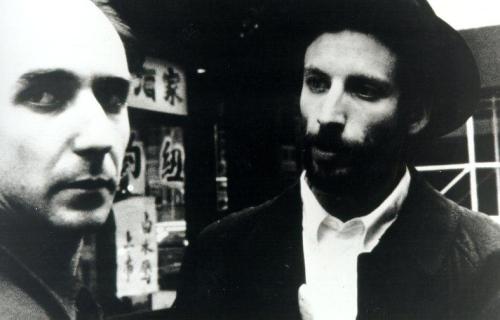
Max Cohen (played by cowriter Sean Gullette) in a reclusive, unbalanced mathematical genius in New York obsessed with discovering the underlying numerical patterns of the stock market. Because these patterns can hold the secret to predicting the behavior of the financial markets, a group of corporate heavies is after his secrets, willing to use force if necessary. Also on his trail is a radical Jewish sect that wants him to uncover the numerology of the Kabbalah. Max just wants to be left alone with his precious numbers, but his pursuers keep him on the run, as well as make him question his relationship with his Jewish heritage and, eventually, draw him mysteriously toward the number pi.
Math is everyone’s least favorite subject in school, but Aronofsky makes it exciting, thrilling stuff. Jewish mysticism gets its due here, too. (As Aronofsky once put it in an interview, “I wanted to make a movie about God, math and badass Jews.”) The combination, accented with gritty black and white cinematography and an alluring electronic music score (by Aphex Twin, Orbital and others), is captivating.
Best Line:
“11:15, restate my assumptions: 1. Mathematics is the language of nature. 2. Everything around us can be represented and understood through numbers. 3. If you graph these numbers, patterns emerge. Therefore: There are patterns everywhere in nature.”
Side Note:
Despite the heavy (and mostly accurate) mathematics in the script, Aronofsky did have to take a few liberties. For instance, Max’s attempt to list all 216-digit numbers would be impossible — it would take even the fastest computer longer than the lifetime of the universe to accomplish the task.
Companion Viewing:
“Run Lola Run” (1996).
Links:
IMDb.
Official site (designed by Gullette).
Darren Aronofsky Online.
A drinking game.
Take a Look:
The trailer:
The Clash Live: Revolution Rock (2008).
 The Scoop:
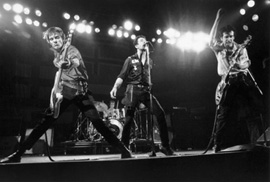
Consider this the concert film The Clash always deserved. The impact of “The Only Band That Matters” can’t be overestimated, and part of that impact came from their incendiary live performances. “The Clash Live: Revolution Rock” does those performances justice.
Divided into sections corresponding to each of the band’s albums, the film features full songs from rarely seen concert footage, all strung together with brief interview snippets from each era. (Mercifully, “Sandinista!” is represented by only one tune, “The Magnificent Seven.”) We see them grow from grimy punk club sensations to arena megastars, and their energy and passion is evident throughout. And with the exception of “Guns of Brixton” (ruined by a crappy sound mix), all the footage looks and sounds great.
There isn’t much historical context or background information on the band, but there’s so much of that already out there in the world that it hardly matters. All that matters is the music, which still packs a bunch a generation later. Don’t miss this one.
Best Bit:
The 1977 performance of “White Riot.”
Side Note:
The only album not covered in the film is 1986’s “Cut the Crap,” which was the band’s last. By that time, both Mick Jones and Topper Headon had been kicked out of the group, and the album was both a commercial and artistic failure. Joe Strummer and Paul Simonon, who broke up the band immediately after its release, have since disowned the album and no mention of it ever appears in any of the band-approved retrospective projects.
Companion Viewing:
“The Clash: Westway to the World” (2000).
Links:
The Clash Online.
Take a Look:
The teaser trailer:
Performing “Magnificent Seven” on “The Tomorrow Show With Tom Snyder” in 1981:
Instrument (1998).
 The Scoop:
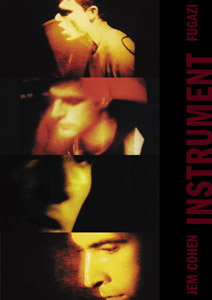
This documentary of the influential Washington, D.C., based punk band Fugazi lets the music do the talking, which is probably the best approach for this subject. While both the band’s music and anti-commercial stance have been revolutionary (lack of major label involvement, fan-friendly pricing, D.I.Y touring, etc.), leaders Ian MacKaye and Guy Piccotto are not necessarily the most articulate offstage spokesmen for those beliefs. Fortunately, director Jem Cohen has chosen to feature Fugazi’s music so prominently here that it makes their case for them.
The film features a decade’s worth of live performance clips, as well as extensive studio footage. Although this approach does make for some slow going in places, the end result is rewarding — a great primer on one of the true independent acts of the time. And for you young’ns, it’s an intriguing look at how bands fought the music industry monopolies in the days before MySpace and MP3s.
Best Bit:
MacKaye berating the “ice cream-eating motherfucker” for pushing people too hard in the crowd.
Side Note:
Cohen has created similar movies for R.E.M. and Elliott Smith. Check ’em out.
Companion Viewing:
“The Decline of Western Civilization” (1981).
Links:
IMDb.
Band page at Dischord Records site.
Take a Look:
The ice cream eater gets what’s coming to him. (The band follows with the song “Little Debbie”):
Performing “Song #1”:
Here’s “Slo Crostic”:
The Gorgon (1964).
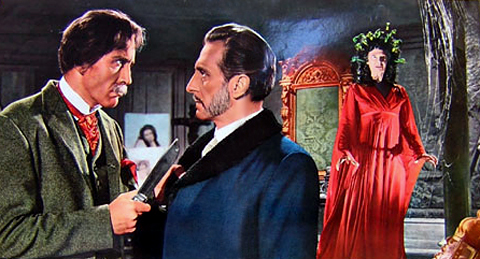
The Scoop:
Britain’s Hammer Studios quickly shot to prominence in the late 1950s with their signature adaptations of Frankenstein and Dracula, each of which launched a popular string of sequels. The secret of their success was a combination of titillation, light gore and garish Technicolor, which shook up the world of those two famous monster movie icons.
“The Gorgon” is apparently Hammer’s attempt to create a new horror franchise, this time out of Greek mythology. It doesn’t totally work, but nonetheless there are some unexpectedly gentle, low-key moments that make this somewhat entertaining.
In 1910, a small German village is threatened by the spirit of a surviving Gorgon (one of those snake-headed sisters who turn everyone they look at to stone), who is inhabiting the body of a local woman (Barbara Shelley) and killing a series of victims. Hammer stalwart Peter Cushing plays the local doctor who is covering up the murders, while Christopher Lee is the university professor investigating them. Unfortunately, both wear rather silly facial hair, but once the monster design is revealed at the end, you’ll realize that’s the least of the film’s problems.
The best treat about this movie is seeing three of Britain’s biggest horror stars working together. Unfortunately, though, Lee is underused (and somewhat misused) — in fact, he and traditional screen nemesis Cushing only have one short scene together. But with plenty of moody atmosphere to carry you over the rough patches, “The Gorgon” comes off as a compelling little diversion.
Best Line:
“I’m turning to stone…”
Side Note:
Although Medusa is the most famous Gorgon, she actually had two sisters, Stheno and Euryale. However, thanks to some shoddy script research, the Gorgon in this film is named Megaera, which in Greek mythology was one of the three Fates.
Companion Viewing:
“The Reptile” (1966).
Links:
IMDb.
Take a Look:
The full version is available in installments on YouTube, starting here:
 Desuko Movie Spot.