The Beast of Yucca Flats (1961).
 The Scoop:
Forget about all the hype about “Plan 9 From Outer Space” being the worst movie of all time. There are plenty of other contenders for that title that are far more deserving, and “The Beast of Yucca Flats” is one of them.
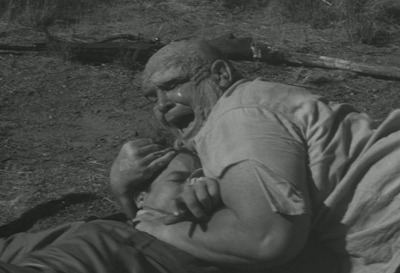
Not only is this writer/director (and bottom-of-the-barrel-scraper) Coleman Francis’ first film (produced by good pal and eternal lead actor Anthony Cardoza), but it also stars the inimitable Tor Johnson. A respected nuclear scientist (played by Johnson, which immediately shoots down any credibility the film might have) wanders too close to an A-bomb test and is turned feral. It’s then up to the local sheriff and a pal to hunt him down.
Or something.
Believe me, after five minutes, you won’t even bother to keep track of the plot anymore. That’s because what plot there is simply involves the actors wandering aimlessly about the desert landscape to no good purpose. And because all the audio got accidentally erased during postproduction, all the dialogue is summarized in nonsensical voice-over narration.
There was nowhere for Francis’ career to go from here but up. So his two follow-up movies — “The Skydivers” from 1963 and 1966’s “Night Train to Mundo Fine” (better known as “Red Zone Cuba”) — are still incompetent in their own right, but at least are a marked improvement over this one. Simply having meaningful action and onscreen dialogue will do that.
Best Line:
“Flag on the moon. How did it get there?”
Side Note:
Between directing projects, Francis tried to make his living as a bit actor, playing blink-and-you’ll-miss-them parts in a number of films, including “This Island Earth” (1954) and “Beyond the Valley of the Dolls” (1970).
Companion Viewing:
“The Creeping Terror” (1964).
Links:
IMDb.
The Astounding B-Monster’s interview with Anthony Cardoza.
Daddy-O’s Drive In Dirt.
Take a Look:
Thrill to this exciting hand-to-hand combat!
The YouTube gods have blessed us with the entire film. Repay them by watching it, won’t you?
Thank God It’s Friday (1978).
 The Scoop:
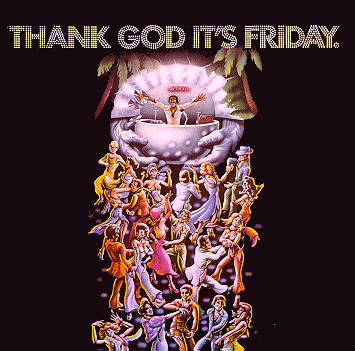
Who knew the disco scene was so boring? This virtually plotless “tribute” to the ’70s night life instead comes off as dreary and lifeless as assorted characters converge on the hot new club in town and find their lives changed. I suppose director Robert Klane and writer Armyan Bernstein were trying to make this the “American Graffiti” of the disco scene, but the result is so weighted down with silly characters and pointless subplots that, if it weren’t for the music, the whole thing would grind to a standstill.
The film features musical performances by Donna Summer (singing “Last Dance,” which won her an Oscar) and the Commodores, as well as early outings by Jeff Goldblum and Debra Winger. The rest of the cast is mostly anonymous.
If you love the music of the era (and we here at Desuko certainly do), you’ll be mildly entertained. But if you don’t, you might want to steer clear of this one.
Best Line:
“Dancing! Everything else is bullshit!” (See the clip below. Context is everything.)
Side Note:
One of the teenage girls is played by Terri Nunn, future lead singer of the ’80s New Wave group Berlin.
Companion Viewing:
“Can’t Stop the Music” (1980), “American Graffiti” (1973) and “Go” (1999).
Links:
IMDb.
Take a Look:
TV spots for the film:
Donna Summer sings “Last Dance”:
I suspect this scene was originally envisioned as a tribute to the great movie dance sequences of yesteryear, but well… Let’s just say it’s no “Singin’ in the Rain”:
The Scarlet Empress (1934).
The Scoop:
Directed by Josef von Sternberg and starring Marlene Dietrich, this lavish epic is the pinnacle of their eight-film cinematic partnership.
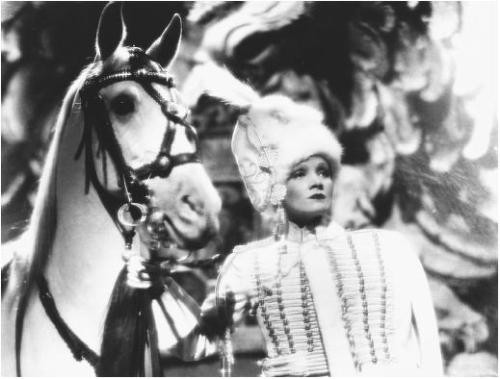
Based on the diaries of Catherine the Great, “The Scarlet Empress” tells the tale of her hard, brutal rise to power in 18th century Russia, going from being naive Princess Sophie of Prussian to becoming Empress Catherine II. Dietrich is at her best, at turns sexy and ruthless, and the film is a visual treat. Von Sternberg’s direction and Bert Glennon’s moody cinematography highlight the sumptuous costumes and elaborate, meticulously-designed sets. It all adds up to a worshipful, erotically-charged love letter to one of history’s commanding personalities — which applies as much to Dietrich herself as to Catherine. Von Sterberg conflates the two, which would ordinarily be a problem, but here it becomes one of the film’s strengths.
There is plenty of sex, deception and passion on display — all sorts of things here to please the modern fan. “The Scarlet Empress” is von Sternberg’s greatest film, and one of the finest historical dramas of the ’30s.
Best Line:
“There is no emperor — there is only an empress.”
Side Note:
Despite the lavish production design, von Sternberg was still budget-conscious. For expensive crowd scenes, he reused footage from Ernst Lubitsch’s film “The Patriot” (1928).
Companion Viewing:
“Queen Christina” (1933) and “Elizabeth” (1998).
Links:
IMDb.
Take a Look:
The young, impetuous Sophie engages in a little girl talk:
Pecker (1998).
 The Scoop:
John Waters’ satirical look at the art world also operates as a drama about the destructive quality of fame.
Edward Furlong is the title character, a happy-go-lucky kid from Baltimore with a strange family and a passion for street photography. Art dealer Rorey Wheeler (Lili Taylor) discovers his work and brings him to New York, where his whole life (and the lives of those around him) is turned upside down. Christina Ricci gives one of her most charming performances as Pecker’s girlfriend Shelley, and Waters fixtures Mink Stole and Patricia Hearst are also along for the ride.
Waters’ usual raunchiness is toned down in favor of messages about the power of art and the true nature of success. Like most of the rest of Waters’ post-Divine work, “Pecker” doesn’t quite come alive with iconoclastic energy of his earlier films. Many of the gags fall flat and some of the characters are just a little too self-consciously quirky. But enough of Waters’ trademark touches shine through to make the film fun, even if this winds up being only a minor addition to the Waters canon.
The most compelling reason to see “Pecker,” though, is its ruminations on fame and art — particularly in their effects on a funky, non-mainstream creative personality who just wants to follow the visions in his head. Because Waters’ much-chronicled career path followed the same trajectory, “Pecker” is by far the most serious and self-reflective of the filmmaker’s works.
Best Line:
“What they call art up in New York, young man, looks like just plain misery to me.”
Side Note:
Yep, that’s art photographer Cindy Sherman playing herself in the Soho gallery scene.
Companion Viewing:
“Serial Mom” (1994).
Links:
IMDb.
Take a Look:
Here is the horribly pedestrian and mainstream trailer. What happened to you, John Waters, to go from “Female Trouble” to this?
The Snow Devils (1967).
 The Scoop:
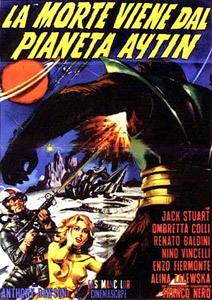
Ah, ’60s Italian sci-fi — a combination of ludicrious plotting, cheesy dialogue and budget effects that come together to form a distinct stylistic departure from run-of-the-mill American B-movies. And then there are the ’60s Italian spy flicks — cheap knock-offs of the James Bond series, full of square-jawed ladies’ man heroes, bikini babes, swinging music and dubious dubbing. “The Snow Devils” tries to straddle these two so-cheesy-they’re-cool genres, but only winds up combining the worst aspects of each.
In this follow-up to “The Wild, Wild Planet” and “War of the Planets,” a Gamma I research station high in the Himalayas is attacked and destroyed, apparently by a Yeti. The agency calls in Commander Rod Jackson (a swinging Bond wannabe played by Giacomo Rossi-Stuart) and his pudgy bald sidekick Capt. Pulasky (Renato Baldini) to investigate. After getting no help at all from eye candy Lisa (played by Ombretta Colli) and a vaguely evil Tibetan sherpa named Sharu (played incongrously by Wilbert Bradley, a black man, who comes off as equal parts Indian coolie and Haitian voodoo priest) there is a boring Alpine climbing sequence. Finally, they uncover an alien plot to take over the earth and freeze it. Defeating these aliens is a two-step process — first in the mountains, then in outer space — but our lantern-jawed hero and his bald buddy are up to it.
There is a cool mod visual style and plenty of retro-futuristic techonology. But it never quite gels into an entertaining whole. The mix of poor acting and bad dubbing gives most of the dialogue an awkward, plodding quality that is even more pronounced than in the earlier films.
Best Line:
“He always wanted to be a spaceman. They called them astronauts in those days.”
Side Note:
Writer/director Antonio Margheriti (who frequently worked under the Anglicanized name of Anthony Dawson) is a legend of European exploitation filmmaking, having directed or written more than 50 feature films. But shortly after “The Snow Devils” was finished, he took a job doing visual effects for Stanley Kubrick’s “2001: A Space Odyssey,” although he wound up receiving no screen credit.
Companion Viewing:
“The Wild, Wild Planet” (1965), “War of the Planets” (1966) and “The Abominable Snowman” (1957).
Links:
IMDb.
1,000 Misspent Hours.
Take a Look:
The trailer. (“The 21st century explodes with excitement!”)
 Desuko Movie Spot.