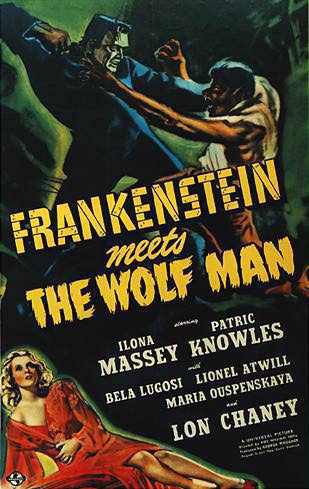
Frankenstein Meets the Wolf Man (1943).
 The Scoop:
Let the monster mash begin! By the 1940s Universal Studios, which had built its empire with its classic monster movies of the previous decade, was in dire straits as it saw its box office returns declining. Fans just weren’t buying into all those new Frankenstein, Dracula, Mummy, etc. movies like they used to. So with this film, Universal tried to up the ante and began blending all it monster franchises into one — this is at once the fifth in the fading Frankenstein series and the second in the more popular Wolf Man series. And with each new entry, it just kept getting worse and worse.
Since this was all about selling youngsters on the fight scenes between the Wolf Man and the Frankenstein monster, the plot is pretty incidental. But here’s what happens — some graverobbers inadvertently awaken Larry Talbot, a.k.a. the Wolf Man (played again by Lon Chaney, Jr., who also played the monster in the previous Frankenstein picture, “The Ghost of Frankenstein”), who seeks out yet another descendent of Dr. Frankenstein to cure his condition. That descendent is played by Ilona Massey this time around, although she doesn’t actually do anything here because, apparently, girls don’t do science. Meanwhile, Bela Lugosi finally gets his chance to play the reawakened monster (after appearing as Ygor in the two previous Frankenstein films and a gypsy werewolf in the first Wolf Man film) and completely sucks at it. In fact, Lugosi’s is arguably the worst Frankenstein monster on celluloid. And to round out the déja vu among the cast, Lionel Atwill returns as his third different character in his third Frankenstein movie, this time playing the local mayor.
This is not just a monster mash, but a mish-mash, and the film’s exciting poster art in no way prepares the viewer for the actually mediocrity it is promoting.
Pitting two previously popular movie monsters against each other is a pretty desperate move, really, and “Frankenstein Meets the Wolf Man” was the first film to go down to that well — and in the process, proving that the well was dry before any of the later imitators even got there. This particular monster mash series would continue for a few more films, eventually incorporating Dracula and even Abbott and Costello into the mix. It also set the stage for other stabs at the genre, including the more recent “Freddy vs. Jason” and “Alien vs. Predator” flicks.
Best Line:
“He is not insane. He simply wants to die.”
Side Note:
Lugosi was the studio’s first choice to play the monster in the first Frankenstein film in 1931, but he turned them down because his star’s vanity (newly-found after the success of “Dracula”) was offended by playing a part with no dialogue and heavy make-up. A dozen years later, with his career on the skids and jealous of Boris Karloff’s career success with the monster, Lugosi finally agreed to play the role.
Companion Viewing:
“House of Frankenstein” (1944), “House of Dracula” (1945) and “Young Frankenstein” (1974).
Links:
IMDb.
The SF, Horror and Fantasy Film Review.
Take a Look:
The trailer:
And just to prove that this film isn’t all monster fisticuffs, here are the obligatory angry villagers doing their thing:
 The Scoop:
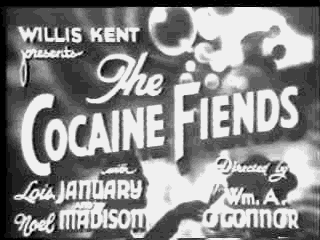
In the proud tradition of such roadside exploitation pulp as “Reefer Madness” comes this similar cautionary tale about the evils of narcotics. The subject this time is cocaine, which is much less benign than marijuana, but the cinematic results are just as goofy. The genre’s full capacity for breathless hysteria is brought to bear on this story of a small-town brother and sister who are led to The Big City by a taste for the nose candy, where they fall into crime, prostitution, racketeering and — worst of all — swearing.
Obviously, this is another classic. It hasn’t attained the legendary cult status of “Reefer Madness,” probably for the simple fact that it wasn’t embraced by the ’60s counterculture the way that film was. If the hippies’ drug of choice had been coke instead of pot, “The Cocaine Fiends” might have wound up being a much bigger part of our cultural history. (Of course, you could argue that if coke had been their drug of choice, Woodstock would have looked like something out of a Hunter S. Thompson novel instead of simply being a mud-caked lovefest.)
This film, like “Reefer Madness,” “Slaves in Bondage,” “Marihuana” and others, was born out of the roadshow circuit that flourished across rural America between the two world wars. Most often made by churches or morality groups, these films purported to offer education and advice on how to deal with many of the problems facing young people — mainly drugs, sex and white slavery. The reels were driven from town to town by showmen who would often set up tents to show the films if the small towns they were visiting did not have movie theaters.
These movies tended to draw big crowds, not only because they were the only show in town, but also because audiences got to see a little titillation on the way to the film’s spoon-fed moral message. It was this last fact that was seized on my many cheapie exploitation producers who found that they could get audiences for their sex-and-violence stories and skirt the mainstream film industry’s production codes by appending ham-fisted moral messages to their work.
The genre was eventually killed off, first by World War II, and then later by the wave of postwar prosperity that brought urban entertainment to every corner of the country. But the films live on as high camp relics of a very different age.
Best Line:
“Tonight I’m gonna take you on a sleigh ride with some snow birds.”
Side Note:
This is a remake of an earlier film called “The Pace That Kills” (1928) and footage from this was later edited into “Confessions of a Vice Baron” (1942) — all three films were directed by William A. O’Connor.
Companion Viewing:
“Reefer Madness” (1936).
Links:
IMDb.
1,000 Misspent Hours.
Take a Look:
The trailer:
Blood of Dracula (1957).
The Scoop:
What an odd little movie.
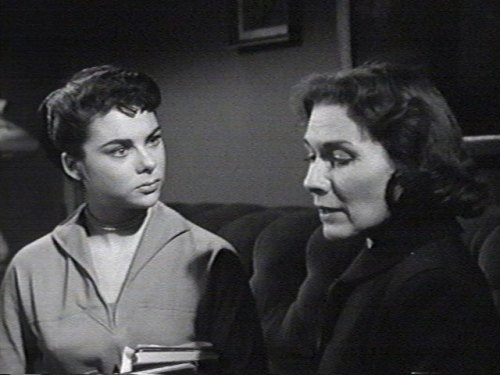
What starts out as just another quickie about misunderstood teens in the usual “Blackboard Jungle”-knockoff mode of AIP soon takes a turn for the surreal in this story of a female teacher (Louise Lewis) at an all-girls school who uses her vampire powers to prey on the student body, led by Sandra Harrison.
This is another Herman Cohen production, made to capitalize on the success of “I Was a Teenage Werewolf” and “I Was a Teenage Frankenstein.” It doesn’t hold up as well in comparison to those two films, but “Blood of Dracula” has it’s own charms, mostly in the way the weird horror elements are so awkwardly grafted onto the standard teen cheapie formula. Sometimes the changes are so swift, you can get whiplash if you’re not careful. Thinly veiled lesbianism abounds, giving the clean-cut image of ’50s lovesick teens a mind-bending twist. And, as if that wasn’t enough, bland crooner Jerry Blaine interrupts all the sexual tension, hypnotism and vampire stalkings to sing his hit song “Puppy Love.”
Despite all of its shortcomings in terms of acting and stale plot, this is one you don’t want to miss.
(And, sorry to disappoint you, but Dracula doesn’t actually appear in this movie.)
Best Bit:
This exchange, prompted by the visit by Jerry Blaine: “We pass him around like a jug of water on a lifeboat.” / “Yeah. One swallow for every girl.”
Side Note:
Unfortunately, this was Harrison’s only starring role. The rest of her filmography consists of an unbilled role in “Desire Under the Elms” and appearances in single episodes of the television shows “The Adventures of Superman” and “Burke’s Law.”
Companion Viewing:
“I Was a Teenage Werewolf” (1957) and “Girls’ Town” (1959).
Links:
IMDb.
Horrorfind.
1,000 Misspent Hours.
Herman Cohen: The Man and His Movies.
Take a Look:
This trailer captures the whiplash-style change of genre pretty accurately:
Dr. Goldfoot and the Bikini Machine (1965).
 The Scoop:
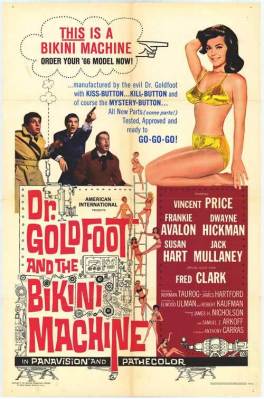
What a classically wonderful piece of ’60s fluff. Teen idol Frankie Avalon plays Graig Gamble, a swinging secret agent hot on the trail of titular supervillain Vincent Price, who has a penchant of gold pixie shoes and is trying to gain the assets of the world’s wealthiest men with sexy female robots (led by American International Pictures mainstay Susan Hart) made in his Bikini Machine.
Yes, these are the original Fembots! If you’re an Austin Powers fan and want to check out the first wave of swinging spy movies, this is the place to go — as well as other such movies, like “Modesty Blaise” (1966) and “Casino Royale” (1967).
There’s swinging music (including the title tune, sung by the Supremes), a cheesy plot, some light humor, plenty of babes in bikinis — such terrific summertime fun, who could ask for anything more?
Best Line:
“Remember — the eyes of Goldfoot are upon you!”
Side Note:
Includes cameos by Avalon’s beach movie costars Annette Funicello, Harvey Lembeck and Tommy Kirk.
Companion Viewing:
“Austin Powers: International Man of Mystery” (1997) and “Dr. Goldfoot and the Girl Bombs” (1966).
Links:
IMDb.
Cloak and Dagger.
Take a Look:
The trailer:
The title sequence, featuring some stop motion animation and that great Supremes song:
Dr. Goldfoot shows off a new weapon:
 Desuko Movie Spot.