When We Were Kings (1996).
 The Scoop:
In our UFC/mixed martial arts age, boxing — with its big padded gloves and strict limitations on engagement — seems positively quaint. At the height of its popularity, boxing was the gladatorial spectacle of its day and although it was cloaked in the “sweet science” rhapsodizing of the writers who covered it, the level of violence (tame by today’s standards) was enough to keep critics aghast.
What also seems quaint is the celebrity of Muhammad Ali, particularly the way he used his fame toward political and social ends rather than commercial ones. Few modern athletes can hope to reach his global appeal, and those who do (such as Michael Jordan or Tiger Woods) seem more interested in selling products than supporting causes. Commerce has trumped conscience, and now even the slightest his of an opinion on a controversial topic is considered career poison.
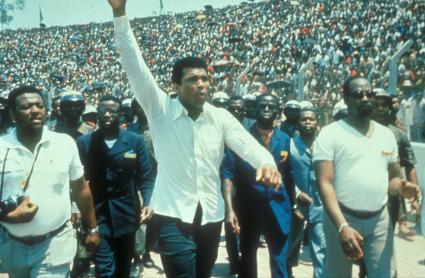
All of which makes Leon Gast’s fine documentary “When We Were Kings” feel like a trip through a time machine. And what a revelatory, eye-opening trip it is. Gast set out to simply document Ali’s 1974 bout against reigning heavyweight champion George Foreman in Zaire — dubbed “The Rumble in the Jungle” by exuberant promotor Don King — but instead happened upon one of the great socio-political crucibles of the 1970s.
Ali’s outsized charisma and outspoken views on American race relations turned out to electrify the people of Zaire (now known as the Democratic Republic of the Congo) and capture the imagination of dictator Mobutu Sese Seko, who used his influence to bring the fight to his country. When Foreman was injured in practice, forcing the postponement of the bout, it just gave Ali that much more time to win over the people of Zaire.
Along with the fight, King also organized a music festival, featuring standout performances by James Brown, Miriam Makeba, B.B. King, the Spinners and other acts. Gast captured these performances with the same eye for nuance and personality that he brings to bear on Ali’s and Foreman’s fight preparations, as well as on glimpses of everyday life in Zaire.
Taking advantage of the 22-year delay between production and distribution (courtesy of legal squabbles with the film’s Liberian investors), Gast couples all this terrific footage with thoughtful interviews with observers like Norman Mailer, George Plimpton and Spike Lee who help put the events into historical context.
It all adds up to a must-see film, even for those who do not consider themselves boxing fans, or even sports fans. “When We Were Kings” is a powerful history lesson that has much to teach 21st century viewers.
Best Bit:
Norman Mailer doing his Ali impression.
Side Note:
Although the film revealed deep personal animosity between Foreman and Ali, they eventually became good friends. When the film won the Academy Award for Best Documentary, the two came onstage together to accept the award.
Companion Viewing:
“Ali” (2001) and “Hoop Dreams” (1994).
Take a Look:
James Brown brings the soul:
Mailer and Plimpton break down the fight:
The Brain That Wouldn’t Die (1962).
The Scoop:
Is it the sexist drivel that makes this film so unbearable, or is it the incompetent production? Maybe you can watch it and be the judge.
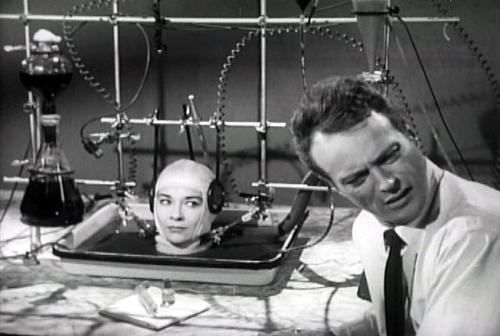
Surgeon Bill Cortner (Herb Evers), who is doing bizarre cell regeneration research on the side, causes a car accident which decapitates his girlfriend Jan (Virginia Leith). Oops. That’s not a problem, though, since the doc’s special elixir and his mangled assistant Kurt (Leslie Daniels) will keep her head alive in a pan while he spends the rest of the movie ogling various strippers and college coeds trying to find a new body for her. The bodyless girlfriend bitches a lot at Kurt (wouldn’t you?) and bonds with the creature living in the closet. Just when you think you can’t take any more of this shit, the creature in the closet breaks free and kills everyone. Woo-hoo!
This film, the product of writer/director Joseph Green, is only recommended for those willing to stoop to the subject matter to get a good laugh.
Best Bit:
Maybe it’s when the assistant gets his one good arm torn out by the root and is beaten to death with it.
Side Note:
Evers went on to become an action TV mainstay, notching guest appearances on “CHiPS,” “The Streets of San Francisco,” “T.J. Hooker,” “Knight Rider,” “The Fall Guy” and seemingly every other show in that genre.
Companion Viewing:
“The Unearthly” (1957).
Links:
IMDb.
Brokedown Cinema.
Internet Archive.
Take a Look:
The trailer:
Stupid science tricks:
A musical tribute:
The Ten Commandments (1923).
The Scoop:
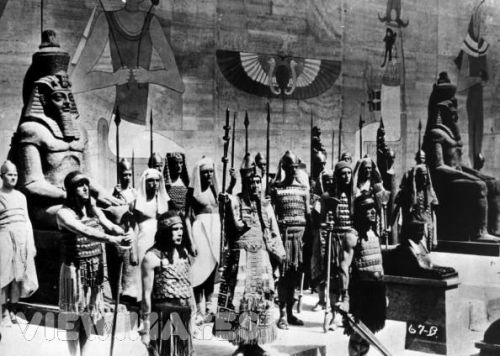
Cecil B. DeMille’s first version of his classic film “The Ten Commandments” contains many similarities to the later, more popular movie, while also containing many of the conventions of the silent era. The story is told in two parts — an extended prologue telling the Biblical story of Moses, and a morality tale set in modern times.
The prologue, which was the only part remade by DeMille, is the best, containing many classic moments. It’s these parts that work best for modern viewers, since they are also the parts DeMille later reused in the remake with little alteration. At its heart is the thrilling chase scene between the Israelis led by Moses (Theodore Roberts) and the army commanded by Pharoah Ramses (Charles de Rochefort) that culminates in the parting of the Red Sea.
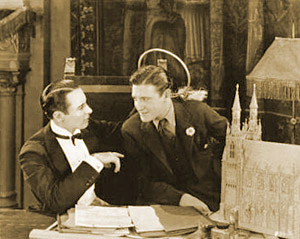 After setting the mood with the history of how the Ten Commandments came to be, DeMille jumps us ahead to early 20th century America to see the power of the commandments in action. This modern story — concerning a long suffering mother (Edythe Chapman), her good son (Richard Dix), sinful son (Rod La Roque) and the woman the two men love (Leatrice Joy) — has not aged well. There’s very little drama here, just heavy-handed examples of sin and redemption. Completely preachy and overwrought. Unless you’ve got a strong curiosity about that sort of thing, just stick with the first half.
Best Bit:
The death of Pharoah’s son.
Side Note:
The screenwriter Jeanie Macpherson started out as an actress and went on to become one of the pioneering female writers and directors in silent films, as well as one of the 36 founding members of the Academy of Motion Picture Arts and Sciences.
Companion Viewing:
“The Ten Commandments” (1956) and “Intolerance” (1916).
Links:
IMDb.
Take a Look:
Moses uses the power of early visual effects to part the Red Sea:
The full movie, in installments:
The Walking Dead (1936).
 The Scoop:
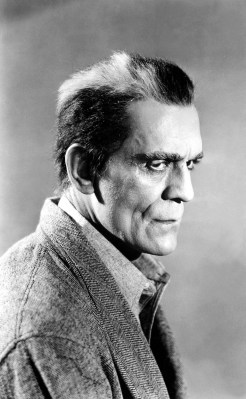
This is an unjustly forgotten classic. It could’ve been just another standard 1930s-era shocker which, to today’s viewer, can be an acquired taste. But what raises it above that is the performance of Boris Karloff.
Karloff plays John Ellman, an innocent man framed and executed for murder, who is brought back to life by a scientist Edmund Gwenn’s experimental process. Ellman then uses his new lease on life to solve the crime and bring the real killer to justice. This character is no mere zombie, but a normal man angered by his wrongful conviction, haunted by the memory of his own death and (perhaps) driven by a higher power.
This kind of material should have just been a run-of-the-mill programmer, but it was made at Universal, then at the height of its first era of horror, which meant they could secure Michael Curtiz as director and Karloff in the starring role. Curtiz does a capable job making the potentially bland source material into something compelling, but once again it is Karloff who steals the show. He brings a touching humanity to the role, making this just one of several movies that prove he had what his fellow horror icon Bela Lugosi never did — range.
Best Line:
“Why did you have me killed?”
Side Note:
Upon its original release, “The Walking Dead” was banned in Finland.
Companion Viewing:
“The Return of Dr. X” (1939) and “Black Friday” (1940).
Links:
IMDb.
Turner Classic Movies.
1,000 Misspent Hours.
Take a Look:
Back to life:
T.N.T. Jackson (1975).
 The Scoop:
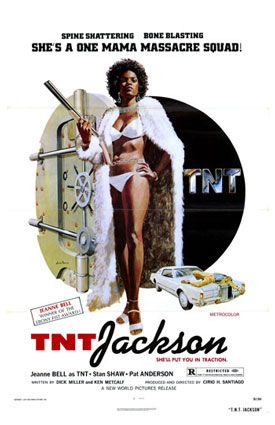
T.N.T. Jackson (former Playboy Playmate Jeanne Bell) is a high-kickin’, trash-talkin’ sistah from the ‘hood who travels to the Far East to seek her lost brother, only to get caught up in the international drug trade. But don’t try to understand any more of the story beyond that — it’s hopeless.
This kung fu/blaxploitation hybrid tries to jump on the bandwagon that combined the era’s two hottest grindhouse trends, but it just wound up with the worst of both worlds — wooden acting, incomprehensible plot, bad dialogue, spastic editing, poor lighting, the works. Wu-Tang would be ashamed.
The one good thing it has going for it, though, is the wardrobe. Some of the finest, funkiest ’70s fashions are on display here and provide the best reason to keep watching.
Best Line:
“Yo’ too fine for all this fightin’.”
Side Note:
The script was co-written by a pair of actors — Roger Corman stalwart Dick Miller (best known for his roles in AIP cheapies like “The Little Shop of Horrors,” “Bucket of Blood” and “Piranha”) and Ken Metcalfe (a mainstay of ’70s and ’80s martial arts cinema, in films like “Enter the Ninja” and “Bamboo Gods and Iron Men”).
Companion Viewing:
The far superior “Cleopatra Jones and the Casino of Gold” (1975).
Links:
IMDb.
Take a Look:
The trailer (Warning! Boobies!):
 Desuko Movie Spot.