Let’s Rock (1958).
 The Scoop:
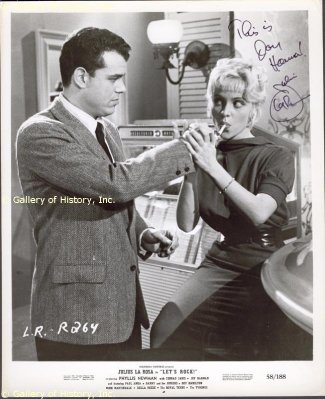
This is a rock ‘n’ roll movie? Uh…. I think not. Instead, the film perfectly encapsulates that bland post-Elvis, pre-Beatles period in pop music when everything on the charts was saccharine-coated and aimed at pleasing the parents, not the kids.
“Let’s Rock” follows boring balladeer Tony Adane (Julius LaRosa) as he tries to stay true to his “art” by resisting the shift to rock ‘n’ roll, only to eventually give in at the end and get the girl (Phyllis Newman). In short, strictly by-the-numbers work from writer Hal Hackady and director Harry Foster. That’s fairly par for the course in these early rock ‘n’ roll movies, which get their strength on the backs of their musical performances. These films were merely meant to showcase the recording artists — any plot we might get is purely incidental.
However, the examples of “rock ‘n’ roll” on display here (performed by Paul Anka and the like) aren’t much different than Tony’s tunes. In fact, the rockingest song in the film is the innocuous “At the Hop,” performed by Danny and Juniors. The only reason to even consider watching this, besides the appearances by the young Wink Martindale and Della Reese, is the ongoing (purely unintentional but amusing) homoerotic subtext between Tony and his “entourage.”
Best Bit:
The weird dancing kids in the park.
Side Note:
Reese didn’t appear on screen again for another 11 years, when she hosted her own TV series, “Della,” starting in 1969, and didn’t make another film until “Psychic Killer” in 1975.
Companion Viewing:
All the better early rock ‘n’ roll films.
Links:
IMDb.
Take a Look:
Here’s a totally low-tech clip of Reese singing “Lovelyville”:
Hercules (1958).
 The Scoop:
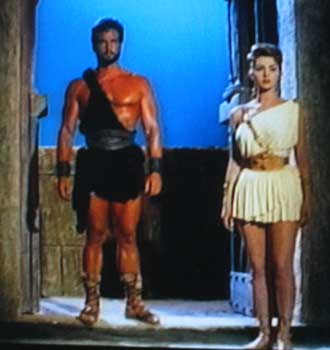
With all his bone-headed bravado, Steve Reeves makes a much better Hercules than Kevin Sorbo, Arnold Schwarzenegger, Reg Park, or any of the other actors who also became associated with the role. And this production, the former Mr. Universe’s first outing in the character and imported to this country by Joseph E. Levine, is responsible for starting the cycle of Italian muscle epics that dominated the drive-ins in the late 1950s and early 1960s.
Ostensibly an adaptation of Herc’s familiar story, this is actually a conglomeration of various Greek myths, thrown together Cuisinart-style for our enjoyment. Just don’t look to this for any kind of accuracy. Sure, we get to see him perform some of his famous labors, but he mixes it up with the Amazons, hogs all the credit for Jason’s recovery of the Golden Fleece, and even gets to do his best Samson impression.
This film is also a milestone in many ways. In his marketing of the movie in the U.S., Levine pioneered the concept of “saturation booking,” in which a film is released on as many screens as possible on its opening weekend in an effort to maximize its up-front gross. This is standard practice among Hollywood blockbusters even to this day. Its success also single-handedly created the “sword and sandal” genre that would dominate the Italian film industry for the next decade.
“Hercules” is fun, albeit in a mindless, lazy Sunday afternoon sort of way. The undemanding story is pulled off with energy and bravado (something that certainly can’t be said for the legions of imitators this film spawned) and Reeves seems perfectly comfortable in some of the most ridiculous circumstances. The cinematography in particular is impressive, but that should come as no surprise because it was handled by Italy’s maestro of the art, Mario Bava.
Best Line:
“The time goes slowly here at sea. I think I’ll start a calendar — one notch for each day.”
Side Note:
The tagline for the original U.S. release described Hercules as “Half god! Half pagan!”
Companion Viewing:
“Clash of the Titans” (1981).
Links:
IMDb.
Hollywood Teen Movies.
Take a Look:
Why Hercules shouldn’t try out for the debate team:
Dante’s Inferno (2007).
 The Scoop:
One unintended consequence of the electronic media age has been a change in the way we experience classic (i.e., pre-20th century) literature. Now it’s all about the adaptation. (Of course, these adaptations make sense for the filmmakers, who get cheap access to familiar material and don’t have to deal with authors who demand royalties or protest changes in the script.) More and more, one’s first encounter with Shakespeare or Dickens or countless other authors is through a film or television adaptation of one of their works. If audiences aren’t rushing to the cineplex for their first tastes of these classics, they are getting them in the classroom — teachers typically now accompany their reading assignments with screenings of films based on these works to help students better understand them. Shakespeare has now become inseparable from Olivier or Branagh, and Jane Austen from the starlet du jour.
All of which brings us to this version of “Dante’s Inferno.”
Italian poet Dante Alighieri’s “Comedy” — his epic tale of his journey through hell (“Inferno”), purgatory (“Purgatorio”) and heaven (“Paradiso”) under the tutelage of his idol, the Roman poet Virgil and Dante’s beloved Beatrice — is notoriously resistant to onscreen adaptation. Except for a couple perfunctory stabs from the silent era and a BBC miniseries from the 1980s, little straight adaptation has been done of the poem. More commonly, elements of the “Comedy” have been used as inspirations or jumping-off points for newer works. (One typical example is the 1935film “Dante’s Inferno,” a turgid morality play in which Spencer Tracy plays a carnival barker wrestling with the ethics of his profession. The attraction he shills for, a ride based on “Inferno,” is shown in only a few scenes, primarily as a comment on the action of the main story.)
So give filmmakers Sean Meredith, Sandow Birk and Paul Zaloom credit for attempting a full adaptation of “Inferno.” One reason adaptors have stayed away from Dante is his work’s resistance to modernized spins on the material (something that has become a staple of filmed Shakespeare, for instance). But the threesome give it a try, mixing in modern situations and personalities with the arcane issues and obscure historical figures used by Dante. Credit should also go to them for doing it in the form of a puppet show.
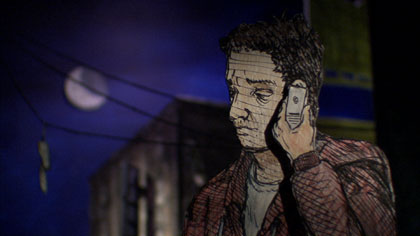
In this version Dante (voiced by Dermot Mulroney) wakes up hung over in a seedy alley, not knowing how he got there. He his approached by Virgil (James Cromwell), who leads him down a sewer into the pit of hell, where they encounter pimps and whores, corporate malfeasance and urban decay to go along with the medieval horrors chronicled in the original.
The puppetwork, using paper figures that manage to be terrifically expressive, is wonderful, but many of the other creative choices fall flat. For every update that works (portraying the Maleboge demons as hypervigilant T.S.A. agents, or mounting Ulysses’ story as a puppet show within a puppet show) there are a handful that don’t (Lucifer’s fondue pot, or the multiple references to the rock band Styx).
Pacing is a problem as well. By the film’s halfway mark, Virgil and Dante have raced through the first seven pits of hell, then spend the last half in a leisurely stroll through the final two pits, including plenty of non-Dante tangents along the way. Also, purists may be offended that (spoiler alert!) Dante’s trip through hell ends with him back on earth rather than preparing to scale the mountain of purgatory.
But in all it’s an admirable effort to try to make a 700-year-old epic poem relevant to modern audiences. The somewhat basic approach may make it cringe-worthy for Dante aficionados. But that makes it ideal for use in a high school classroom, giving another generation an opening to understanding a monumental piece of literature.
Best Bit:
The Pope John Paul II cameo.
Side Note:
Zaloom is better known as Beakman from the TV show “Beakman’s World.”
Companion Viewing:
“Dante’s Inferno” (1935).
Links:
IMDb.
Official Site.
Take a Look:
The trailer:
A song and dance number explaining the grip lobbyists hold on Congress:
The Giant Gila Monster (1959).
 A quick administrative note: It’s summer vacation time here in Desukoland, so the blog will be going on a temporary hiatus until about mid-July. Look for new reviews then, and enjoy the downtime.
The Scoop:
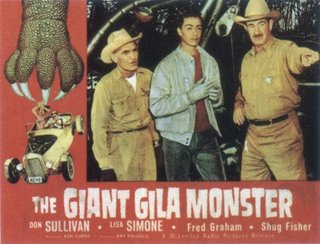
Writer/director Ray Kellogg works his unique brand of non-magic with this turd about the titular critter, which “terrorizes” a small desert town. This “terrorizing” consists mostly of sulking about in the shadows and then putting its head through a barn wall. (Never mind that the reptile used in the film is actually a Mexican beaded lizard, not a gila monster.)
Meanwhile, there’s some pointless drama about teen mechanic Chase Winstead (played by Don Sullivan) who wants to start a singing career while caring for his handicapped sister (Janice Stone), romancing his girlfriend (Lisa Simone) and tangling with Sheriff Jeff (Fred Graham). Finally, it all comes to a head at the record hop.
It’s all hooey, but at least it’s amusing hooey if you’re the type who enjoys hot-rodding teenagers and rear projection special effects.
Best Bit:
Chase’s song that goes something like “I sing whenever I sing whenever I sing…”
Side Note:
Ken Knox, who plays the disc jockey who discovers the singing mechanic, was a longtime DJ in Dallas who only wound up in the film because of the aspirations of station owner Gordon McLendon, who wanted all his popular jocks to take movie roles. Knox only appeared in two other films before deciding to stick to radio full-time.
Companion Viewing:
“The Killer Shrews” (1959), “Beginning of the End” (1957) and “Them!” (1954).
Links:
IMDb.
Badmovies.org.
Take a Look:
The trailer:
Hey, Chase — singing crappy songs like this won’t help your sister get any better:
The Creeping Terror (1964).
 The Scoop:
This is what happens when people with no technical skills, no talent and no money try to make a movie — bad acting, bad writing, bad direction, voice-over narration in place of dialogue and a monster made out of shag carpeting.
There’s something about an alien invasion. The victims don’t get eaten so much as they climb into the monster’s mouth. All the law enforcement officials and army officers are called by their first names. Vic Savage (who also directed), Shannon O’Neil and William Thourlby don’t so much “star” in the movie as they just walk around in front of the camera. Do you really want to know more?
A true endurance test.
Best Bit:
The scientist trips and falls on his face as he runs to his truck.
Side Note:
The reason for the narration is that early on in shooting (on location at Lake Tahoe, California) the director/star Vic Savage accidentally knocked his sound equipment into the lake and couldn’t afford to replace it. So, he recorded the narration himself in a studio during post-production. The ironic thing is, none of the scenes actually take place anywhere near the water.
Companion Viewing:
“Monster a Go-Go” (1965) and “The Eye Creatures” (1965).
Links:
IMDb.
BadMovies.org.
Monster Shack.
Take a Look:
Some clips:
A look inside the aliens’ spaceship:
 Desuko Movie Spot.