Wordled.
There’s new content coming soon, I promise! In the meantime, here’s the site rendered in Wordle (click to enlarge):

[via http://wordle.net/.]
Stargate (1994).
(Note: It’s hiatus time again. The Movie Spot will return with new content in the last week of August.)
 The Scoop:
When a movie is especially good or especially bad, that makes it easy to review. When it’s merely average, it becomes a tougher dragon to slay. And beyond that, there are the films that are really, really average — vigorously non-descript in a way that seems intentionally designed not to make an impression.
And then there’s “Stargate.”
Nothing stands out about this movie. Every aspect is competent, but not particularly praiseworthy or blame-worthy. The script tries to give a new twist to the age-old theories that the Egyptian pyramids were built by ancient aliens, but even that is swallowed whole by the all-consuming blandness of the production. If it wasn’t for the fact that it spawned the highly successful (and generally better) television series “Stargate: SG-1” and “Stargate: Atlantis,” there would be nothing memorable about this film at all.
So what can you say about this movie? The script, by producer Dean Devlin and director Roland Emmerich, finds Egyptologist Daniel Jackson (played by Mr. Bland himself, James Spader) discovering an alien teleportation device that sends him, Col. Jack O’Neil (Kurt Russell) and a small strike force to a distant planet ruled by the androgynous Ra (Jaye Davidson).
All the familiar hallmarks that would turn up in later Devlin/Emmerich productions — like “Independence Day” (1996) and “Godzilla” (1998) — are here, but they don’t manage to distinguish themselves like they did in those later films. True, the imagery and effects have a way of staying with you, but you can get that from just one viewing of a trailer — you don’t need to actually sit down and watch the whole movie. The rest is just eye candy.
Best Bit:
There is none, unless you like bland.
Side Note:
As one of the last pre-CGI sci-fi effects films, Devlin and Emmerich had to do their crowd scenes the old fashioned way — with actual bodies instead of cloning actors in the computer. However, the production’s tight budget made it too expensive to hire extras, so mannequins were used instead.
Companion Viewing:
“The Fifth Element” (1997), “Stargate: SG-1” and “Stargate: Atlantis.”
Links:
IMDb.
“Stargate” toys!
Take a Look:
Dr. Jackson takes his first trip through the Stargate:
Dr. Jackson drops some knowledge (and backstory):
A clip compilation:
Rocketship X-M (1950).
The Scoop:
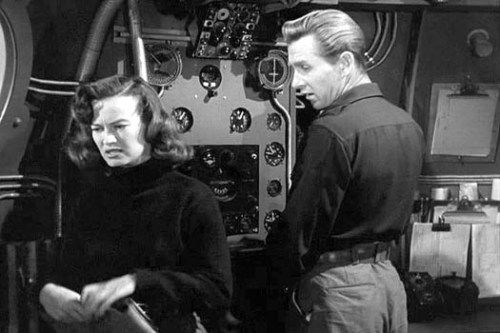
This purports to be the first serious film about the realities of space exploration. Boring and silly is more like it. The crew of the first-ever manned space flight takes off for the moon, led by Lloyd Bridges, John Emery and constantly-condescended-to Osa Massen as (OMG!) the First Girl in Space. Things go really, really wrong and they wind up landing on Mars instead.
What little scientific accuracy that remains quickly goes out the window as the natives of the red planet throw some rocks around, and the rocketship crew is forced to return to Earth. Unfortunately, (spoiler alert!) they don’t have enough fuel to land, dying in a fiery crash instead.
And on that cheery note, the film ends. Lots of negatives here (including the cheap sets, rampant sexism and bad science), but on the plus side there is a nifty theremin score.
Best Line:
“When a Texas man says he wants to do something, that’s it, period.”
Side Note:
Dalton Trumbo, perhaps the most celebrated of the blacklisted screenwriters, was an uncredited cowriter with director Kurt Neumann.
Companion Viewing:
“The Angry Red Planet” (1959).
Links:
IMDb.
1,000 Misspent Hours.
KQEK soundtrack review.
Take a Look:
A few selected scenes — followed inexplicably by a Three Stooges short:
A musical interpretation:
The Puma Man (1980).
 The Scoop:
Donald Pleasance was the John Carradine of his generation (or something like that) — a star of Oscar-caliber films who also couldn’t stop making terribly bad movies. And this is definitely one of the latter.
This Italian-made cheapo monstrosity is about a dorky guy (Walter George Alton) gets chosen by the ancient Aztec gods to be the recipient of the exalted puma powers (which mostly revolve around flying, something I didn’t know jungle cats knew how to do) and must fight Kobras, a Dr Evil-type (Pleasance) who plans to take over the world one person at a time with his gold-plated, mind-controlling mask.
Just watch the unintentional hilarity ensue…
Best Bit:
The geeky hero is indoctrinated into his powers by Vadinho, the leader of an Aztec cult that has waited millenia for his arrival. But first, Vadinho (Miguelangel Fuentes) must find the fledgling Puma Man, which leads to the most ridiculous sequence of the movie — Vadinho testing random guys to see if they have the puma powers by throwing them out of high-rise windows. If the unsuspecting guy hits the ground and dies, then he isn’t the Puma Man and Vadinho continues his search.
Side Note:
Alton went on to only one other starring role, in “Heavenly Bodies” (1984). Pleasance, meanwhile, appeared in more than 200 films and television shows before his death in 1995.
Companion Viewing:
“The Greatest American Hero.”
Links:
IMDb.
The Puma Man action figure!
Take a Look:
The trailer:
Shamelessly copping a scene from the first “Superman” movie:
Moulin Rouge! (2001).

The Scoop:
Just look at those happy, cloying faces. So full of happiness and song, so eager to keep you entertained…
Baz Luhrmann’s extravagant, self-aggrandizing, over-the-top redefinition of the movie musical is a stunning, landmark achievement despite its narrative shortcomings. Despite having an overlong running time and getting mired down in its tedious, melodramatic love story in its latter half, “Moulin Rouge!” (yes, the exclamation point is an essential part of the title) works best as a summation and celebration of all the popular music and culture of the last century. Set at the turn of the 20th century and using all the flash, glamour and storytelling magic of the turn of the 21st century, the narrative is propelled by a fascinating potpourri of music, in which hard rock, showtunes, jazz and opera are blended together seamlessly. It is as if Busby Berkeley, Rodgers and Hammerstein, and Nirvana all came together in a gloriously campy fever dream. (In fact, the soundtrack features vocal contributions from both Placido Domingo and Ozzy Osbourne.)
The story, such as it is, concerns the growing love triangle between sensitive poet Christian (Ewan MacGregor), cabaret performer Satine (Nicole Kidman) and the diabolic Duke (Richard Roxburgh). It takes place in and around the titular nightclub, the turn of the century Paris hotspot popularized by the art of Henri Toulouse-Lautrec (played here by John Leguizamo on his knees). The cast, not to mention the seemingly endless parade of extras, all are in fine voice and give fun, high-energy performances, but it is Jim Broadbent who tops them all as Harold Zidler, the ringmaster of the club’s exuberant extravagance.
The film’s billing as “a sensual ravishment” is an apt description — especially in the sense that “ravishment” is a polite euphemism for “rape.” Luhrmann fully crystalizes the vision he had shown earlier glimpses of in “Swing Kids” and “William Shakespeare’s Romeo + Juliet” by assaulting the viewers with a kaleidescope of color, sound, editing and exuberance that is truly breathtaking. When it works, as in the first half of the film, particularly during Christian and friends’ first visit to the nightclub, it is a knockout, a stunning work of genius. But as the paper-thin story begins to stray from that light-heartedness and into the turgid dramatics of the play-within-the-movie and the love triangle, the approach becomes both sappy and overbearing.
In spite of its problems, though, “Moulin Rouge!” remains a must-see film. Not only is it entertaining, but it also revived the art of the movie musical and its visual style has influenced the “baroque cabaret” styles of fashion and pop music that have persisted throughout the decade.
Best Bit:
It’s a toss-up between Broadbent singing “Like a Virgin” and Kylie Minogue popping up as the green absinthe fairy.
Side Note:
During the shoot, Nicole Kidman broke two ribs and twisted a knee in one of the dance sequences. In many of the shots that wound up in the finished film, she performed in a wheelchair.
Companion Viewing:
“Moulin Rouge” (1952), “42nd Street” (1933), “Singin’ in the Rain” (1952), “American Pop” (1981) and any number of Panic at the Disco music videos.
Links:
IMDb.
Hollywood Teen Movies.
LazyDork’s “Moulin Rouge” Drinking Game.
Take a Look:
The trailer:
The “Roxanne” tango:
 Desuko Movie Spot.