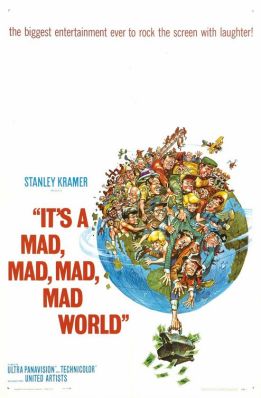
It’s a Mad, Mad, Mad, Mad World (1963).
 The Scoop:
This has to be a one-of-a-kind film — the world’s only epic comedy. At a time when American cinema was overflowing with lavish historical and biblical epics (complete with overtures, intermissions, exit music, casts of thousands — and gargantuan running times), it shouldn’t be too surprising that someone tried to use the formula on a slapstick comedy. And it shouldn’t be too surprising that the trend never really caught on.
The story concerns an ever-widening circle of strangers in a race to find a fortune “buried under a big W.” But this paper-thin plot is really just an excuse to string together a seemingly endless array of kitschy sight gags and pratfalls. The film is filled with just about every familiar face producer/director Stanley Kramer could lay his hands on. While some of them are a treat (specifically Spencer Tracy and Buster Keaton), most of them just get lost in the shuffle. Among the parade of stars are Milton Berle, Buddy Hackett, Sid Caesar, Mickey Rooney, Jonathan Winters, Phil Silvers, Terry-Thomas, Edie Adams, Peter Falk, Eddie “Rochester” Anderson, Joe E. Brown, Jim Backus, Don Knotts, the Three Stooges, Jimmy Durante…. Need I go on?
Although there are some good gags, they get absolutely deadening after being pounded into the viewer’s skull for more than three hours straight — not counting, of course, the obligatory intermission. (The director’s cut, which no longer survives, was apparently even longer.) And, frankly, just a mere five minutes of Ethel Merman is enough to make a sane man kill. Even the title is a mouthful when used in casual conversation. In the end, it’s a whole lot of manic energy expended on a whole lot of nothing.
Best Bit:
I’m not sure there is a best bit, but if you’re looking for something definitive, it probably would have to be some form of scream. There’s a lot of screaming and yelling in this movie, mostly by Ethel Merman.
Side Note:
The film was the first to be shot in the “single camera” Cinerama format. (Previously, three cameras were needed to shoot Cinerama films.) Its premiere opened the landmark Cinerama Dome theater in Hollywood, which is still in operation today.
Companion Viewing:
“1941” (1979).
Links:
IMDb.
DVD Savant.
Retroland.
Take a Look:
The trailer:
This clips comes from the midpoint of the movie, where we get to check in with what wacky predicaments everyone’s gotten themselves into!
Everybody get on board the fire engine!
Putting it in Spanish doesn’t make it any more entertaining:
In the Company of Men (1997).
The Scoop:
Writer/director Neil LaBute is becoming one of cinema’s most astute chroniclers of the social estrangement of white males, and this, his debut feature, contains the seeds that would flower in his later work.
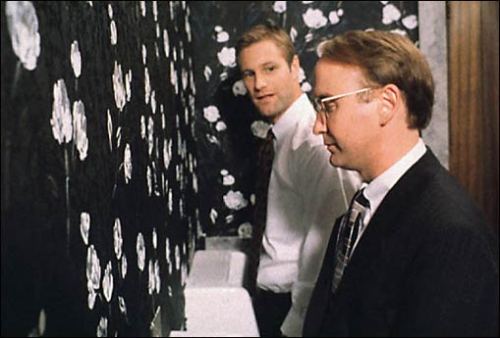
Two young business executives (Aaron Eckhart and Matt Malloy) who are both having relationship trouble decide to vent their frustrations on an extended business trip by intentionally seducing and then destroying the emotions of an insecure woman. The subject they find is a deaf secretary in their office (Stacy Edwards) and things wind up being stickier than they ever intended.
Despite a few slow parts, this is a scathing portrayal of misogyny and rampant, misplaced testosterone. Sharp, but not for the faint of heart.
Best Bit:
The entire “He’s a prick” scene.
Side Note:
The screen if full of people pulling double duty. In addition to Malloy also serving as executive producer, most of the actors used in the bit and extra parts were members of the crew.
Companion Viewing:
“Your Friends and Neighbors” (1998).
Links:
IMDb.
Urban Cinefile.
Take a Look:
The trailer:
Bowling for Columbine (2002).

The Scoop:
Whether you love Michael Moore or hate him, you have to admit that he’s made a pretty powerful statement with “Bowling for Columbine.” While taking its inspiration from the 1999 massacre at Columbine High School in Littleton, Colo., the film does not examine the particulars of the shootings so much as use it as a jumping-off point for a larger, thought-provoking mediation on America’s gun culture.
This isn’t the simple liberal screed Moore’s critics might expect, since he admits at the beginning (much to the surprise of many, I am sure) that he owns several guns himself and is a lifetime member of the National Rifle Association. Ever the self-referentialist, Moore bookends his film with segments about his hometown of Flint, Mich., — the first about local members of the Michigan Militia and the last about a school shooting involving two first graders. In between there are visits to Littleton (including a lengthy segment with the harrowing, unedited surveillance footage and 911 recordings of the Columbine massacre), Hollywood, Canada and even K-Mart corporate headquarters. Along the way, he allows a lot of voices to be heard, from people on the street, to corporate shills, to Columbine victims, to Marilyn Manson (who offers a surprisingly thoughtful response to those who blamed his music for the shootings). There is even a coda with a surprise interview with NRA president Charleton Heston, who unfortunately misses his chance at a little image rehabilitation be refusing to answer any of the tough questions.
Moore doesn’t offer any easy answers, because the subject is far too complex for that, but a couple of culprits behind the problem jump out pretty quickly — namely, the NRA’s hardline leadership and the fear-driven news coverage of the modern media. He also tries to make a case for the culpability of the entire military-industrial complex, which, although it deserves blame for a lot that is wrong in the world, seems to be a bit of a stretch.
There are a few grandstanding moments (it wouldn’t be a Michael Moore film without them) but they are kept to a minimum in favor of some good old-fashioned, non-partisan muckracking. It is perhaps Moore’s best, most fully-realized film. It is certainly his most decorated, having won a bushel full of awards, including the Oscar for Best Documentary (which prompted a most memorable acceptance speech).
Best Bit:
James Nichols (brother of Oklahoma City bombing conspirator Terry Nichols) giving free rein to his psychosis. (Also, the animated history of U.S. paranoia is pretty good, too.)
Side Note:
At the time it was released, “Bowling for Columbine” became the highest-grossing documentary of all time. It only held the title for two years, though, when it was surpassed by Moore’s next film, “Fahrenheit 9/11.”
Companion Viewing:
“Roger and Me” (1989) and “Fahrenheit 9/11” (2004).
Links:
IMDb.
Official Site.
Truth about “Bowling for Columbine” by David Hardy.
A response to Hardy’s piece.
Moore’s reaction to pro-gun critics of the film.
Take a Look:
The trailer (And if you look closely at the beginning, you’ll see that one guy from “Best Week Ever.” Right on!):
A brief history of the United States of America:
Some more “highlights” from American history:
The Ghost of Frankenstein (1942).
The Scoop:
Okay, by this point it was just getting silly. This fourth installment in Universal’s Frankenstein series started its long downhill slide in quality, mirroring the overall decline of the horror film genre in the 1940s.
This time around, there’s yet another descendant of the mad doctor (Sir Cedric Hardwicke) trying to control the creature. Bela Lugosi is back as Ygor (despite the fact that he was killed at the end of the previous movie), and so is Lionel Atwill, although he’s playing an entirely different character. Ralph Bellamy and Evelyn Ankers play the obligatory young couple. Since Boris Karloff wisely bowed out, the moster duties were turned over to Lon Chaney Jr., whose performance is an utter parody of Karloff’s.
Hell, the whole movie is practically a parody of its predecessors. That didn’t stop Universal from milking this cash cow, though — this was followed by four more films in the series, which finally ended with a sputter with “Abbott and Costello Meet Frankenstein.”
“The Ghost of Frankenstein” was written by Scott Darling (a rewrite of the original script by Eric Taylor, which the studio found too depressing) and directed by Erle C. Kenton — genre veterans with filmographies that are long on B-grade quickies, but short on quality. The makeup and costume design leave a lot to be desired, too. But on the plus side, the film looks good, thanks to the efforts of art director Jack Otterson and cinematographers Woody Bredell and Milton Krasner.
Best Bit:
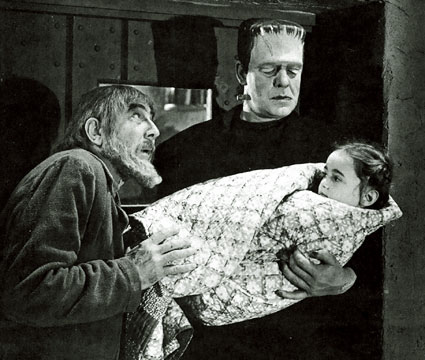
The monster trying to indicate that he wants to trade brains with a little girl. It is every bit as ridiculous as it sounds.
Side Note:
The film was released on a Friday the 13th.
Companion Viewing:
The rest of the series.
Links:
IMDb.
Monster Hunter.
1,000 Misspent Hours.
Moria.
Take a Look:
The heart-pounding trailer!
“You talk as though this is the dark ages!”
The Day of the Locust (1975).
 The Scoop:
Nathanael West’s 1939 novel about ambition and alienation in the golden age of Hollywood makes an excellent jump to the screen, thanks to director John Schlesinger and screenwriter Waldo Salt, who imbue the glamour of Tinseltown with the weight of biblical prophecy.
William Atherton and Karen Black are two hopefuls trying to make it in the movie business while pursuing a doomed romance — Atherton’s Tod Hackett is a set painter while Black’s Faye Greener hopes to be an actress. Along the way they cross paths with the eccentric and doomed denizens who inhabit the periphery of stardom and pursue their shallow dreams. All this alienation, desperation and repression finally erupt in a harrowing, apocalyptic climax.
The performances are uniformly great, and among the supporting cast are such able veterans as Burgess Meredith, Donald Sutherland, Geraldine Page, Billy Barty, William Castle and others. The story’s deliberate pace requires close attention at times, but it is amply rewarded. A stunning film. You’ll never listen to “Jeepers Creepers” in the same way again.
Best Bit:
The final sequence at the movie premiere, still one of the most shocking and effective scenes put on film.
Side Note:
Sutherland’s unbalanced simpleton is a memorable character, in more ways than one. The character’s name is Homer Simpson, which is has become forever linked with Matt Groening’s “The Simpsons.”
Companion Viewing:
“L.A. Confidential” (1997).
Links:
IMDb.
Senses of Cinema.
Take a Look:
The trailer:
The final scene. (Warning, spoilers abound! Seriously, don’t watch this unless you’ve already seen the rest of the movie. I can’t stress this enough.):
 Desuko Movie Spot.