Safe at Home! (1962).
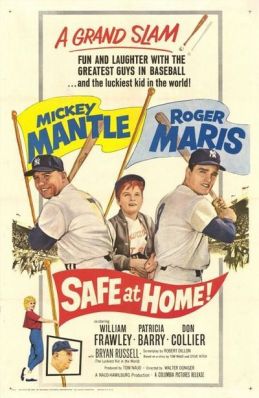 The Scoop:
It’s World Series time again, which is an ideal time for dusting off this little curio. The New York Yankees may not have made the playoffs this year, but with the Tampa Bay Rays going on their remarkable run, Florida baseball is getting its due. And the Florida locations (shot in and around Fort Lauderdale) provide a strong background for “Safe at Home!”
Wooden acting abounds in this little morality play about a Florida boy (Bryan Russell) who deals with the arrival of his widowed father’s new girlfriend by lying to his Little League teammates about knowing New York Yankee greats Mickey Mantle and Roger Maris. So, he has to travel to the Yankees’ spring training camp to get the guys to back him up.
Roger and the Mick are better ballplayers than actors, of course, but at least they (along with teammate Whitey Ford and manager Ralph Houk) manage not to embarrass themselves too much. Along the way, we learn that lying is bad and that the power of baseball can conquer just about everything.
This is a modest, cheesy little film that has a lot to love, even in its inadequacies.
Best Line:
“There’s that kid again! He’s followin’ us! He must be a spook!”
Side Note:
The script was co-written by Robert Dillon – the auteur behind “Muscle Beach Party” (1964) and “X: The Man With X-Ray Eyes” (1963) – and Steven Ritch, a veteran actor in many TV Westerns.
Companion Viewing:
“Headin’ Home” (1920) and “Kill the Umpire” (1950).
Take a Look:
The trailer:
Rush Hour (1998).
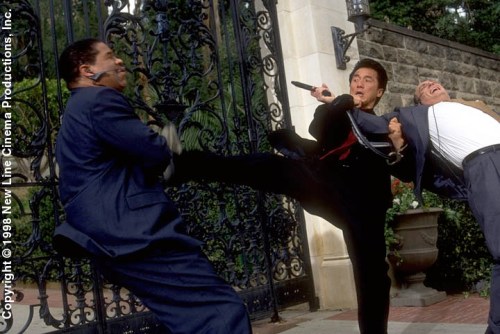
The Scoop:
It may be saddled with a predictable plot, silly fish-out-of-water jokes and a tone overly reminiscent of the “Lethal Weapon” movies (particularly the fourth one), but “Rush Hour” still manages to slide by on the combined charm of Jackie Chan and Chris Tucker. Chan’s incredible stunt work and Tucker’s hilarious motor mouth have both been put to better use in other movies, but they still work well together and have fun showing off what they do best.
Basically, the plot (courtesy of director Brett Ratner and screenwriters Ross LaManna and Jim Kouf) is this — a fast-talking LAPD cop teams up with a Hong Kong detective to find the kidnapped daughter of the Chinese consulate. The rest is filler and fluff and gags, but at least they are kept light and entertaining.
There are far, far worse ways to spend an hour and a half. Like watching any of the useless sequels, for instance.
Best Bit:
The in-car singalong by Julia Hsu, who plays the little girl who gets kidnapped. I don’t know why I love it so much, but I do.
Side Note:
Jeff Nathanson, the screenwriter extraordinaire behind the turdbucket “Speed 2: Cruise Control” (1997) is also an uncredited writer here.
Companion Viewing:
“Lethal Weapon 4” (1998) and “Rush Hour 2” (2001).
Links:
IMDb.
Take a Look:
Sing it, girl!
Shadow of the Vampire (2000).
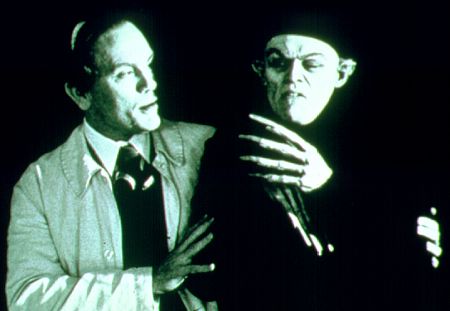
The Scoop:
Director E. Elias Merhige’s and writer Steven Katz’s film is a provocative, yet highly fictionalized, account of the creation of the landmark horror classic “Nosferatu.”
John Malkovich plays German director F.W. Murnau as a tempermental, single-minded genuis and Willem Dafoe is his mysterious star Max Schreck. The script’s conceit is that Schreck was a real vampire, not just an actor lost in his role (as was the case in real life). There are faithful recreations of several of the sequences and settings of “Nosferatu,” with many given an extra supernatural twist by the fact of Schreck’s vampirism.
All this makes “Shadow of the Vampire” a hard film to categorize — too fanciful for a biopic and too grounded in reality for a supernatural thriller — but an enjoyment nonetheless.
There are good performances all around from a cast that includes Udo Kier, Catherine McCormack, Cary Elwes and Eddie Izzard. And extra kudos go to the gang of Pauline Fowler, Jamie Iovine, Amber Sibley, David Stoneman and Julian Murray for their Oscar-nominated makeup job on Dafoe.
Best Line:
“If it’s not in frame, it doesn’t exist!”
Side Note:
The real life Max Schreck was a veteran German stage actor and although “Nosferatu” was his film debut, he went on to make more than 20 other movies before his all-too-human death by heart attack in 1936, at the age of 57.
Companion Viewing:
“Nosferatu” (1921) and “Gods and Monsters” (1997).
Links:
IMDb.
Official site.
Dave’s Other Movie Log.
Take a Look:
The trailer:
The Phantom Planet (1961).
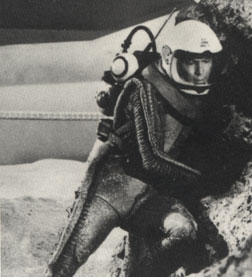 The Scoop:
In the fantastically futuristic world of 1980, a miniature planet roams the Solar System at will, capturing Earth’s exploratory rockets. The studly Capt. Chapman (Dean Fredericks) is sent to investigate, and winds up on the planet, shrunk down in size to visit with its tiny inhabitants. Turns out they’re at war with a race of dog-faced aliens, who are also very small. Chapman helps them win their war, and along the way cures a mute girl (Colleen Gray). All in a day’s work!
This bit of B-movie fluff from director William Marshall (and a large posse of screenwriters and producers) is certainly odd, but the novelty value alone isn’t enough to make its 82 minutes exactly fly by. “The Phantom Planet” is best in small doses. (And yes, this is where that crappy band got its name.)
Best Line:
“You know, Captain, every year of my life I grow more and more convinced that the wisest and the best is to fix our attention on the good and the beautiful. If you just take the time to look at it.”
Side Note:
Under the mask of the captured dog alien is none other than Richard Kiel, best known as Bond villain Jaws. As if that wasn’t enough, the leader of the tiny aliens is played by aging silent film star Francis X. Bushman, who is a long way from his “Ben Hur” days.
Companion Viewing:
“Fire Maidens From Outer Space” (1956).
Links:
IMDb.
Music from the Monster Movies, 1950-1969.
io9.
Take a Look:
The hilariously overwrought trailer:
 Desuko Movie Spot.