The Body Snatcher (1945).
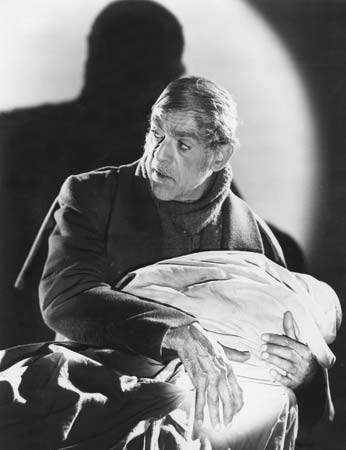 The Scoop:
Boris Karloff is at his best in this Val Lewton chiller (directed by the great Robert Wise), which also features a good performance from Bela Lugosi.
Based on the short story by Robert Louis Stevenson, this is a loose adaptation of the Burke and Hare murders, in which a 19th century Scottish doctor (played by Henry Daniell) must turn to the unscrupulous grave robber Cabman Gray to complete his medical research. As is usually the case, things quickly get out of hand when the local graveyard runs short of corpses and bodies must be obtained by more nefarious means.
Karloff has never been more menacing, and he does more than anyone to carry the film to its exciting climax. Like all of Lewton’s best work, “The Body Snatcher” is a humble masterpiece.
Best Bit:
That edge-of-your-seat ending.
Side Note:
This was the last of Karloff and Lugosi’s eight screen pairings, and one of the best.
Companion Viewing:
“The Black Cat” (1934).
Links:
IMDb.
1,000 Misspent Hours.
American Film Institute.
The screenplay.
Take a Look:
The trailer (as seen on TCM):
Gray is a bad, bad man. (Warning: Not safe for dog lovers):
Slacker Uprising (2008).
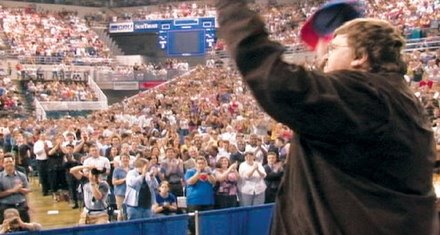
The Scoop:
Typically, new releases are outside the scope of the Movie Spot, but because today is election day in the U.S., we’re making an exception.
Michael Moore’s new film “Slacker Uprising” documents his national college tour in the run-up to the 2004 presidential election, trying to register new voters and raise awareness off the issues at stake. To get the college kids involved, he offers a number of slacker enticements, such as free Ramen noodles, clean underwear and musical performances from the likes of Eddie Vedder, Tom Morello and Steve Earle. In his speeches, Moore offers the same viewpoints and passion we’ve come to expect from him, along with some stumping for John Kerry. (Of course, Kerry’s campaign was ultimately futile and poorly-run, something Moore was able to admit in hindsight in the editing process.) The tour took place in the wake of the release of “Fahrenheit 9/11” so there is also plenty of reaction to that film, and to Moore’s credit he includes plenty of conservative criticism as well.
But at 97 minutes, the message begins to wear thin after a while. The terrific musical performances help the time go by, but there isn’t much diversity in the storyline otherwise. Still, the message is important, and there are certainly worse ways to spend 97 minutes of your life.
Now get out there and vote!
Best Bit:
Moore’s promises to a group of Republican hecklers about the fair treatment they can expect from a Democratic administration.
Side Note:
Not only is the film available as a free download, Moore has also given anyone permission to stage public showings of the film, free of copyright.
Companion Viewing:
“Fahrenheit 9/11” (2004) and “The Big One” (1997).
Links:
IMDb.
The official site, where you can download it for free for a limited time, or order a DVD copy.
Take a Look:
The trailer:
Dracula (1931).
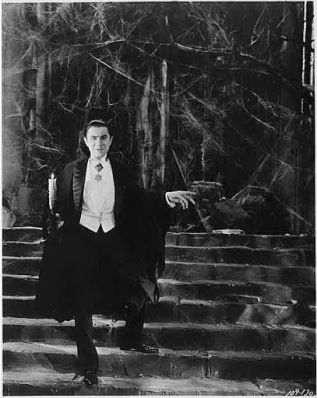 The Scoop:
What would Halloween be without the king of the vampires?
An iconic milestone of horror cinema, “Dracula” made Bela Lugosi a star, made Universal Studios a mint and established the archetypes for all vampire movies to follow.
The script, by Garrett Fort, is a loose adaptation of the immensely popular Hamilton Deane/John L. Balderson play, which in turn was a loose adaptation of the classic Bram Stoker novel. The end result bares little relation to the source material, but that’s beside the point. What makes this film a legend is Lugosi’s threatening, sexually-charged performance as the undead Transylvanian count who wants to move to London to continue his bloodthirsty ways. Lugosi reprises his performance from the play here, as does Edward Van Sloan, who plays Dr. Van Helsing.
This film marked the high point of Lugosi’s career (in only his first American movie) and would dominate his psyche for the rest of his life. It also (along with Boris Karloff’s performance in “Frankenstein” that same year) firmly injected the horror genre into the modern consciousness.
Despite its legendary reputation, though, “Dracula” has sequences that are as stagey and talkative as any creaky melodrama of the period. It is considered the crowning achievement of director Tod Browning’s career, although it is reported that his drinking problem got so out of hand during the shoot that cinematographer Karl Freund had to step in to do much of the direction. This is evinced best by the contrasts in quality between the moody, gothic atmospherics of the Transylvanian scenes (attributed to Freund) and the stodginess of the London scenes (attributed to Browning). By this point, all of Browning’s best work was behind him, left behind in the silent film era, while Freund would go on to be a successful genre director in his own right.
Despite its flaws (armadillos, anyone?), “Dracula” remains a landmark of the genre and a must-see for any serious film fan.
Best Line:
Either “I never drink… wine,” or, “The children of the night — what music they make!”
Side Note:
In spite of being a runaway success and matinee idol for starring in the stage version, Lugosi was the last choice to play the role of the bloodsucking count on film. The producers and other studio executives thought Lugosi did not have the star quality to carry the movie and went through several alternatives, thoroughly ignoring Lugosi’s active petitioning for the role. The actor who was finally chosen to play Dracula was Browning’s frequent collaborator, the great Lon Chaney, who died just before filming began. When the other contenders weren’t available on such short notice, Lugosi was finally given the role simply to keep the production on schedule. Despite playing the title character, Universal wound up paying him only half of what they paid the other principal actors.
Companion Viewing:
“Dracula (Spanish Version)” (1931) and “Frankenstein” (1931).
Links:
IMDb.
The Broadway production, from the Internet Broadway Database.
Bram Stoker’s novel.
Take a Look:
Dracula’s entrance — keep your eyes peeled for those famously anachronistic armadillos:
Dracula vs. Van Helsing:
The Undying Monster (1942).
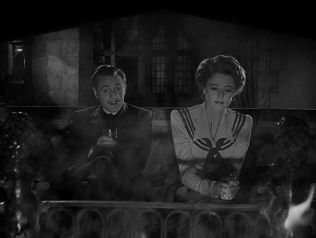 The Scoop:
Excellent photography highlights this bite-size British thriller, which moves briskly through its too-short 60 minutes.
Scotland Yard investigators use modern forensic techniques to examine the legends of centuries worth of supernatural killings at an isolated English manor, which may or may not be caused by an ancient family curse. In addition to the creepy atmosphere, there are strong performances from the entire cast (led by James Ellison, Heather Angel and John Howard) and the odd burst of dry humor. John Brahm’s direction is brisk and tight, working from a script by Lillie Hayward and Michael Jacoby, who adapted the novel by Jessie Douglas Kerriush. Although some of the plot elements owe an obvious debt to “The Wolf Man” and “The Hound of the Baskervilles,” they are not merely derivative and are used here to good effect.
Highly recommended, this is an A-list film in B-movie clothing.
Best Line:
The last line — I won’t spoil it for you.
Side Note:
Brahm became more commercially successful after coming to Hollywood and working in television. He’s best known for working on episodes of “The Twilight Zone,” “Alfred Hitchcock Presents,” “The Man From U.N.C.L.E.” and “The Outer Limits.”
Companion Viewing:
“The Wolf Man” (1941) and “Sleepy Hollow” (2000).
Links:
IMDb.
The Missing Link.
Horror-Wood.
The Grim Cellar.
Take a Look:
The trailer:
Summer of Sam (1999).
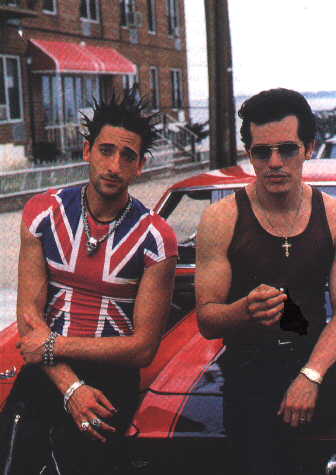 The Scoop:
Spike Lee’s take on the Son of Sam killings in New York during 1976 and 1977 is a welcome stretch for him, but ultimately a let-down.
It’s an interesting concept — a study of how the lives of a young Bronx couple, Vinny (John Leguizamo) and Dionna (Mira Sorvino), and their neighbors are affected by David Berkowitz’s notorious killing spree, as well as the other noteworthy events in New York during the summer of ’77 (including the popularity of disco, the emergence of punk rock, the record-setting heatwave and the great blackout). Lee commits his usual sin of over-reaching here, including so many different plot elements that the film becomes long and tedious. The core story, though, has potential and Leguizamo and Sorvino both give first-rate performances.
To Lee’s credit, he tried to move out of his usual urban African-American milieu here. It does not always work to great effect, though, particularly in his treatment of the punk rock scene, which he obviously doesn’t quite understand. His biggest flop, though, is the scene in which he tries to get into Berkowitz’s head — resulting in a talking dog on screen. Talk about a misstep.
Still, Lee is the type of visionary director whose missteps are interesting missteps, and be working outside of his comfort zone here he was able to flex his creative muscles for later projects like “25th Hour” and “Miracle at St. Anna” that show more maturity.
Best Line:
For pure camp value, how can you beat a dog chanting, “Kill! Kill! Kill!”?
Side Note:
David Berkowitz is still serving his life term in prison, but has since become a born-again Christian. He now has a personal website to share his ministry.
Companion Viewing:
“NY77: The Coolest Year in Hell” (2007), “Last Days of Disco” (1998) and “Clockers” (1995).
Links:
IMDb.
LazyDork drinking game.
Take a Look:
Just another night in the life of Vinny and Dionna:
“Saturday Night Fever,” this ain’t:
The fucking short version:
 Desuko Movie Spot.