The Tale of Despereaux (2008).
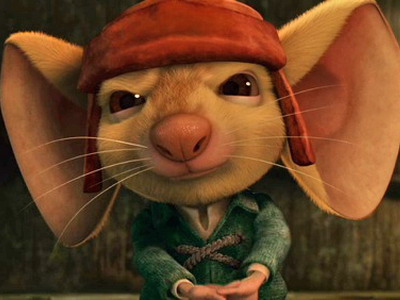 The Scoop:
“The Tale of Despereaux” is filled with the kind of high-minded earnestness that you just don’t see much in children’s entertainment anymore — and for good reason.
The story, from Kate DiCamillo’s book, concerns a brave, bookish mouse who doesn’t fit in with the other mice; a kind-hearted sailing rat who gets stuck in a dungeon with his conniving brethren; a palace servant girl who will do anything to be princess; a grimy jailer who pines for the infant daughter he had to give up years ago; a king who withdraws from the world after his wife’s death; a princess who wishes the joy would return to her world; a genius chef who draws inspiration from a magical vegetable spirt; and a kingdom that really, REALLY loves its soup.
The voice cast features a ton of recognizable names, including Matthew Broderick (as Despereaux the mouse), Dustin Hoffman, Sigourney Weaver, Emma Watson, Kevin Kline, Tracey Ullman, Stanley Tucci, Robbie Coltrane, William H. Macy, Frank Langella, Christopher Lloyd and Bronson Pinchot.
Whew.
As you might guess, the plot gets a little convoluted. Four main storylines eventually get resolved together at the end, But not without a few liberties to cram it all into less than 100 minutes. Many of the plot turns seem arbitrary rather than organic, and the climax depends an out-of-character change of heart by Roscuro the rat that (of course) turns out to be only temporary.
On the other hand, the animation and production design are particularly lavish and painterly, and that, along with the sight of talking rodents and some mild swashbuckling adventure, should be enough to satisfy many kids. But the rest of the family would be better served by something with a little more humor and bit, like the work of Pixar or even some of the Dreamworks animated features.
Best Bit:
The absurdity of Boldo the vegetable man leading the charge into the dungeon.
Side Note:
The design for Boldo is based on the work of 16th century painter Giuseppe Arcimboldo.
Companion Viewing:
“Angelina Ballerina.”
Links:
IMDb.
Official Site.
Kate DiCamillo’s novel.
Take a Look:
The trailer:
The Happening (1967).
 The Scoop:
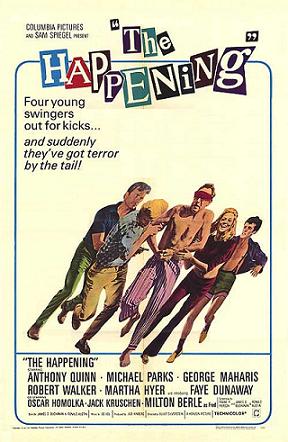
Four of the cleanest beatniks/hippies you’ll ever see (Michael Parks, Robert Walker Jr., George Maharis and Faye Dunaway) accidentally get talked into kidnapping Miami mobster Roc Delmonico (Anthony Quinn) then have to figure out what to do with him. When he finds out that no one wants to pay his ransom — not his wife (Martha Hyer), not his business partner (Milton Berle and his bad mustache), not his mob boss (Oscar Homolka) — Delmonico decides to take matters into his own hands.
The film starts out promisingly enough as the sort of campy unintentional comedy that was so prevelant at the time as the major studios tried (but failed) to understand and cater to the burgeoning counterculture movement. But it quickly devolves from there into a typically “wacky” (and unfunny) mainstream ’60s comedy.
That’s not to say there aren’t a few bright spots after that first half hour. Quinn gives his all for the trite material like the old pro he is, and there are a few genuinely funny gags here and there.
And, of course, there’s Dunaway at her most enchanting. “The Happening” was just her second film (following her debut in Otto Preminger’s “Hurry Sundown” by just a month), and she would follow it up with her twin breakout roles in “Bonnie and Clyde” and “The Thomas Crown Affair.”
But none of this is enough to save what is ultimately a snoozefest that works neither as a campy bad movie nor an unironic good movie. The film just falls flat in between, which might be the worst fate of all.
Best Line:
“Call the cops? That’s socialism! Can’t anyone do anything for themselves anymore?”
Side Note:
Composer Frank De Vol, who wrote both the score and the swinging Supremes songs on the soundtrack, had a second career as a television character actor, guest starring in a wide range of shows, such as “My Favorite Martian,” “Get Smart,” “Bonanza,” “The Jeffersons” and “Silver Spoons.”
Companion Viewing:
“It’s a Mad, Mad, Mad, Mad World” (1963).
Links:
IMDb.
Take a Look:
The trailer:
The whole film in installments on the YouTube plan, beginning here:
200 Motels (1971).
 The Scoop:
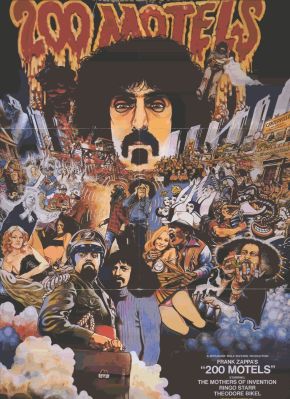
Part rock opera, part tour exposé, part vanity project, part absurdist theater, part experimental music video — Frank Zappa’s “200 Motels” can be a tough nut to crack.
Zappa and the early-1970s version of his band, the Mothers of Invention, had an ongoing fascination with the life of a touring rock band. This fascination found its way into their music, and their shows became increasingly elaborate musical theater pieces full of songs, skits and jokes centered around sex, drugs and other outrageous behavior. It was all based on things they had done themselves, or on the stories that made the rounds among other groups. This exploration of the lifestyle finally culminated in “200 Motels.”
Beneath all the madness and surrealism of the film, there is a plot of sorts — Zappa (played by Ringo Starr) and the Mothers (who all play themselves) roll into the generic American town of Centerville looking for a good time. There, they cross paths with a pair of groupies (Janet Ferguson and Lucy Offerall), the devil (Theodore Bikel), a nun (Keith Moon) and a host of other strange characters.
Many of the situations come right from the Mothers’ tour experiences, and much of the dialogue is based on transcripts of conversations captured by Zappa and his cassette recorder during downtime on the road. The result is surprisingly genuine, despite the intentionally stilted delivery of the troupe of non-actors and Zappa’s notorious ironic detachment from his material.
Musically, the work here comes from one of Zappa’s most fertile periods, and it finds him following two different creative strands. With the Mothers, he creates some straight-ahead, powerful blues rock that would not sound out of place alongside the Allman Brothers, Zeppelin or even Sabbath. These songs are interspersed with FZ’s more experimental compositions, performed by the Royal Philharmonic Orchestra. These pieces represent a turning point in his avant garde career, both looking back to the studio-bound “sound sculptures” of his early albums and also foreshadowing the orchestral work he would do in earnest a decade later.
For Zappa neophytes, “200 Motels” (both the film and the soundtrack album) is probably not the best introduction to the man’s work. But for fans it is essential and rewards close, repeated viewings.
Best Line:
“The fuckin’ devil’s got an English accent. I seen him three weeks ago on TV. So you know, you can just take this big needle here and hang it in your ass as far as I’m concerned!”
Side Note:
Offerall and Pamela Miller (who plays the Interviewer) were members of the GTO’s (Girls Together Outrageously), a groupie collective/performance art troupe/singing group whose music was produced by Zappa. Miller would go on to become Pamela Des Barres, author of the infamous memoir “I’m With the Band.”
Companion Viewing:
“Head” (1968).
Links:
IMDb.
Understanding 200 Motels.
Take a Look:
The trailer:
Welcome to Centerville (a real nice place to raise your kids up)!
Jimmy Carl Black (the Indian of the group) performs “Lonesome Cowboy Burt”:
In the Bleak Midwinter (a.k.a., A Midwinter’s Tale) (1995).
Note: With this post, we’ll be taking a short holiday break. See you in the new year!
 The Scoop:
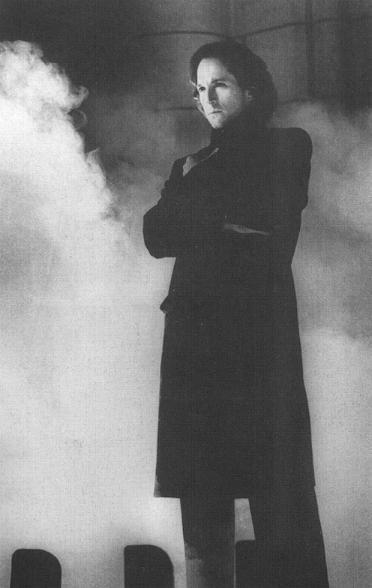
A sort of upper-crust version of “The Full Monty,” this hilarious (though sometimes aggressively quirky) little film follows the travails a group of oddball actors who try to mount a Christmastime production of “Hamlet.” It is, of course, a colossally ill-thought out idea because, really, who wants to be that depressed on Christmas? But, as written and directed by Kenneth Branagh, it makes for a great, intimate film and a touching tribute to the struggles and idiosyncrasies of community theaters, whether in Britain or the U.S.
The cast of British theater veterans seems to be having great fun in this back-to-basics production by the usually over-elaborate Branagh. It’s easy to see Branagh’s attraction to this material, considering the many parallels between his life and the character of the director in the film. In fact, Branagh used this as the warm up for his wonderful uncut film version of “Hamlet.”
Best Line:
“Is this whole production going to be based on innuendo?”
Side Note:
Costars Michael Maloney, Richard Briers and Nicholas Farrell all went on to star in Branagh’s “Hamlet,” but in different roles than their characters play in this movie’s production of the play.
Companion Viewing:
“The Full Monty” (1997) and “Hamlet” (1996).
Links:
IMDb.
Venice Film Festival press conference transcript.
Take a Look:
The opening monologue:
The Black Room (1935).
The Scoop:
Gather your torches and pitchforks! It’s time to storm the castle!
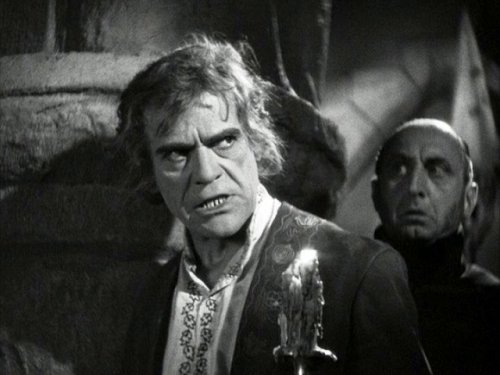
This Columbia production does a good job of capturing vaguely old Eastern European milieu of the classic Universal horrors of the same period in this story aristocratic twin brothers battling an ancient family curse.
“The Black Room” stars an old Universal hand, Boris Karloff, who is at his best playing the twins — diabolical Gregor and saintly, crippled Anton. We start with a brief prologue, in which the family castle’s ancient torture chamber is walled off to prevent the fulfillment of a prophecy of the family’s ruin — namely that the younger twin will kill the older. Flash forward a few decades and Gregor, who has inherited the family’s baronage, invites Anton, who has been living abroad for year, back home. Anton discovers that the villagers all hate Gregor since he’s essentially a serial killer who has been abducting the young women of the village, raping them, then killing them in “the black room,” for which he has discovered a secret entrance. From there, we get the obligatory double-crosses, twin role switching and eventual triumph of good over evil that we expect. And of course, the prophecy comes true in the most ironic way possible.
The plot is pretty predictable and formulaic. This was obviously an attempt by Columbia to steal some of Universal’s thunder, and the trite screenplay by Arthur Strawn and Henry Myers, shows this. But “The Black Room” is worth watching, though, not just for Karloff’s typically fine acting, but also for the direction of Roy William Neill and the cinematography of Allen G. Siegler. Together, they create a rich Gothic atmosphere, with plenty of oddball touches.
Especially fascinating is how heavily Catholicized this film is. Huge crucifixes and statues of the Virgin Mary abound, given prominence in many establishing shots. Even the many chases between the village and the castle (through landscape that, anachronistically, is straight out of an early Western) pass several Catholic icons.
It’s an odd mix, but it works. Thanks to the efforts of Neill, Siegler and Karloff, the film rises above the banality of the genre programmers it was meant to join.
Best Bit:
The dog objects!
Side Note:
Two different dogs were used to play Anton’s loyal hound — one male and one female. The difference is obvious on screen, sometimes even from shot to shot.
Companion Viewing:
“The Black Cat” (1934).
Links:
IMDb.
Classic-Horror.com.
Take a Listen:
No clips right now (curse you, Internet!) but be sure to enjoy this little tidbit of dialogue.
 Desuko Movie Spot.