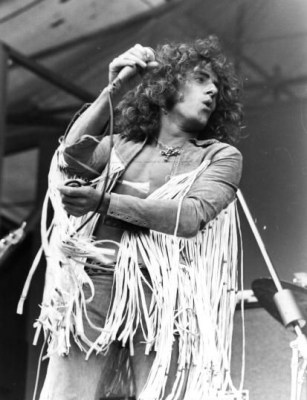
Listening to You: The Who at the Isle of Wight (1970).
 The Scoop:
A critic once said that watching Pete Townshend play the opening notes of “Pinball Wizard” was like watching John Hancock sign his name. But forget a simple autograph — with this performance, Townshend and his bandmates wrote their manifesto.
The Who made the rounds of all the big rock festivals of the late ’60s and early ’70s, even turning up elsewhere on film with memorable performances in “Woodstock” and “Monterey Pop.” But it’s at the Isle of Wight where Townshend, Roger Daltrey, John Entwistle and Keith Moon hit their collective peak. Caught between the epic reach of 1969’s “Tommy” and the power of 1971’s “Who’s Next,” the band rips through a muscular set of early material, covers of ’50s rockers and a mostly-full rendition of “Tommy.”
It is brilliant, powerful, melodic stuff that could be used as a how-to guide on being a rock band.
What’s more, producer/director Murray Lerner and his crew do the music justice by capturing the spirit of the performance without imposing themselves on the material. You just get The Who, unfiltered, which is what a good concert film should be.
Best Bit:
“Shakin’ All Over” (originally by Johnny Kidd and the Pirates) is a barnburner to begin with, and it gets a fierce treatment here.
Side Note:
Lerner’s filmography is kind of thin outside of various Isle of Wight Festival movies, but he did win an Oscar for Best Documentary Feature for “From Mao to Mozart: Isaac Stern in China” (1981).
Companion Viewing:
“Woodstock:” (1969) and “Jimi Hendrix at the Isle of Wight” (1991).
Links:
IMDb.
Isle of Wight Festival.
Take a Look:
“Young Man Blues”:
“Substitute”:
The finale of “Tommy”:
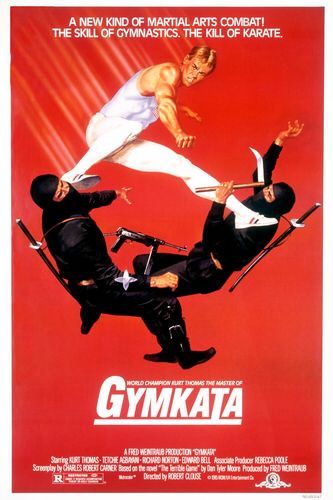
Gymkata (1985).
 The Scoop:
Let’s just cut to the chase here. This is one of the strangest, silliest movies you’ll ever see.
Olympic gymnast Kurt Thomas plays a secret agent who is a specialist in a martial arts discipline that is part gymnastics, part karate. Actually, in the hands of non-actor Thomas, it just winds up being all gymnastics and no karate. But that hardly matters, since the rest of the plot is pure gibberish anyway. There is some sort of a secret mission to a generic Eastern European country where Thomas has to play deathsports with other fighters. Somehow, a princess is involved, too.
Even after all these years, I’m still not sure what this all adds up to, but (spoiler alert!) the good guys win in the end. But that (and cracktastic fight choreography) is really about all you can expect from movies like this. It also happens to be Thomas’ only movie role ever. I wonder why?
This one is a bad movie must.
Best Bit:
The scene in which Thomas is chased down an alley by a gang of thugs, only to find a conveniently placed pommel horse, which he uses to defeat his enemies.
Side Note:
This is actually based on a novel, “The Terrible Game” by Dan Tyler Moore. I dare you to read it.
Companion Viewing:
I’m not sure what a good analogue for “Gymkata” would be. Maybe if you smooshed together “Enter the Dragon” (1973) and “Stick It” (2006), then drained out all the quality, that might come close.
Links:
IMDb.
Gymkata.com.
Badmovies.org.
I-Mockery.
A fan page that is pretty awe-inspiring in its own right.
Take a Look:
The trailer. Gymkata!
The infamous pommel horse scene. Thrill as hundreds of angry villagers just stand around waiting to be kicked!
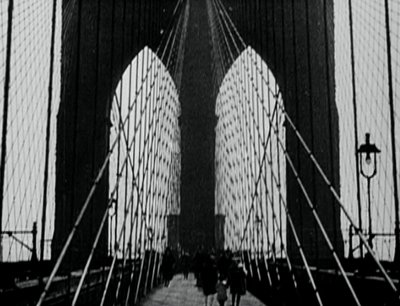
Manhatta (1921).
 The Scoop:
The rise of modernism in art brought with it not only the elevation of abstract forms and structure, but also a faith in mechanical progress. The signature media of modernism — photography, architecture and film — celebrated modern machinery, the emerging American metropolis and the products of each. A bold new century required a bold new vision supplied by an energetic new generation artists. Among these were Paul Strand and Charles Sheeler.
Strand was a photographer whose pioneering work helped separate photography from the painterly conventions of the 19th century and establish its own aesthetic. While Sheeler was a photographer as well, his best known work came as a painter. But his canvases revealed a strong photographic sensibility at a time when most other painters were caught up in the maelstrom of cubism and, later, abstract expressionism.
Which brings us to “Manhatta,” a collaboration between Strand and Sheeler meant to celebrate the modernist vision of New York City, with its new, towering skyscrapers and bustling population. Both artists were experimenting with motion pictures at the time and worked together compile this 10-minute short film, a collection of images of the city — from the ships in its harbor, to the crowds in its streets, to its majestic skyline. The film is based on Walt Whitman’s poem “Mannahatta,” and excerpts from that work are used as intertitles.
While there are some impressive individual shots, they don’t hang together as a narrative whole, particularly toward the end. And the intertitles just distract from the flow of the imagery. While “Manhatta” does not rank among Strand’s or Sheeler’s best work, it is a fascinating experiment from two great artists and also offers a great rare look at a much younger NYC.
Best Bit:
That one shot of the Brooklyn Bridge’s supports, which is pure Strand.
Side Note:
“Manhatta” was added to the National Film Registry by the Library of Congress in 1995. By that point, the original negative of the film had long since been destroyed and only a single, damaged 35mm print was known to survive That print was used as the source for the digital restoration that’s available today.
Companion Viewing:
“Koyaanisqatsi” (1982) — although I love the fact that IMDb’s automated recommendations include “Escape From New York” and Peter Jackson’s remake of “King Kong.”
Links:
IMDb.
Metropolitan Museum of Art.
Take a Look:
The full film, with a modern electronic soundtrack:
…and with a conventional soundtrack, if that’s your preference:
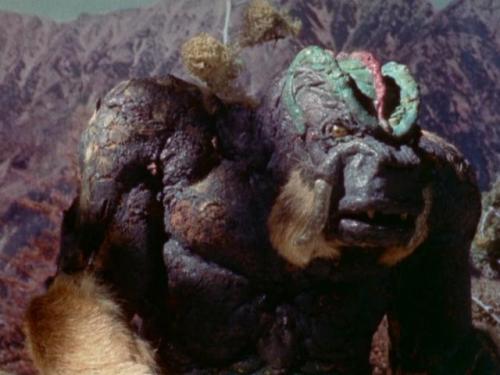
Equinox (1970).
The Scoop:
This student film (and believe me, it shows) has gone on to become an underground classic. A group of stupid college students go into the woods and uncover a book of spells that brings about all sorts of supernatural trouble. Sound familiar?
Despite the extreme technical ineptitude, the story is excellent (borrowed liberally by Sam Raimi and put to better use for “The Evil Dead” and “The Evil Dead 2”), the special effects are good and some successful careers were launched here. Most notable among them is special effects supervisor Dennis Muren, who has gone on to win nine Oscars designing the effects for James Cameron’s “Terminator 2” (1991) and George Lucas’ “Star Wars” movies. Also, the assistant cameraman is future actor Ed Begley, Jr., and one of the stars is Frank Bonner, who later starred in “WKRP in Cincinnati.”
Shot in 1967 by writer/director Jack Woods, this sat on the shelf for three years until it was purchased by producer Jack Harris, who reshot some scenes and released it.
There are some primo bad movie shenanigans going on with this one. Check it out.
Best Line:
“Your book! You have to take it!”
Side Note:
The sound effect for the transitions was lifted from “Earth vs. the Flying Saucers.” Also, Forrest J. Ackerman turns up in a cameo as the voice on the tape recorder.
Companion Viewing:
The “Evil Dead” trilogy and “The Blair Witch Project” (1999).
Links:
IMDb.
Horror Movie a Day.
Take a Look:
The trailer:
A compilation of stop motion effects from the film:
Bug Buster (1998).
 The Scoop:
There’s something terrific about goofy, campy sci-fi movies. But what makes them especially fun is their dead earnestness. Maybe the parties involved really believe in the quality of what they are doing, or maybe they know it’s all ludicrous but are willing to put in good work for a paycheck. But either way, when talented or even semi-talented people give their all for their material, regardless of its quality, that’s when the magic happens.
When a film tries to be intentionally goofy and campy, that’s when things start getting a little iffy. The folks at Troma — both in their own productions and in the outside productions they choose to distribute — do a good job of walking that thin line, but a lot of others do not.
Producer/director Lorenzo Doumani’s “Bug Buster” is one of them.
The plot is pretty familiar territory — big bugs threaten a small town and it is up to the local teens (including the luscious Katherine Heigl and Meredith Salenger) and a world-famous exterminator (Randy Quaid) to stop them. While there are some good moments, the film is mostly too self-conciously silly for its own good, despite the able cast.
Lord knows why Quaid lowered himself to be in this thing. The same can’t be said, on the other hand, for “Star Trek” alumni James Doohan and George Takei, Bernie Koppell of “The Love Boat” (who has a sex scene — eeew!) and MTV’s Downtown Julie Brown, who no longer had any careers to speak of anyway.
And as if that all weren’t enough, there’s also an aging country band that sings a song called “I Itch.”
*facepalm*
Best Line:
“I don’t want to go to the hospital! People die there!”
Side Note:
Filmed in the lovely mountain resort town of Big Bear, California.
Companion Viewing:
“Earth vs. the Spider” (1958), which handles the premise with the old school earnestness it deserves, and “The Lost Skeleton of Cadavra” (2001), which does intentional camp right.
Links:
IMDb.
House of 1,000 Courses.
Take a Look:
The trailer:
Gen. George S. Merlin’s exterminator TV ad:
 Desuko Movie Spot.