The Trip (1967).
 The Scoop:
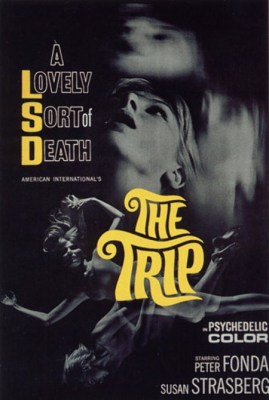
It’s a flood of groovy music, kaleidoscopic colors and odd vignettes in this Roger Corman confection as a director of television commercials (Peter Fonda) takes his first LSD trip.
Purporting to be the first serious, first-hand exploration of psychedelic drugs, it mostly comes off as hokey and dated. The first half of the film — with Fonda, dealing with marital trouble with his wife (Susan Strasberg), going through the early stages of his high with his “guide” (Bruce Dern) — come off as a doped-up version of “My Dinner With Andre,” as the pair sit ensconced in Dern’s Hollywood Hills mansion and discuss the sort of pretentious minutiae that seems really “deep” when you’re high. But the action picks up a bit when Fonda flees the house in a panic and encounters a variety of both middle class and hippie characters in the streets of Hollywood. This lack of action is broken up intermittently by exotic, effects-laden shots of Fonda’s hallucinations.
Despite the talented cast, the acting is as wooden as you’d expect from a Corman film, but it still offers its own brand of goofy fun. Look for Dennis Hopper, Luana Anders, Dick Miller, Peter Bogdanovich and Corman regular Beach Dickerson in small parts. The script was written by Jack Nicholson.
Best Bit:
The all-too-brief snippet of the commercial jingle for “Psyche Soap.”
Side Note:
The very psychedelic score is by The Electric Flag, a one-off super-group including Mike Bloomfield, Buddy Miles and other acid-blues rockers.
Companion Viewing:
“Psych-Out” (1968) and “Easy Rider” (1969).
Links:
IMDb.
TCM Underground.
Take a Look:
The trailer:
Some friendly advice from Luana Anders:
The Skydivers (1963).
 The Scoop:
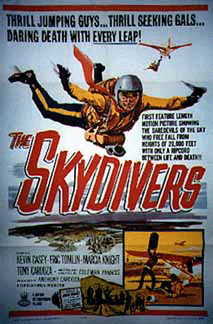
This Coleman Francis creation may be a psychodrama about the sinister goings-on behind the scenes at a desert sky diving school. It’s kind of hard to tell, since the film sucks so much. Bad acting, bad writing, bad directing, bad editing, bad location audio — everything is terrible.
Francis stalwart (and producer) Tony Cardoza stars as Harry Rowe, the owner of a skydiving school who cheats on his wife (Kevin Casey) with the town floozy (Marcia Knight). Miss Floozy tries to get her revenge by seducing some other guy (Titus Moede) and then hatching a convoluted murder plot involving acid in the parachutes. Meanwhile, Harry’s old army buddy (Eric Tomlin) wanders around and asks for coffee. Some other stuff happens, too, but it doesn’t make much sense and can probably be safely ignored.
However, the one aspect of the film that sets it above the rest of the Francis ouevre is the ludicrously eclectic cast of extras. Among others, there’s the beat poet with a chicken, the camera club geek, the gargantuan woman in a bathing suit, and to top it all off, the dancing Scotsman.
Francis, a Hollywood bit player for a number of years, struggled mightily to carve out a writing and directing career for himself in the early ’60s by churning out a string of quirky, incompetent melodramas that always seemed to come back to coffee and light aviation. While he stayed true to his singular vision, it didn’t work out for him — he died a homeless alcoholic in 1973.
But “The Skydivers” is good for many, many unintended laughs, even if you’re willing to brave it without the “Mystery Science Theatre 3000” treatment.
Best Line:
“I like coffee!”
Side Note:
Jimmy Bryant, the lead singer of the Night Jumpers, the band featured at the runway party, also lent his vocals to “West Side Story” (1961).
Companion Viewing:
“The Beast of Yucca Flats” (1961) and “Red Zone Cuba” (1966).
Links:
IMDb.
Daddy-O’s Drive-In Dirt.
he loved him some movies.
The Agony Booth.
Take a Look:
The trailer:
Rock Around the Clock (1956).
 The Scoop:
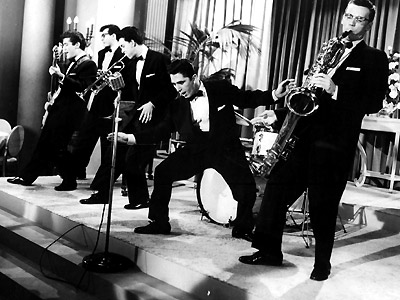
Rock ‘n’ roll music helped gain its legitimacy with this film, the first-ever rock ‘n’ roll movie. Bill Haley and the Comets play themselves in a story chronicling a small-town band with a new sound on its way to success. (The story, of course, had nothing at all to do with the band’s real career path, but that’s beside the point.)
There’s plenty of music, provided not only by the Comets, but also by the Platters, Tony Martinez, and Freddie Bell and his Bellboys. Pioneering deejay Alan Freed is also along for the ride. The non-musical parts of the film (written pseudonymously by Robert E. Kent, directed by Fred F. Sears and starring Johnny Johnston, and Alix Talton) is strictly routine. But it is at least executed competently and doesn’t drag the film down.
The box office success of this film launched the wave of ’50s rock films, and it’s still one of the best, filled with great music and great dancing.
Best Line:
Visitor: “Hey sister, what do you call that exercise you’re getting?” / Dancing Girl: “It’s rock ‘n’ roll, brother, and we’re rockin’ tonight!”
Side Note:
Although this was the first rock ‘n’ roll film, it was actually the second to feature a rock ‘n’ roll song on its soundtrack. The first was “Blackboard Jungle” (1955) whose opening credit theme was, of course, “Rock Around the Clock.” It was delirious reaction to that film by teen audiences that helped get this film made.
Companion Viewing:
The whole wave of ’50s rock ‘n’ roll films, including “Mister Rock and Roll” (1957), “Go, Johnny, Go!” (1958) and “Rock Rock Rock” (1956).
Links:
IMDb.
Hollywood Teen Movies.
Haley’s Rock ‘n’ Roll Hall of Fame page.
Take a Look:
The trailer:
Bill Haley and the Comets are discovered while performing “See You Later Alligator”:
Freddie Bell and the Bellboys do “Giddy Up a Ding Dong”:
The Mole People (1956).
 The Scoop:
How dreary can the subterranean world be? Very.
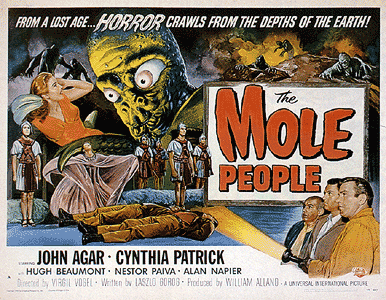
This lovely little film starts off with a professor giving the audience a strange, rambling lecture on the history of various crackpot theories about ancient civilizations underground. When the story finally gets started, we find an archeological team headed by smug know-it-all John Agar that discovers an underground colony of albino Sumerians and their mole-like slaves. Agar’s sidekicks include Hugh Beaumont (TV’s Ward Cleaver) and the evil underground high priest is Alan Napier (best known as Alfred the Butler from the “Batman” TV series).
When the heroes’ chief weapon in a flashlight, you know you’re in trouble.
Luckily, this foolishness doesn’t last long before the mole slaves revolt, the albino society crumbles and Agar and Beaumont escape in just the nick of time, along with their Sumerian love interest, played by the luscious Cynthia Patrick.
“The Mole People” isn’t as bad as some critics make it out to be, but that’s not saying it’s a good film, either. Director Virgil Vogel put together a solid, if unremarkable, genre piece that only suffers because some of the absurdities in László Görög’s script. If you can get past the questionable science and the fact that the mole people look like beatniks dressed for trick-or-treating, it’s not a bad little film.
Best Line:
“Do you think anybody’s ever tried to smoke dried mushrooms?”
Side Note:
The professor from the beginning is Dr. Frank Baxter, who in the mid-’50s left his job teaching English at the University of Southern California to lend his authoritative aura to introducing various educational TV shows. In addition to his star on the Hollywood Walk of Fame, he was also the recipient of the first ever Golden Gavel from Toastmasters International.
Companion Viewing:
“She” (1935).
Links:
IMDb.
Take a Look:
The trailer:
Science! Brilliant!:
Jail Bait (1954).
The Scoop:
Ah, yes. The classics…
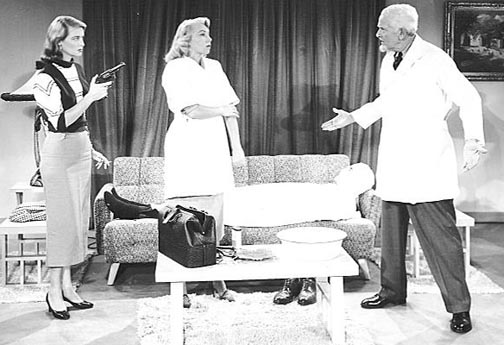
This is an Ed Wood product, so what else can you say about it? Like so many of his other masterpieces, this one is eminently watchable and virtually unreviewable. The plot, such as it is, involves a hardened criminal (Timothy Farrell) who draws an young innocent (Clancy Malone) into a life of crime, then blackmails the boy’s plastic surgeon father (Herbert Rawlinson, who died the morning after he shot his scenes) into giving him a new face so he can evade the cops (led by Lyle Talbot).
Along with Wood mainstays Farrell and Talbot, the cast also includes Dolores Fuller (in an angora sweater, of course) and Steve Reeves, in his first speaking part, as a cop.
The incompetence on display here is staggering. In fact, you could say it is Woodian in the truest sense of the word. “Jail Bait” belongs with “Glen or Glenda?” (1953) and “Plan 9 From Outer Space” (1959) in the triumvirate of classic Ed Wood cinema.
Best Line:
So much great dialogue, so little time. How about this great exchange: “Come on, let’s go.” / “Where to?” / “What do you mean, where to?” / “Just that — where to?”
Or, how about “This afternoon we had a long telephone conversation earlier in the day.”
Side Note:
The “director’s cut” available on most recent releases features an extraneous, gratuitous striptease act, which replaces the original scene of a blackface minstrel nightclub performance.
Companion Viewing:
“The Violent Years” (1956) and “The Sinister Urge” (1961).
Links:
IMDb.
phillyBurbs.
A highly unofficial fan page.
Take a Look:
Trailer:
Steve Reeves gives the ladies what they came for (warning: crappy audio):
Wood’s cast models the fashions of “Jail Bait”:
 Desuko Movie Spot.