Gamera (1965).
The Scoop:
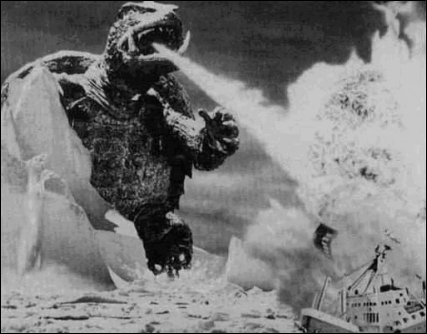
The folks at Japan’s Daiei Studios wanted to compete with Toho in the kaiju arena by creating their own monster movie series to rival “Godzilla.” So they came up with this — a black and white film about a nuclear explosion that awakens an evil monster. (Kinda sounds familiar, doesn’t it?)
Unfortunately, they miscalculated a bit — turtles, even giant ones, just aren’t that scary. So, even at his most fearsome, Gamera is no match for the original lizard king himself.
The plot is almost a complete rehash of “Godzilla” — a nuclear explosion in the Arctic awakens Gamera, who has been sleeping under the ice for millenia. Of course he wakes up on the wrong side of the bed and goes on a worldwide rampage looking for energy. A group of scientists try everything they can to stop him, but to no avail. Instead (and this is the only original wrinkle in the formula), it is up to young boy with a special link to Gamera to put a stop to his rampage.
The results just don’t hold a candle to the first “Godzilla” movie. Not only are the writing and directing weak in comparison, but the effects are laughable and Gamera comes off as more humorous than threatening. It is no wonder that as the series continued, he was quickly made into a good guy who, as the script of every film likes to remind us, “is the friend to all children.”
The film’s American distribution rights were bought by schlock-meister Sandy Frank, who dubbed it, recut it, shot some new footage and released it as “Gammera the Invincible.” For years, that version was the only one available in the United States. If you have a choice, opt for the original if you can. That doesn’t necessarily mean it’s better, but at least you’ll be seeing it as the director intended.
Best Bit:
Old Man: “I guess that flying saucer I saw was really Gamera.”
Old Woman: “As the old saying goes, ‘We see terrible things if we look too long.'”
Side Note:
“Gamera” was the last of Japan’s tidal wave of monster movies to filmed in black and white.
Companion Viewing:
“Godzilla, King of the Monsters” (1955) and the rest of the “Gamera” series.
Links:
IMDb.
Stomp Tokyo.
Brain Eater.
Beyond Hollywood.
Sci Fi Japan.
Take a Look:
The trailer:
Much like the Spider before him, Gamera hates rock ‘n’ roll:
Earth vs. the Spider (1958).
 The Scoop:
Run away!
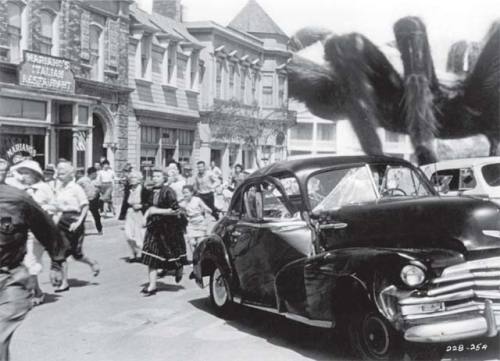
Well, okay, first off… the title’s a little misleading. The giant spider doesn’t actually take on the whole world, just a few rubes from a small town. And then, all it does is come out of its cave, sit on a house, then get electrocuted in what amounts to little more than a high school science class demonstration.
This is among the worst of the ’50s big bug movies — yet another Bert I. Gordon creation in which something grows too big for its own good. But there is something endearing about “Earth vs. the Spider,” mostly in the dead earnestness of everyone involved with the film as they go about their silly business.
Gordon, who directed and gets story credit, made this sort of fare his bread and butter in the ’50s. The script was provided by Laszlo Gorog and George Worthing Yates, and the cast is led by Ed Kemmer (as high school science teacher Art Kingman, our square-jawed hero), June Kenney and Gene Persson (and the bland teenage couple) and Gene Roth (as the obligatory crusty sheriff). The crappy rear projection visual effects are credited to Gordon and his wife Flora.
“Earth vs. the Spider” is a pretty definitive example of the genre, and certainly enjoyable when you approach it in the right frame of mind.
This was remade in 2001 as part of the Cinemax “Creature Features” series, which included modernizing “reimaginings” of several classic ’50s B-movies. While it was competently executed (and even starred Dan Aykroyd and Theresa Russell), the story was completely changed and it just doesn’t have the same spirit as the original.
Best Line:
“Usually, if nature produces a freak, it dies immediately.”
Side Note:
If you look closely at the set decoration, you’ll spot movie posters for two other Gordon masterpieces, “The Amazing Colossal Man” and “Attack of the Puppet People.” Also on hand is the first issue of Forrest J. Ackerman’s “Famous Monsters of Filmland,” the magazine that became the sci-fi/horror bible of movie fans in the ’50s and ’60s.
Companion Viewing:
“The Amazing Colossal Man” (1957) and “Bug Buster” (1996).
Links:
IMDb.
Music From the Monster Movies, 1950-69.
1,000 Misspent Hours.
Daddy-O’s Drive-In Dirt.
The Monster Shack.
Take a Look:
The trailer:
The spider hates those darn kids today and their crazy rock ‘n’ roll music!
Celebration at Big Sur (1971).
 The Scoop:
“Celebration at Big Sur” is another one of those rock festival documentaries that came in waves in the late 1960s and early 1970s. But it is one of the better ones, and definitely worth a look.
This film, much like the concert it chronicles, is a sort of mini-Woodstock. The bill featured a lot of the same music (although strictly focused on folk rock this time around), many of the same performers, and the same peace-and-love vibe. The film, too, carries a similar aesthetic as the “Woodstock” film. There are also several moments in the Big Sur festival (and film) that are conscious, or maybe not-so-conscious, looks back at that weekend at Yasgur’s farm.
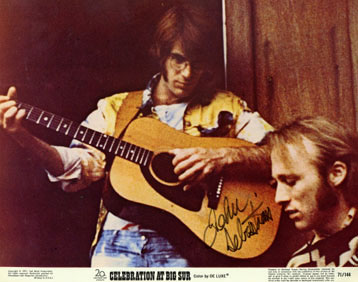
From 1964 to 1971, the Esalen Institute at Big Sur hosted an annual music festival, which drew the luminaries of the folk rock world. This film chronicles the sixth festival, held on Sept. 13-14, 1969, just a month after Woodstock. There are great performances from the likes of Joan Baez, John Sebastian, Crosby Stills & Nash, and Joni Mitchell, as well as scenic shots of the beautiful Northern California coast.
The relatively small size of the crowd, coupled with the fact that the musicians all perform next to a swimming pool, gives the concert the feel of a backyard party. It is this intimacy in particular that sets “Celebration at Big Sur” apart from the other hippie festival flicks, which all feature the performers onstage towering above crowds of thousands of kids.
This rarity, still sadly unavailable on DVD, is worth the effort of tracking down.
Best Bit:
Neil Young dropping in on his buddies Crosby Stills & Nash for a show-stopping version of “Down By the River.”
Side Note:
This concert featured Joni Mitchell’s public debut of her song “Woodstock,” which was later popularized by Crosby Stills & Nash.
Companion Viewing:
“Woodstock” (1970).
Links:
IMDb.
Big Sur Festival, 1964-1971.
Take a Look:
Down by the deep end of the pool… er, I mean “Down by the River”:
Joni Mitchell performs “Woodstock”:
Joni and friends belt out that hippie chestnut, “Get Together”:
April Fool’s Day (1986).
 The Scoop:
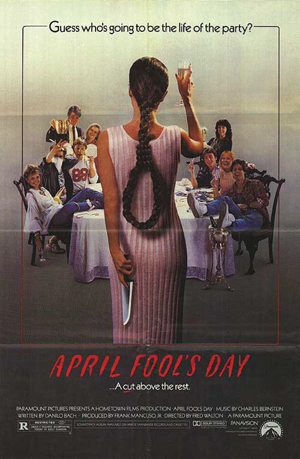
This is supposed to be a horror spoof, but frankly, it’s not very funny and not very scary.
Birthday girl Muffy invites a bunch of her mopey preppie friends to spend April Fool’s weekend in an island vacation house, where they spend the time whining about their lives, playing practical jokes on each other and getting hacked to bits.
Deborah Foreman (who was briefly a star in the ’80s following her turns in “Valley Girl” and “My Chaffeur”) plays dual roles as Muffy and Buffy, while the rest of the cast is rounded out by the likes of “Friday the 13th” veteran Amy Steel, Griffin O’Neal, Jay Baker, Pat Barlow, Tom Heaton and other sorta-beens and never-weres.
It’s all meant to poke fun at the slasher genre, but instead of something clever and inventive like “Scream,” but instead director Fred Walton and writer Danilo Bach deliver a sort of bloodier version of a Whit Stillman film. If whoopee cushions and exploding cigars are your idea of a good time, this might be up your alley. But otherwise — eh, not so much. Allegedly, the script is based on the Agatha Christie story, “And Then There Were None.” If you squint, you might be able to see the resemblance.
The end credits theme is wonderfully goofy, though — it’s a catchy, ’20s-style jazz novelty number called “Too Bad You’re Crazy,” written by the film’s composer, Charles Bernstein, and performed by Jerry Whitman and Linda Harman. It is worth sticking around through all the other nonsense just to hear it.
“April Fool’s Day” was remade in 2008, for reasons that escape me.
Best Bit:
Although most of the practical jokes are pretty predictable, the one with the bedroom lamps is particularly inventive and funny.
Side Note:
An alternate, more downbeat, ending was shot, but was ultimately scrapped for being too convoluted. It is currently unavailable on DVD, although you can sign a petition to change that.
Companion Viewing:
“Metropolitan” (1990).
Links:
IMDb.
It’s a Bad, Bad, Bad, Bad Movie.
Take a Look:
The trailer:
The Trial (1962).
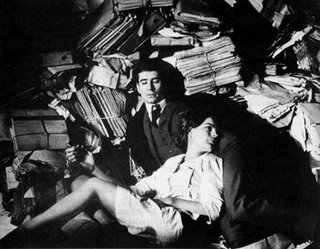 The Scoop:
Trying to adapt Franz Kafka for the screen is pretty much a losing proposition from the get-go, so Orson Welles, Hollywood’s fabled fallen boy wonder, should get extra genius points for even attempting it.
But what results from his version of “The Trial” is a fairly faithful depiction of the physical action of the novel, without much of the overarching existential dread that made it a masterpiece of modern literature.
Well past his physical prime, Welles turned the starring role of Joseph K. over to the underrated Anthony Perkins, who carries the film with another fine performance. Welles instead plays The Advocate, while the rest of the great cast includes Jeanne Moreau, Romy Schneider and Akim Tamiroff.
By this point, Welles’ glory days were long behind him and it was only by overcoming the greatest resistance that he was able to make any movies at all. So, it is something of a miracle that this film even got made in the first place. Because of that, the film’s low budget is quite obvious, and Welles seems to be trying to overcompensate by presenting a grand directorial “vision” that winds up overreaching in spots. But despite its flaws, “The Trial” is still a worthy addition to the Welles canon, and proof that he had more cinematic genius in him than just “Citizen Kane” or “Touch of Evil.”
Best Line:
“Yes, that’s the conspiracy: to persuade us all that the whole world is crazy, formless, meaningless, absurd. That’s the dirty game. So I’ve lost my case. What of it? You, you’re losing too. It’s all lost, lost. So what? Does that sentence the entire universe to lunacy?”
Side Note:
Welles changed the ending to one in which K. does not get killed, because he thought a scene of a Jew being killed would be too reminiscent of the Holocaust.
Companion Viewing:
“Touch of Evil” (1959).
Links:
IMDb.
Kafka at the Movies.
Combustible Celluloid.
Take a Look:
The trailer:
The typically Wellesian opening sequence:
The court sequence:
 Desuko Movie Spot.