Homicidal (1961).
 The Scoop:
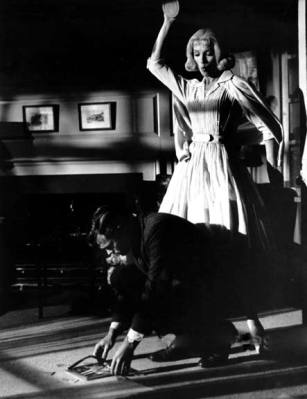
Producer/huckster extraordinaire William Castle’s attempt to cash in on the success of Alfred Hitchcock’s “Psycho” is actually surprisingly good in its own right.
A young woman returns to her family mansion in a small town to claim her half of an inheritance. However, her brother and their elderly nanny’s caretaker (don’t ask) have other ideas.
Even though the killer is identified in the first 10 minutes, the script keeps the viewer guessing about motives until the end, and the sly visual references to “Psycho” make the blatant plot appropriations more palatable.
This is all enough on it’s own to make a fun film, but then there’s Castle’s gimmick this time around. It’s the “fright break,” in which the film pauses for 45 seconds right before the climactic scene to that viewers who are too scared can retreat to the lobby and stand in the “Coward’s Corner.”
Shot in the cheesy tourist trap town of Solvang, California, “Homicidal” also features one of the most dysfunctional cinematic families this side of “Spider Baby,” as well as a great, campy performance by Joan Marshall.
It’s films like this that give B-movies a good name.
Best Bit:
Karl, the nerdy hero (played by Glenn Corbett), overreacts to some minor vandalism in the flower shop: “What kind of mind would do something like this? More like an animal than a human being!”
Side Note:
The bathrobe worn by the justice of the peace was reused by Castle for the 1963 film “13 Frightened Girls!”
Companion Viewing:
“Psycho” (1960) and “Die, Mommie, Die!” (2003).
Links:
IMDb.
Take a Look:
The low budget trailer:
The Ghost of Slumber Mountain (1918).
 The Scoop:
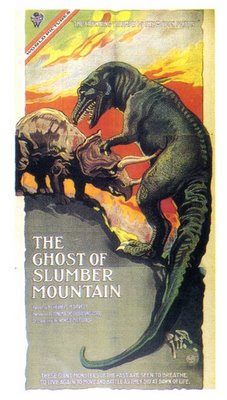
This short film by the legendary Willis O’Brien (best known for creating the original King Kong) and his partner Herbert Dawley is one of the earliest examples of stop-motion animation on film.
The plot is simple — two young boys ask their Uncle Jack to tell them a story, and he weaves a yarn about meeting the ghost of an old hermit on a mountain trip, who gives him magical binoculars which let Jack see into the prehistoric past. The prehistoric scenes, featuring O’Brien’s stop-motion dinosaurs and birds, will probably seem crude by today’s standards (not to mention the standards of O’Brien’s later works), but still exude a certain charm. The seeds of O’Brien’s later, more famous, work can already be seen. And if you watch it with a certain sense of humor, the rest of the plot becomes bizarrely entertaining.
The project started life as a feature, but after the usual “creative differences” Dawley cut down the film to 18 minutes and removed O’Brien’s name. O’Brien would get the last laugh, though, by taking many of the concepts and models from “The Ghost of Slumber Mountain” and using them for 1925’s “The Lost World,” his breakthrough film that launched his long, legendary career.
Best Line:
“I tried to convince Joe to take off his clothes and pose as a faun.”
Side Note:
Besides writing and producing the film together, O’Brien and Dawley also costar in it — O’Brien as “Mad Dick” the hermit, and Dawley as Uncle Jack.
Companion Viewing:
“The Lost World” (1925).
Links:
IMDb.
1,000 Misspent Hours.
Take a Look:
The full film:
Watchmen (2009).
 The Scoop:
When Alan Moore and Dave Gibbons’ “Watchmen” was released in 1985, it became a landmark in the emerging genre of graphic novels and has cast a long shadow. Not only did it enlarge the storytelling possibilities in the comics field, but its effects have also been felt in the larger popular culture, particularly the way films and television shows have handled superhero themes. It was also very much a product of its times, delving deep into the Cold War anxieties of the mid-1980s.
All of which make any sort of film version of “Watchmen” especially problematic. As written by David Hayter (“X-Men”) and newcomer Alex Tse and directed by Zack Snyder (“300”), the film is full of thunder and excitement, but runs up against a few walls.
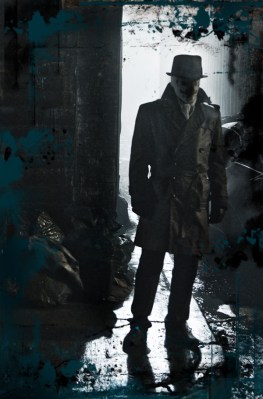
The story takes place in a darker, alternate version of 1985 America in which costumed adventurers and vigilantes are common place and, after their halcyon days in the 1940s, have become increasingly distrusted by the public for enforcing the oppresive policies of the U.S. government, led by Richard Nixon in his fifth term as president. Against the backdrop of escalating nuclear tensions between the U.S. and Soviet Union, the hero-turned-military-mercenary The Comedian is murdered. As the sociopathic vigilante Rohrshach tries to solve the crime, he and his former compatriots (including Nite Owl, Silk Spectre, Dr. Manhattan and Ozymandias) uncover corruption and a global power grab.
The novel’s genius lies in its multi-layered storytelling, which is rich in symbolism, literary allusions and a wonderfully fleshed-out cast of supporting characters. The history of this alternate world is also richly detailed, providing a running commentary on the main story and rewarding careful attention. All these elements combine to debunk the idealized superhero mythos, turning a cynical eye to the corruption possible when so much power is concentrated in the hands of flawed human beings. It is a world that is less about Superman and more about Travis Bickle.
Accordingly, a faithful film adaptation is a pretty tall order. The Cold War paranoia has lost much of its edge in the nearly quarter century since its release, as had the shock of the novel’s innovations. The filmmakers do their best to honor the source material, but come up with a mixed bag.
For the sake of brevity and to not alienate those who haven’t read the novel, the filmmakers sweep aside much of the complex backstory for the film. While this serves to keep the focus on the current generation of heroes, it also diminishes the psychological realism of the piece. Consequently, a lot of the characters’ actions exist in a vaccuum, and much of Moore’s original message is lost. Almost all of the cast of minor characters is lost, too, making the proceedings seem so much thinner and one-dimensional.
And then there’s the violence. While the novel and the film are each especially violent, they wind up being two different creatures. Snyder and his writers toned down many of the more brutal passages of the book in favor of Snyder’s patented garish fight choreography. Limbs shatter and blood gushes in gruesome slow motion. It’s hypnotic and balletic, but ultimately just eye candy. The amoral brutality that Moore used to illuminate his hard-edged characters is replaced by empty and gratuitous exercises in CGI wizardry.
But it’s not all bad. The novel’s greatest weakness — its convoluted, inorganic ending — is given a minor revamp here to better effect. It’s still not wholly satisfying, but it is definitely a step in the right direction. There is also terrific cinematography by Larry Fong (a veteran of “300” and “Lost”) that vividly brings to life some of the best parts of Gibbons’ original artwork.
The acting, too, is solid. With the exception of a wooden turn by Malin Ackerman as the second Silk Spectre, this is a talented ensemble. Billy Crudup (as Dr. Manhattan) and Jackie Earle Haley (as Rohrshach) are particularly great.
In total, “Watchmen” is not completely successful, but it’s not a failure, either. Just be sure to read the book first, to fully appreciate the story’s rich possibilities.
Best Line:
“Never compromise. Not even in the face of Armageddon.”
Side Note:
Having been in development for decades, “Watchmen” has had numerous actors, writers and directors attached to the project at various times. Among the directors considered were Terry Gilliam, Darren Aronofsky, Paul Greenglass and Michael Bay. Among the candidates to play Rohrshach were Robin Williams, Simon Pegg, Daniel Craig and Doug Hutchinson.
Companion Viewing:
“V For Vendetta” (2005) and “The Incredibles” (2004).
Links:
IMDb.
Official Site.
Watchmen Wiki.
The Annotated Watchmen.
Take a Look:
The trailer:
Gamera vs. Zigra (1971).
 The Scoop:
At last, the final first-wave Gamera movie!
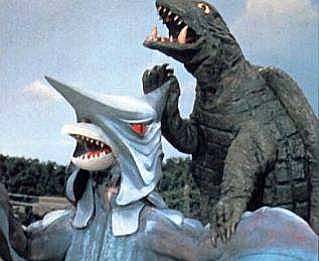
Environmental concerns get a little spotlight here when an alien race flying a shark-shaped spaceship comes to Earth to conquer our oceans. The catch is that the aliens want us to clean up all our pollution first so that their new home is nice and pristine. There’s lots of silliness with the obligatory child characters trying to outsmart the aliens, then Gamera finally shows up to lay the smack down. Zigra, the alien leader, transforms himself into a giant land shark to battle our turtle hero. Good triumphs over evil in the end, as always, presumably freeing up humankind to keep polluting all it wants.
Whatever. At this point, the seventh in the series, everyone seems to have stopped caring. This is strictly bottom of the barrel Gamera, which is really saying something.
From here, Gamera went dormant, only to be resurrected in 1980 for “Gamera Super Monster,” which was assembled seemingly almost entirely from clips of the previous films. The series was brought back in a more formal way in 1995 with “Gamera: The Guardian of the Universe.” Much like its first incarnation, this revival was simply following the path of the Godzilla revival of the ’90s. There were two sequels before it petered out again.
So, there you have Gamera in a (very long) nutshell. Now let’s get back to some non-flying turtle movies, shall we?
Best Line:
“This will be the greatest earthquake ever!”
Side Note:
This is the film that finally bankrupted Daiei Studios, which is the only reason the original film series stopped.
Companion Viewing:
“Godzilla vs. the Smog Monster” (1971).
Links:
IMDb.
1,000 Misspent Hours.
The Shrine of Gamera.
Take a Look:
The Japanese trailer, which makes wonderful use of the Gamera theme song:
 Desuko Movie Spot.